


Trisha Brown Dance Company / Rose Theater, Lincoln Center, NYC / April 13-16, 2005
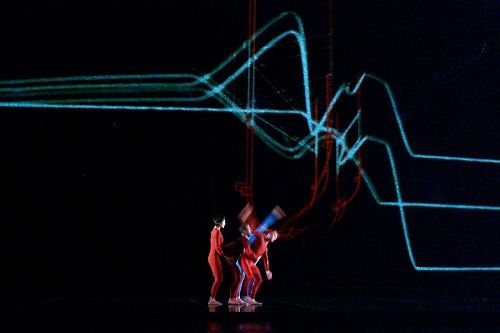
Celebrating her company’s 35th anniversary and adhering to her ongoing impulse to “make it new,” Trisha Brown devoted the second of the two programs she presented in Lincoln Center’s Great Performers series to recent work. The brand new piece that copped all the advance notice was how long does the subject linger on the edge of the volume . . . , an experiment with motion capture technology that had its premiere at Arizona State University where it was developed. (Brown co-opted the title for her piece from an overheard remark made by a techie on the project. Her maverick imagination found a wry poetry in it.)
What’s going on here? Well, to put it as simply as possible, both the ever-shifting visual imagery projected onto a scrim that veils the stage and the sound score are generated by computers receiving information from sensors attached to some of the seven dancers’ costumes (gleaming unadorned unitards in sapphire or vermillion). The images, in white sparked with bright red, consist of lines (and, subsequently, geometric shapes) that smudge, like skywriting, a few moments after they appear. Of course these animated graphics are distracting, though that’s partly because dance viewers aren’t used to scenography with a mind of its own (even if the intelligence is conspicuously artificial). The minimal score, on the other hand, is barely there.
Meanwhile, the dancers are doing the most remarkable things, many of them diverging from the vertical, the bodies leaning, lunging, jackknifing, plunging or sliding to the floor, arms, legs, and torsos rising to the challenge of tasks hardly within their original job description. Other aspects of the action derive from commonplace gesture and the groupings of crowds, this pedestrian material, absorbing in itself, unemphatically offset by some odd and beautiful lifts. Of all the Trisha Brown dances (and anti-dances) I’ve seen over the years, this one seems the most abstract, the most like Merce Cunningham’s work. The visual designs, however, bring to mind the mid-twentieth century explorations of Alwin Nikolais—all done, it should be noted, with unsophisticated equipment but quite similar results.
Occasionally the visuals get so feisty, you hardly notice the dancers, who at those moments appear small, insignificant, all but obscured, as if graffiti had been sprayed over them. Even when the images are more subdued, the scrim necessary for their projection thwarts the dancing, making it look more like something seen on TV than live performance. Tellingly, all the articles I read in advance of the New York premiere—the experiment was clearly a publicity magnet—made almost no mention of the particulars of the choreography. Elizabeth Zimmer, writing for the Village Voice, reports that the youngish techno-artists participating in the project complimented the 68-year-old Brown on having “a digital sensibility.” Has choreographic intelligence, I wonder darkly, become insufficient?
Two earlier works filled out the program. Geometry of Quiet, created in the aftermath of 9/11, is muted, intimate, infinitely tender. Its rarefied music, by Salvatore Sciarrino, played onstage by the flautist Mario Caroli, evokes a slew of natural sounds such as breathing, ocean waves invading and receding from the shore, wind in a vast tunnel, bouts of coughing, and fragments of birdsong. Jennifer Tipton’s lighting creates a perpetual dawn in which the sun seems veiled—as if by fog or clouds in the sky or smoke rising from the earth. Christophe de Menil has dressed the six dancers in the white of angels and medical personnel, and Brown herself has framed the stage in panels of rippling white cloth, giving the dancers long translucent stretches of the fabric that they pull toward the center of the space to suggest shelters or, perhaps, sacred areas.
Delicacy is the watchword of this dance. Like Agnes Martin’s paintings, it records a spectrum of subtleties. In an atmosphere of rapt attention, the dancers execute their small precise gestures, their infinitesimal shifts in weight and placement in the space. Many of the movements suggest succor—body clasping body, bodies gathering in small, tight clusters. Very occasionally, the action becomes angry, even ferocious, but these passages are so brief and their execution so fastidious, they never contradict the overall mood. At the heart of the piece lies a duet for a small man and a tall woman. Its leitmotif of discrete phrases that resolve in sculptural poses suggests that the experience of a moment may have an ongoing life in history. The fact that this duet is echoed immediately by a second couple (in which the heights are reversed) reinforces a complementary idea—that individual experience expands into communal experience. At the finish of the piece, the pale light finally fades altogether, much more swiftly—as in much of human existence—than one would have expected.
I have a predilection for art in this exquisite vein, and I liked Geometry of Quiet very much. A colleague sitting next to me found it exasperating.
Present Tense, made in 2003 but new to New York, offers a good example of Brown’s divine fluidity—the aspect of her choreography that streams directly from her own body, her unique physical temperament. Set to selections from John Cage’s Sonatas and Interludes for Prepared Piano, it opens with a long male solo (handsomely danced by Neal Beasley) full of squiggles and loping. The dance then unfurls into a septet that, using a typical Brown tactic, moves laterally in and out of view, much of the action concentrated on the peripheries of the space. The choreography makes canny observations on how people combine or bond, especially when they’re supporting each other’s bodies, either in pairs or larger groups. Eventually the participants help each other soar aloft, outstretched limbs slicing the air.
I thought the proceedings were intermittently funny, but the audience didn’t respond along these lines, at least not overtly, remaining reverently still, as if awed by the evening’s air of a visit to the cutting edge. And yet the dance was, at the very least, playful, the brightly clad bodies repeatedly trying out moves or spatial relationships, then shaking their heads no and nodding them yes, like little dolls set in motion by a playful inventor in a toy landscape. Present Tense actually has a landscape—a backdrop by Elizabeth Murray depicting a Keith Haring-like figure neatly sandwiched between the treetops of a forest and low-hanging dark clouds in what I assume is a faux-naif comment on the human condition.
Photo: Tim Trumble: Members of the Trisha Brown Dance Company in Brown’s how long does the subject linger on the edge of the volume . . .
© 2005 Tobi Tobias