


Mark Morris Dance Group / BAM Howard Gilman Opera House, NYC / April 19-23, 2005
This year, the Mark Morris Dance Group brought no brand-new, grand-slam work to its annual season at BAM. The sole novelty was a piece that had its premiere last fall, way west, in Berkeley, California. But it’s a honey. Rock of Ages, set to the adagio movement of Schubert’s Piano Trio in E flat, is a small, quiet dance that, like meditative deep breathing, expands the consciousness until it seems to reach the deepest feelings and an ever-widening understanding of how the world works.
Its population of four, plainly dressed, enters one by one from the four 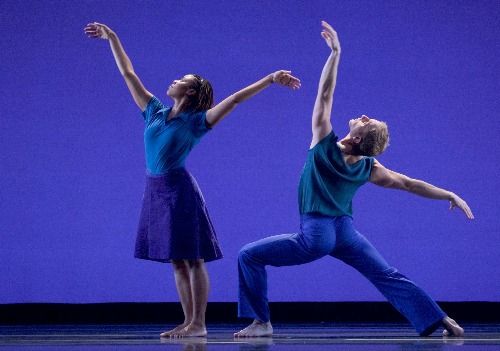 corners of the stage, briefly converges at the center of the space, then moves on (though a pair pauses briefly, side by side), each person simply continuing along the diagonal path prescribed by his or her first step. The ending reiterates this action, which is clearly the simple message of the dance: We exist alone; we meet when we occupy a common space; we interact in passing, our identity left essentially unaltered; we part—because it is only natural that we should.
Dominating the dance are brief phrases that, after their original impulse, slow and then coalesce into sculptural poses; these, having registered, melt into the succeeding phrase. Certain gestural motifs keep repeating as if they were lodestars. In one, the dancer turns her/his back to the audience, extends one leg behind herself diagonally and stretches her arms behind her back, hands clasped. She turns her head to one side, tipping it downward as if to examine the earth, then suddenly twists it to the other side, and upward, as if scanning the sky. (I thought of 9/11. How could you not?) Elsewhere, a single dancer faces the audience dead on, legs wide, knees deeply bent, arms extended horizontally, as if measuring the space or rooting herself to mark it as significant.
The dancers seem to traverse the stage at random (though even the most casual examination of the choreography reveals that their placing and timing are exquisitely plotted). Encountering one another, they don’t appear so much to be relating as singular personalities with private agendas as simply participating in the same event or sharing, almost anonymously, a common feeling. (Again I thought of 9/11. How could you not?) Occasionally they cluster–in pairs, occasional trios, even all four together, but only very briefly, for the stream of the dance is very fluid—then quickly regroup, exit, reappear. They look into the distance a lot, occasionally at each other, in a prevailing state of self-contained contemplation. Some swift and airborne things happen, too, but they’re just accents placed by a master well aware of the pitfalls of self-indulgence.
The whole dance emanates from the music as if Schubert’s sublime trio were—on this particular playing—being rendered as a quartet. The choreography has a calm, fated feeling; everything that happens is presented as acceptable and accepted, on a plane that lies beyond the tumult of contradiction. I wanted it to go on forever; when it was over, I wanted to see it again right away.
In the engagement’s four performances, eight dancers, ranging from veterans (among them, Joe Bowie, whom followers of the troupe love like family) to a relative newbie (the heavenly Rita Donahue), rotated in the four roles—in different combinations. Morris is the last choreographer on earth to consider his dancers interchangeable. But they are replaceable, instructively so. The shifting distribution of personnel—a tactic used in other parts of the repertory as well—shows any spectator on a repeat visit how a choreographic text, while remaining stable, is significantly inflected by the performing artists essential to bringing it to life.
This one-program engagement also boasted a burnished production of Morris’s 1995 Somebody’s Coming to See Me Tonight. Set to familiar songs by Stephen Foster, it illustrates Morris’s great gift for continually shifting tone within a single work, deepening the overall effect of the choreography by playing one mood against another or, more typically and wonderfully, intertwining them to reflect the way in which real life experience sends us multiple simultaneous messages. At the time of their composition (the mid-1840s to the mid-1860’s), Foster’s songs reflected prevailing sentiments in genteel American culture. Subsequently they came to be considered over- (even nauseatingly) sentimental. Nowadays they’re hailed as examples of classic Americana. Revealing the profound shadings that bodies can lend to words, Morris constructs scenes that find innocent tenderness in love and a final (even welcome) peace in death. Abutting or coexisting with these echt-Foster evocations are ironic takes on the lyrics that infuse them with bawdy humor or irrepressible gaiety (as in the polka that’s rendered in square-dance formations with an odd man out) and an underlying sense of life’s tragic dimension. Like almost all of Morris’s choreography, the piece is immaculately structured, with patterning at once surprising and satisfying in the way Balanchine’s is. The dancers, attentive to details of gesture and feeling, make it luminous.
The program was completed by Silhouettes, a disquisition on mirror-imaging, as well as From Old Seville, a riff on the excesses and beauties of flamenco style, which is too short, and Rhymes With Silver, a glorification of its Lou Harrison score, which is far too long. Seville featured Morris, who, though growing ever more portly as he winds down his performing career, is as rhythmically acute as ever, and Lauren Grant, a tiny, swift, well-muscled blonde, who refuses to be upstaged by the boss. Silver employed just about everyone but Morris, and, if there’s a grander heterogeneous troupe of dancers around, I’d like to know where it is.
Photo: Susana Millman: Michelle Yard and Craig Biesecker in Mark Morris’s Rock of Ages
© 2005 Tobi Tobias