


Matthew Bourne: Play Without Words / BAM Harvey Theater, NYC / March 15 – April 3, 2005
Matthew Bourne, who has relentlessly been creating new takes on golden holies (Nutcracker, La Sylphide, Cinderella, and—the one that made it to Broadway—Swan Lake), insists in interviews that his work, if it’s dance at all, is for people who don’t like dancing. Yet a number of well-known dance critics, both American and British, have been dancing around it, clapping their hands, and Bourne has won enough awards to require a dedicated trophy room. Now his Play Without Words—which copped an Olivier in 2002, when it was created for the Brits’ National Theatre—has come to town. I like dancing; should I have stayed home?
No one in his right mind would praise Bourne for choreography per se. The weakest element of Swan Lake, it is virtually absent from Play Without Words, which deals mostly in highly stylized mime pumped up with show biz moves, the mix paying little heed to musical structuring. Ostensibly Bourne’s appeal lies in his vivid theatricality and his transgressive bravado. (That flock of gorgeous, vicious boy swans in Swan Lake is typical.) I’m not entirely convinced, or entertained, by either.
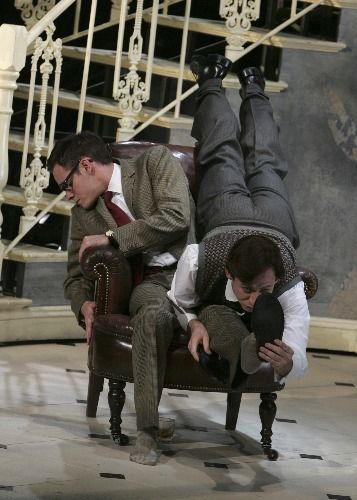 Play Without Words takes off from Joseph Losey’s memorable 1963 film The Servant. The ominous screenplay by Harold Pinter tells—in words and even more provocative silences—the black tale of a privileged fellow who hires a “man” (a combination butler-housekeeper-valet) who, playing upon varieties of erotic desire laced with class struggle, proceeds to undo his master. Each of these chaps has a woman in his baggage. Our deplorable/unfortunate hero comes equipped with a fiancée, though neither member of that cold couple has the wits to acknowledge that the gentleman is, at the very least, bisexual. The servant, having made himself indispensable in the household, introduces his “sister” as a maid. The irresistibly provocative miss is, of course, the servant’s bedmate; her real job, to consolidate working-class power by seducing the boss, which she does, ironically, with genuine pleasure.
Bourne captures none of the film’s Turn of the Screw atmosphere, its all but palpable air of half-concealed desire, corruption, and menace. His equivalents of the four main characters are tepid, sometimes two-dimensional to the point of caricature. He himself may have found his efforts insufficient, since he casts three dancers, often performing simultaneously, in each role. This persona-in-triplicate scheme makes for a crowded stage and some confusion, though it reveals Bourne’s ability to direct traffic in ways that are visually effective. He has also added a fifth persona, a hefty blue-collar guy who clearly can have any woman he wants, and does. (This character, Bourne’s publicist explained to me, is a composite derived from other movies of the period.)
The Losey film’s pervasive and haunting motif of the characters’ spying on one another translates largely as simplistic farce in Play Without Words. Still, a couple of Bourne’s scenes are clever and genuinely amusing, in particular a double duet of the master being undressed—for a bath, of course, what were you thinking?—and dressed by his man. One passage—in which man and master all but destroy each other, then reconcile—achieves some authentic human depth, making you understand that they’re the most symbiotic lovers in the piece. Yet for the most part, though Bourne is touted as being a dynamic storyteller, Play Without Words fails to convey its characters’ motivations and feelings. It doesn’t even deliver a clear plotline. No wonder the show often grows tedious. Yes, even the change-partners-and-dance sexual exploits involving the kitchen table.
The production boasts a pleasant jazz score by Terry Davies and a Red Grooms-ish set by Lez Brotherston who also provided the early sixties costumes, including stiletto heels that, astonishingly, don’t for a moment faze the handsome ladies in the show.
I’m left wondering if Play Without Words isn’t simply a sign of our times, in which the creative powers-that-be assume their audience needs to be lured by shock tactics—the raucous, the garish, the forbidden, extremes of novelty for novelty’s sake. Surely the insistent use of these means, which quashes the virtues of sincerity and subtlety, is self-defeating. Most of today’s audience is already beyond shock and, what’s more, benumbed by the ever-escalating onslaught.
Photo: Richard Termine: Sam Archer and Steve Kirkham as master and man in Matthew Bourne’s Play Without Words
© 2005 Tobi Tobias