


La La La Human Steps / BAM Howard Gilman Opera House, Brooklyn, NY / February 1-5, 2002
There’s a part of the dance audience that—to hell with the classical tradition and the classical canon—only wants to see a vivid show. Increasingly, producing organizations are catering to these spectators. How else, the (just possibly faulty) logic goes, will they manage to sell enough tickets to stay afloat? Some go the “popular entertainment” route, delivering ballets aspiring to cousinship with light opera or musical comedy, even gaudy nightclub acts. Others, like the Brooklyn Academy of Music, dare more and opt for the presumed sophistication of the cutting edge. At times they seem willing to settle for its outward trappings.
On the eve of its 25th anniversary, La La La Human Steps, Édouard Lock’s Montreal-based troupe, brought the choreographer’s Amelia to BAM for its final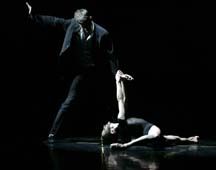 showings. Only the dead know Brooklyn? The idea is suited to this would-be noir-ish show, inspired, Lock says in interviews, by his memories of a transvestite he visited as an adolescent. Lock also claims that Amelia tackles the issue of “gender politics,” but that’s just wishful thinking. Shakespeare evokes the effect I believe Lock is actually laboring to produce: “O comfort-killing night, image of hell, / Dim register and notary of shame, / Black stage for tragedies and murders fell, / Vast sin-concealing chaos, nurse of blame! (The Rape of Lucrece). The choreographer, like so many of his peers, falls short because he gets sidetracked by the allure of surface appearances.
In Amelia, the visual set-up is all-important. The stage is stripped of color; black and white rule in the décor (Stéphane Roy) and the costumes (Vandal). The lighting (John Munro) pierces the prevailing Stygian gloom with glaring beams that might ferret out escapees in a prison break. Roaming here and there, switching on and off, the light contributes to the aimed-for tension. At intervals spider web-like drops descend and rise to veil and expose proceedings that aspire to be transgressive. Filmed projections provide invasive (and, of course, gorgeous) close-ups of the dancers seen, simultaneously, live. The women wear skin-tight see-through black tops. Their fabulously muscled bare legs are shod in flesh-colored pointe shoes. They’re partnered by black-suited, black-shirted, black-shod guys with equally sleek physiques. In a cross-dressing episode, the leading lady gets suited and her male partner dons pointe shoes and churns out a string of bourrées as silkily as a Queen of the Wilis. (Think what the Trocks might make of this!) But I digress; this choreographer intends to provoke, not amuse.
Employing Lock’s signature vocabulary, the dancers operate at such a wildly accelerated speed that, abetted by tricky lighting, their limbs imprint a rapid succession of images on the air, one blurring into the next, in the manner of Gjon Mili’s high-speed multiple-exposure photographs. Accordingly, this dancing is more visual than visceral. Revealingly, its focus is on the arms and legs, not on the gut—the cave of the viscera and the impulse point for emotional drama, as Graham and Tudor have taught us. Its images suggest violence, first of all, and then a kind of madness—the communal madness bred in contemporary urban existence. The ferocious, stuttering strings of gestures are like the gibberish of people consumed by fury. At one point a woman attempts to calm her mate—accept and contain him—with sparser, slower moves, but she’s soon forced to respond to him in his own vein, so that both of them end up in a state of spasm. The words of the vocalist accompanying them were hard to make out, but at one point I caught the very apt “be the death of me.”
This failed-placation passage is one of the several duets that dominate a piece in which the material is almost exclusively about disaffection, futile attempts to communicate, and the cruelties that inevitably result from such pervasive alienation. The message is stated again and again, without respite or revelation. You come away from an intermissionless hour and a half of this stuff muttering, “But we knew that already.”
The unremitting onslaught soon grows monotonous. Even the remarkable speed—which, one commentator observed, makes a dancer look like an “animated cyberdoll”—loses its initial impact. Just as with the assault of a incessant siren or the prolonged screaming of an infant or a person in unbearable pain, you think at first it will drive you mad. Eventually, though, you get used to it and blot it out or convert it to something tolerable. So with this choreography; after a while you just stop taking it in. Curiously, when you watch something so unvaryingly fast for so long, it eventually produces the same effect as slow motion.
One segment of the piece yields a little more human eloquence and insight. A male duet (for Jason Shipley-Holmes and Bernard Martin) begins, typically, with a wary encounter in which the two make moves that look mutually menacing. Undertones of tragic isolation creep in as the men separate and eye each other, fading in and out of the available light, then work in tandem without connecting, as in the self-absorbed “parallel play” of toddlers. Tentative approaches to bonding follow, all the more poignant because they’re abortive. These two simply don’t have the means—neither the words nor the moves, it would seem—to make connection a hope. And then a third guy comes along (a former lover of the younger-looking one, perhaps), intrudes, breaks them up. With that, another fellow appears, and the passage fans out into a pas de quatre for two doers and a pair of voyeurs (or episodes, à la Tudor, in the protagonists’ past), and the moment of possibility is lost. Granted the scenario is trite, but its implementation is effective, and it provides the work with its sole instance of probing past a glossy veneer.
As I’ve suggested, Amelia lays claim to all the visual trappings of noir film—and is, indeed, self-consciously cinematic in its methods. But an essential element is missing from the mix. It’s just not sexy. Handsome as she is, its hero/heroine, Zofia Tujaka—nearly 5’ 11”, radically blonde, radically leggy, showing lots of bare ivory skin when she’s not in drag, her face the enigmatic mask of a fashion mannequin—projects no erotic allure. And, without that, the whole premise of the piece collapses. Andrea Boardman is the most compelling dancer in the show, but she can’t carry it; she’s cast as the heroine’s—well, not friend, the folks in this piece are clearly incapable of having friends. Let’s say alter-ego.
Praise where praise is due: The music, by David Lang, with lyrics taken from Lou Reed songs for the Velvet Underground, is extremely attractive—alternately seductive and charged with energy. The dancers—Mistaya Hemingway, Keir Knight, Chun Hong Li, and Billy Smith, along with Boardman, Martin, Shipley-Holmes, and Tujaka—are terrific too. But their being required to perform every last bit of the frenetic choreography at the highest possible pitch is not simply exhausting (for the viewer, as well as for them) but also self-defeating. Rendering the world implacably in terms of black and white, Amelia ignores the importance—in dance, in life—of shades of gray.
Photo: Richard Termine: Bernard Martin and Andrea Boardman in Édouard Lock’s Amelia
© 2005 Tobi Tobias