BODY LANGUAGE

Molissa Fenley and Dancers / The Kitchen, NYC / September 29 – October 9, 2004
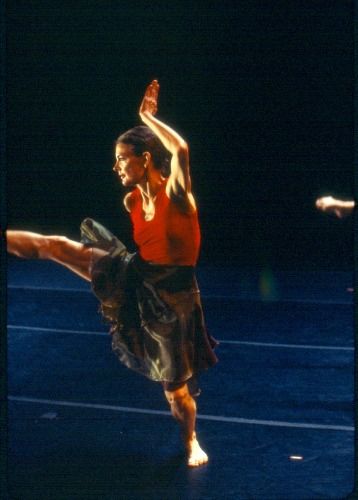
More than a quarter-century after Molissa Fenley first appeared on the postmodern dance scene, an oddity in her way of moving—apparent throughout the cycles of solos and group works she’s choreographed—remains a distinct personal signature. She holds her hands sharply angled at the wrist, palms very flat, fingers tight together, thumb joined to them or splayed outward. This articulation, at once awkward and graceful, is accompanied by an unusual fluidity in the arms and a sentient pitch to her torso. It gives her a feral air, which is augmented by her intent concentration. She has passed this creature-like stance on—as far as any individual way of moving can be replicated—to the five women, at least a generation her junior, who joined her to perform some of her new and recent choreography in the first of two programs at the Kitchen. (The second, to run October 6-9, constitutes a revival of her 1983 Hemispheres.)

The look I’ve described proved to be most effective in the atmospheric sextet Kuro Shio, created in 2003. Set to music by Bun-Ching Lam called Like Water, this dance does, indeed, suggest an imagined natural world. The creatures disporting themselves in Evan Ayotte’s soft silvery jeans and translucent shimmering tops under David Moodey’s low, azure-filtered light might well be postmodern neriads. And while they are happily diverse in ethnicity, coloring, and body type, the dancers (Ashley Brunning, Tessa Chandler, Wanjiru Kamuyu, Cassie Mey, and Pan Tanjuaquio) are all clearly disciples of Fenley, who works among them, serving as the model for their inner-directed focus; their poised, unemphatic reiteration of gestures and groupings; the hieroglyphic work of their hands and arms.

The new piece, Lava Field, to John Bischoff’s Piano 7hz, is not as successful. It delivers a familiar Fenley message about the certain, if essentially unfathomable, connection among living things. In a kind of prelude, three women gently fit their bodies together. Lying on the ground, they move with the fluidity of molten lava—pouring in streams and coalescing in rivulets—as if they represented an ocean born of fire now lapsing into quiescence. When they’re erect, forming abstract stage patterns that allow them to disperse only to re-bond as parts of a matrix, the same principle holds. The implication is that interdependence, observable throughout inanimate nature, is no less present in human relationships.

The problem is that this is not exactly news and, in Lava Field, Fenley gives it no particular illumination or even intensity of statement.
Throughout the piece, the movement is very arm-y and leggy, as is this choreographer’s wont. Here you begin to wish—at least I did—that she would allow the mid-section of the body to take charge more, serve as an energy center, initiating the impulse for the dance and provide a compelling urgency in place of a calm that is neither hypnotic nor ecstatic but, rather, flaccid and monotonous.

From the first, I think, Fenley’s choreography has suffered from a condition that plagues all of modern dance—the limitations of a vocabulary derived largely from a single body’s instincts. It’s instructive to study how and to what degree some of the greats in the field—Martha Graham, Merce Cunningham, Paul Taylor, Mark Morris—have escaped from the prison of self.

Photo credit: Paula Court: Molissa Fenley in her Lava Field.

© 2004 Tobi Tobias

October 3, 2004 9:00 PM |

Categories:

Other Words


. . . and while I know a woman who learned Greek at ninety there are nevertheless some skills, like ballet dancing and gum chewing, which can only be mastered by the very young.
-- Jean Kerr, Penny Candy

Now that my hair is white, and my years of life ahead are growing fewer, I think that the pains I have taken over dancing have not really been pains, and I must study harder, much harder.
-- Onoe Kikugoro VI (familiarly called Rokudaime), in Ben Bruce Blakeney, "Rokudaime," Contemporary Japan, 18

When people grow old they must be dull. Dancing can't go on for ever.
-- Anthony Trollope, Can You Forgive Her?

When you do dance, I wish you / A wave o' the sea, that you might ever do / Nothing but that.
-- William Shakespeare, The Winter's Tale

Sitelines

ARTSJOURNAL

ARTS & LETTERS DAILY

BALLET.CO

BALLERINA GALLERY

THE DANCE INSIDER

DANCEVIEW TIMES

FOOTNOTES

GREAT DANCE WEBLOG

THE WINGER

The RÉUNION DES MUSÉES NATIONAUX (The National Museum Association's Photographic Agency) offers a photographic catalogue of some 200,00 holdings of French museums. It can be searched by artist, country, period, subject, and so on. You can make a personal album of your favorites on the site. New York's Metropolitan Museum of Art and D.C.'s National Gallery have similar services, but the French one is the most ambitious and extensive. Text in English as well as French.

AddALL is an ultimate umbrella for finding used and out of print books online. It doesn't have the atmosphere of Foyle's, Powell's, or even the Strand, but it will give you every opportunity to need yet another bookcase.

PROJECT GUTENBERG More books. No bookcase required. Over 6000 free electronic texts.

CALLIGRAPHY LESSONS ONLINE Learn the italic hand and make yourself legible. Don't miss the animation.

Color charts of HERBIN INKS. If you have to ask, you'll never know.

THE NEW YORK TIMES Because it's there.

About this Entry

This page contains a single entry by Seeing Things published on October 3, 2004 9:00 PM.

CARRYING ON was the previous entry in this blog.

ELEMENTS OF STYLE is the next entry in this blog.

Find recent content on the main index or look in the archives to find all content.

AJ Ads

Introducing
AJ Arts Blog Ads

Now you can reach the most discerning arts blog readers on the internet. Target individual blogs or topics in the ArtsJournal ad network.

Advertise Here

AJ Blogs

AJBlogCentral | rss

special
Program Notes
the blog of the National Performing Arts Convention
culture
About Last Night
Terry Teachout on the arts in New York City
Artful Manager
Andrew Taylor on the business of arts & culture
blog riley
rock culture approximately
CultureGulf
Rebuilding Gulf Culture after Katrina
diacritical
Douglas McLennan's blog
Flyover
Art from the American Outback
Life's a Pitch
For immediate release: the arts are marketable
Mind the Gap
No genre is the new genre
Rockwell Matters
John Rockwell on the arts
Straight Up |
Jan Herman - arts, media & culture with 'tude

dance
Foot in Mouth
Apollinaire Scherr talks about dance
Seeing Things
Tobi Tobias on dance et al...

jazz
Jazz Beyond Jazz
Howard Mandel's freelance Urban Improvisation
ListenGood
Focus on New Orleans. Jazz and Other Sounds
Rifftides
Doug Ramsey on Jazz and other matters...

media
Out There
Jeff Weinstein's Cultural Mixology
Serious Popcorn
Martha Bayles on Film...

classical music
The Future of Classical Music?
Greg Sandow performs a book-in-progress
On the Record
Exploring Orchestras w/ Henry Fogel
Overflow
Harvey Sachs on music, and various digressions
PostClassic
Kyle Gann on music after the fact
Sandow
Greg Sandow on the future of Classical Music
Slipped Disc
Norman Lebrecht on Shifting Sound Worlds

publishing
book/daddy
Jerome Weeks on Books
Quick Study
Scott McLemee on books, ideas & trash-culture ephemera

theatre
Drama Queen
Wendy Rosenfield: covering drama, onstage and off
lies like truth
Chloe Veltman on how culture will save the world
Stage Write
Elizabeth Zimmer on time-based art forms

visual
Aesthetic Grounds
Public Art, Public Space
Artopia
John Perreault's art diary
CultureGrrl
Lee Rosenbaum's Cultural Commentary
Modern Art Notes
Tyler Green's modern & contemporary art blog
Creative Commons License
This weblog is licensed under a Creative Commons License.