


Mark Morris Dance Group / New York State Theater, Lincoln Center, NYC / August 19 and 21, 2004
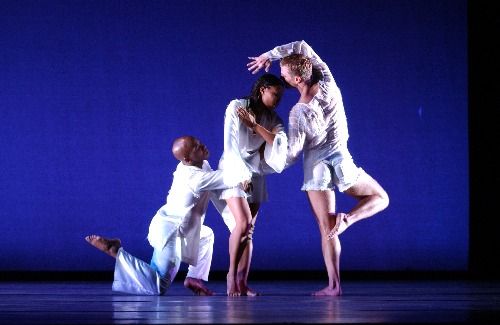
Typical Mark Morris! His company gets invited (for the third year running) to perform in Lincoln Center’s Mostly Mozart Festival—where dancers rarely tread—and he weighs in with a program of four pieces, not a single one of them choreographed to a Mozart score. Instead, the bill consists of Marble Halls (from 1985, to Bach), A Lake (1991, Haydn), Jesu, Meine Freude (1993, Bach), and I Don’t Want to Love (1996, Monteverdi). Since I’ve written about each of these works closer to the time of its making, instead of talking here about choreography, I want to consider the second element that has always made the Mark Morris Dance Group extraordinary—its dancers.
From the start, Morris has gone in for nonconformity when it comes to the bodies he chooses to animate his work. Instead of selecting for uniformity and conventional notions of a physical ideal, he has regularly assembled a miniature motley society of the small, the stocky, the lushly ample, the tall-and-skinny beanpole type, the delicate, the blunt, and, yes, a few whose ballet teachers may have had high hopes of placing in one of those finalists-only classical companies that go by their initials. The flat-footed and those whom the gods of turn-out have not favored have their place with Morris, as do the fresh and frank American girl and the sultry glamour girl (Betty and Veronica, if you will), the beach hero and the fellow into whose face the beach hero kicks the sand. And of course the company has always been multi-ethnic—so thoroughly so that, simply by appearing, it defies tokenism, demonstrating that there are an infinite number of ways to be Caucasian, black, Asian, or a mix thereof.
Of course this fine assemblage couldn’t call itself a company—excuse me, a group—if its members didn’t have some key traits in common. What might they be? As Morris famously said in a Q & A session, “That’s a good question, and here is the answer.”
These dancers are acutely musical. Well, they’d have to be, given the fact that Morris is the most musical—and music-driven—choreographer currently at work in the Western world. To have them otherwise would be unbearable for him; he’d simply self-destruct.
They are wonderfully intelligent. I’m not talking about book learning here, though many of them have their share of it, but, rather, dance intelligence. In performance a dancer is making critical decisions about matters of timing and tone at every instant. To be sure, the choreographer has set the performer’s steps and gestures and is continually correcting and coaching the execution of that material—or appointing a deputy to do so. But much of what we think of as dancing—in other words, the interpretation as opposed to the part of choreography that’s capable of being notated—must be left open, flexible, if the results are not to look mechanical. That’s where dance intelligence comes in, making the choreographic score breathe. Morris’s dancers possess it in abundance.
In all their performances, they offer a full-bodied commitment to the work. These are not people who dance by half measures. Ever.
They have a magnificent sense of weight. To paraphrase Agnes de Mille on Martha Graham, they have taken the floor into their confidence. Yet, while gravity is their ally, every one of them knows how to jump, wrenching herself or himself from the earth to rejoice, triumphant, in the air for a moment and then to return—mind you, with equal pleasure—to native soil. Nevertheless, when the occasion requires it, they can be light and, what’s more, buoyant.
They allow themselves to be vulnerable. I don’t mean to look vulnerable, but to be vulnerable. This lends their dancing, as appropriate, great drama and great pathos. They are—is this a corollary?—capable, equally, of ferocity and gentleness.
They’re not addicted to harmony. Most of them have been blessed with a natural grace that has, certainly, been amplified by years of dance training. Some of them, though, retain aspects of awkwardness, and Morris honors this quality in his choreography, makes much of it, in fact, and reintroduces it to the smoother performers, because he knows that to be awkward is to be human.
They’re expressive without even a shard of narrative.
Their dancing has terrific texture. Part of this is due, I imagine, to the fact that many of them are not in the first-youth decade of their careers but rather in their thirties, even forties, so their dancing benefits from both their dance experience and their life experience.
And, indeed, these dancers remind you of real people. Morris sees to it—I’ve witnessed this at rehearsals—that they move without affectation. Routinely, they de-emphasize the artifice that is, after all, essential to their trade. Their mode of self-presentation is the very opposite of the high stylization that practitioners of classical ballet and Martha Graham’s brood revel in. Instead of being icons of the ideal, Morris’s dancers are icons of the norm. This helps the audience identify with them, and thereby with the situations—the predicaments and exultations—that Morris’s choreography proposes.
Over the last two plus decades Morris has gradually gone from making dances on the people who were simply available to him–as he himself said, his friends—to choreographing on formidable pros. Today he chooses his dancers from an enormous talent pool—people are clamoring to dance with him, they audition by the hundreds—and their anatomy is sleeker, their technique more proficient than the old gang’s. What’s more, Morris, clearly their senior in years, now rarely dances among them. So no one on the stage or in the audience would claim that the current dancers are choreographer’s friends. Oddly and happily, they have come to seem like the viewers’ friends.
I know, I haven’t named names here. Two decades’ worth of performers have contributed to my impression of the remarkable kind of dancer the Morris troupe welcomes and hones. People tend to stick with this company for long stints, too, and I’ve had the pleasure, over the years, of watching them mature. Doing all of them justice would require a book. Neither do I care to single out just a few who are presently with the company while neglecting equally worthy others. But what about just listing the current crew?—you know, for the record. Here goes: Craig Biesecker, Joe Bowie, Charlton Boyd, Amber Darragh, Rita Donahue, Marjorie Folkman, Lauren Grant, John Heginbotham, David Leventhal, Bradon McDonald, Gregory Nuber, Maile Okamura, June Omura, Matthew Rose, Noah Vinson, Julie Worden, Michelle Yard. When Morris takes his curtain call at the end of a concert, he always bows to the dancers first. As well he might.
Photo credit: Robbie Jack: (l. to r.) Joe Bowie, Michelle Yard, and Matthew Rose in Mark Morris’s I Don’t Want to Love
© 2004 Tobi Tobias