


Universal Ballet / New York State Theater, Lincoln Center, NYC / July 30 – 31, 2004
Korea is a land with its own venerable dance traditions. Classical ballet, which had taken root there by the 1960s, was a distinctly foreign import (just as it once was in the U.S.). The major influence on the development of ballet in Korea has come from Russian practitioners who brought it a Russian approach to technique and a Russian repertory—nineteenth-century classics like Swan Lake and twentieth-century works in the Soviet style. A native style and a repertory that springs from native culture is budding, possibly, but when the 20-year old Universal Ballet chose a vehicle for its American tour this summer, it relied on Romeo and Juliet, in a version choreographed by Oleg Vinogradov, the company’s present artistic director, who led the Kirov Ballet for over two decades. (The general director of the Universal Ballet is Julia Moon, one of its former ballerinas and the daughter-in-law of the Reverend Sun Myung Moon and his wife, who are billed as founders and patrons of the company. I’m not about to tackle the issue of the Universal Ballet’s connection to the Unification Church, but my colleague Mindy Aloff touched on the subject in a recent interview with Moon for the DanceView Times. An earlier pair of articles by Hilary Ostlere for Dance Magazine, further elucidates the relationship.)
Vinogradov’s take on Romeo and Juliet, created in Novosibirsk, Siberia, back in 1965, unfortunately has little to recommend it, certainly not the corny new ending recently tacked on. Vinogradov makes a hash of the familiar Prokofiev score—presumably to serve the libretto he’s concocted from Shakespeare’s version of the tale and his claimed desire to emphasize dancing over pantomime. He has also, to his peril, taken liberties with Shakespeare’s cast of characters. Conspicuously missing are Benvolio (replaced by a few anonymous friends-to-Romeo) and Juliet’s Nurse (whose absence gravely diminishes our understanding of Juliet’s circumstances). Added are the wholly unnecessary figure of Death—surely de trop in a narrative clearly saturated with morbidity and concerning realistic, not symbolic, characters—and a crew of modern young sweethearts in jeans (straight out of the Joffrey Ballet of the seventies), reverently lighting their votive candles at Romeo and Juliet’s tomb and spilling from stage out to the audience as the curtain falls.
In style, the choreography is a little Soviet exalted realism, a little Classic Comics simplistic vividness. If the dancing seems to have no impulse, no drive, no phrasing, it’s because the choreography doesn’t demand such things—indeed, appears to have no idea they exist. And the dancers haven’t been encouraged to make up for the deficiency. The music keeps issuing urgent reminders on the subject, but no one, apart from the audience, hears them.
In the course of the proceedings, some very peculiar occurrences stand out. On no less than four occasions, when Romeo has Juliet artfully cantilevered from his body, making her a piece of sculpture in the air (this is no time to protest that you dislike this sort of thing), he lifts one leg to make the feat even more difficult. Of course it then looks absurd and detracts from any idea of ecstasy Vinogradov means his lovers to convey. And then there’s the scene in which Juliet’s father so gives way to his anger over her disobedience in refusing the suitor he’s chosen for her that he resorts to a violent physical abuse—throwing her to the floor and stomping on her ribcage, as I recall, or was it her pelvis?—that’s entirely out of keeping with the intimate, interior scenes of the ballet as opposed to its “outdoor” brawls. What do these two instances have in common? Nothing (which makes them all the more disconcerting) or perhaps simply a mind-boggling absence of taste.
Despite these failings, the handling of the masses is fine indeed, charged with vitality and a symbolic dimension as well. At Juliet’s coming out party, for instance, the aristocratic guests line up in cross-stage rows, assuming a series of frozen poses. In this way, they form a human sculptural corridor through which Romeo and Juliet waft after they fall in love at first sight—a corridor, it soon becomes clear, in which they’re spied upon by society at large and from which they cannot escape.
The dancing per se is done a disservice first by choreography that refuses to let it flow and then, it would seem, by coaching that hasn’t once suggested it be allowed to breathe. But, though the company’s overall technical standard comes nowhere near that set by the major classical companies we see in New York, it is respectable and what one might call, given the comparative youth of the company, promising.
Hye-Min Hwang, who was the opening-night Juliet, is appropriately delicate and willowy in her build, though not as refined in her dancing. Eventually, seemingly through sheer hard labor, she works herself up to an anguish that’s believable.
Jae-Yong Ohm, as Romeo, is a sweet prince, a charmer, but oddly lacking in the impulsive passion essential to the character. He has, instead, a whimsical quality that’s almost asexual, perfect for a commedia dell’arte Harlequin. Oddly enough, Paris is no more suitable as a match. He looks like that famously languid young Renaissance aristocrat drawn by Nicholas Hilliard and behaves with well-bred reticence to Juliet as if, entirely absorbed in his own lovely image, he doesn’t much care if he gets to marry her or not.
Jae-Won Hwang, who has the compact build and raw energy of a demi-caractère dancer, makes a swell Tybalt, and the senior character artist Igor Soloviev, as Friar Laurence, is straight out of Dostoevsky. Granted, this characterization is entirely at odds with the rest of the production, but the rest of the production is such a hodge-podge anyway, the little Russian star turn is entirely welcome.
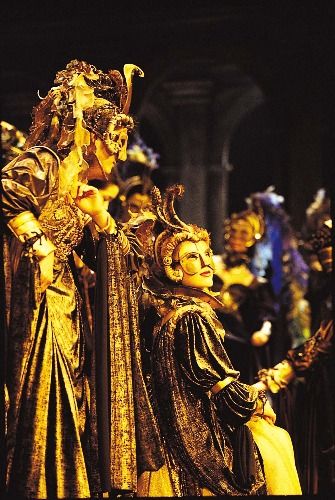
The sets and costumes, by the Russian-bred designers Simon Pastukh and Galina Solovieva, respectively, are the most memorable—and expressive—part of the show, the element that makes it undeniably worth seeing. The basic set is solidly architectural, serving both as exterior (with the community’s meeting place anchored upstage first by an imposing equestrian statue, then by a stage within the stage for a pointed play within the play) and interior (now anchored by the altar in Friar Lawrence’s church, then by Juliet’s fateful bed). It has the confident air of being historically exact and is, at the same time, laden with atmosphere, making you feel you’re in a real place and, what’s more, a place haunted by everything that has happened in it up to the present moment. The costumes, apart from Juliet’s virginal gowns, rightly suggest the flamboyance and excess of wealth—an extravagant beauty that is, at heart, evil. The ballroom get-up of the Capulets and their guests, to cite just one example, is nothing short of sensational—very cloth-of-gold against jewel tones, topped by fantastic headdresses combining extravagant hanks of hair with the plumage of exotic birds. To date, the main venues for these scenic artists’ work seem to have been Russia, Korea, and the American Midwest. London, Paris, and New York might profitably pay them greater attention.
Photo: Kwang-Jin Chung: Members of the Universal Ballet in Oleg Vinogradov’s Romeo and Juliet
© 2004 Tobi Tobias