


Anne Teresa de Keersmaeker/Rosas / LaGuardia Concert Hall, NYC / August 25, 27, and 28, 2004
Mostly Mozart is looking to update its image. The annual summer festival at Lincoln Center, now in its 38th year, and its second under a new director, Louis Langrée, has ventured beyond pure concert work to what it terms—adopting corporate-world lingo—“new program initiatives.” One of these initiatives turns out to be theatrical presentation—specifically a couple of partnerships with dance. Last week, the Mark Morris Dance Group, in its third Mostly Mozart appearance, offered a fine program of regular repertory works set to Baroque music. This week came a more pointed (and far less successful) attempt to emphasize the connection between music and dance—a revival of the Belgian choreographer Anne Teresa de Keersmaeker’s 1992 Mozart/Concert Arias, un moto di gioia (a flash of joy). The time has by no means yet come to give the festival the disclaimer nickname Mostly Music, but the de Keersmaeker piece suggested—to me, anyway—that quality control might be more firmly exercised as the festival extends its parameters.
The score concocted for (let’s call it) Concert Arias is an assemblage that alternates short vocal and instrumental pieces from various points in Mozart’s career. The sung numbers, all for the soprano voice, were created for concerts or as insertions or replacements in the composer’s own operas and those of others. Some of them are profoundly beautiful; others are remarkable as tours de force.
The choreography for the piece tries and fails, dismally, to integrate its three singers (and pianoforte player) and its fourteen dancers onstage, requiring them to relate to one another as if they shared a mode of expression. I’m not saying categorically that this sort of thing can’t be done. Trisha Brown brought it off wonderfully in her staging of Monteverdi’s Orfeo (though less than wonderfully in her setting of the Schubert song cycle Winterreise). The undoable often becomes possible in the hands of great talent. Still, much as today’s soprano is physically far more svelte and fluent than her predecessors, she rarely shows to advantage when consorting with professional dancers. (You can see the absurdity of thinking she might, if you consider the dancers’ being asked to sing.) In Concert Arias, the interaction between singers and dancers is most often reduced to the sopranos’ being placed like fixed points amidst the dancers’ shenanigans and the male dancers’ annoying the singers with teasing flirtatious attentions barely worthy of high school boys.
As for the choreography for the dancers, I found it baffling and, after the first of two intermissionless hours, stupefying. Kate Mattingly’s essay in the house program quotes de Keersmaeker’s intention to deal with “the theme of love that can exist despite the distance between two people, even if the ultimate distance is death.” The words to the arias, also given in the house program, conjure up that theme almost generically, along with several others that testify to the vitality of romantic and erotic passion. But the choreography you actually get to see in this show is really about horsing around (lightly, and intermittently) and (deeply, and pervasively) incompatibility and hostility between the sexes.
Men and women segregate themselves in separate groups that often pace tensely, warily eyeing each other. Their inevitable conjoining is beset with frustration, occasionally downright antagonism. There seems to be nothing personal in their inability to couple with joy; their failure looks more like something fated, something in the air, a universal miasma that suffocates the spirit. Needless to say, this view of life is antithetical to the one evident in Mozart’s vocal music, where a gamut of emotions is expressed with, as it were, free will—indeed embraced as defining the human condition.
The dance language of de Keersmaeker’s piece, which is severely limited, ranges from shards of classical ballet that appear warped in their execution—inadvertently, I believe, for lack of expertise in that department—to motions suggesting jungle animals, as if to imply that human passions, even when sung about with infinite delicacy and sophistication as they are in Mozart, have to do with the primal and the wild.
Much of the choreography consists of falling to the floor; scuttling across it on the knees, beetle-style; and rolling around on it in ways that bode no good for the causes of love and human dignity, or, for that matter, aesthetic accomplishment. Early in the piece, the falls are largely confined to graceful ones—lyric spills derived, I’d guess, from Doris Humphrey’s technique. But as time moves (crawls, I should say) on, the situation seems to degrade and disintegrate, and the plunges do too.
Surprisingly, though a solo of rude gyrations repeats itself at intervals, the action never goes so far as to be transgressive. A duet that seems to serve as the climax of the prevalent amatory despair has some technical interest, as the man and woman involved are recumbent most of the time, rolling over each other and rolling away, only to initiate another round of approach and rejection. It seems to be a metaphor for the conflict between mutual desire or need and ingrained mutual opposition. Unfortunately it comes too late in the proceedings to revive a viewer’s interest.
Beside the surfeit of horizontal writhing, Concert Arias offers a half dozen sophomoric jokes that make you cringe; dancers who vocalize as they move, giggling, sighing, and sobbing; and avant-garde clichés that must have seemed tired by the time they were done a second time, decades ago, such as a performer’s skirting the perimeter of the dancing space with her eyes closed, threatening with every step to plunge into the abyss of the orchestra pit. This stuff, along with the portentous yet inconsequential pacing, is tedious enough in itself. Endlessly repeated, it’s intolerable.
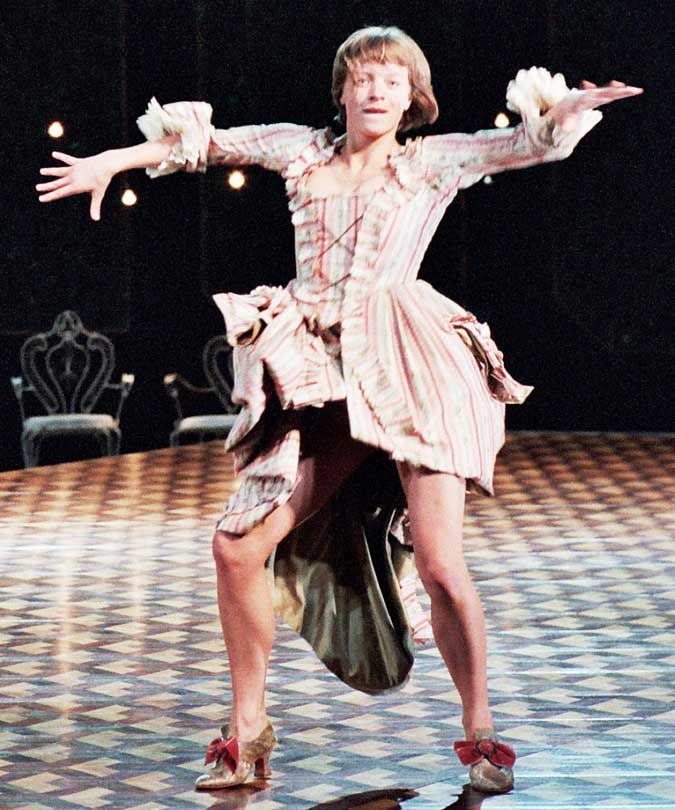
Change of costume is a central element of de Keersmaeker’s show. The costumes themselves, by Rudy Sabounghi, are inventive and beautiful. Their theme? Sleek postmod irony meets Liaisons Dangereuses. In their contemporary urban-cool mood, the women pair drop-dead chic black suit jackets with micro-mini jet skirts, long stretches of bare leg, and footgear inspired by eighteenth-century fashion. (Not unexpectedly, the shoes eventually get used as props in bits of foot-fetishism.) For their retro mood, the ladies are assigned picturesquely wrecked (and movement-friendly) versions of eighteenth-century dress for high and low walks of life (the milkmaids are delicious!). The guys, though they remain barefoot (and bare shinned as well), have period gear to match the women’s—long lush jackets, embroidered weskits, lavishly loose white shirts with ballooning sleeves that double as nightshirts, and legwear that lies provocatively between pantaloon and trouser. The dancers spend a great deal of their time dressing and undressing (with obvious implications of erotic adventures), mixing and matching various pieces of both their own costumes and those of the opposite sex. While a costume maven like me will find this diverting, it’s still no substitute for dancing. For the record: The trio of sopranos wear ladylike variations on a theme of blue velvet, as if they’d explained to the saleswoman at Bendel, “Something for a classical music recital, you know. Elegant, but not too showy.”
The three admirable sopranos were Patrizia Biccirè, Anke Herrmann,
and Olga Pasichnyk; Steven Lubin was the man on the pianoforte; Gregory Vajda conducted the Orchestra of St. Luke. The dancers came from de Keersmaeker’s company, Rosas.
Photo credit: Rosas, Herman Sorgeloos: Anne Teresa de Keersmaeker’s Mozart/Concert Arias, un moto di gioia
© 2004 Tobi Tobias