


New York City Ballet: Boris Eifman’s Musagète, world premiere June 18, 2004
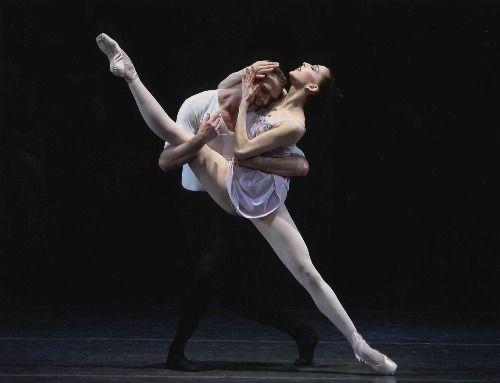
For reasons too discouraging to explore, the New York City Ballet commissioned a work from Boris Eifman for its year-long Balanchine centennial celebration, now winding down. And Eifman came up with Musagète (Leader of the Muses), a 50-minute extravaganza that–despite its appalling notions of choreography, biography, and their possible relationship–claims to be a homage to the master. This is an event that could only have occurred over Balanchine’s dead body. The Eifman Ballet of St. Petersburg is much acclaimed in its home town (the city that bred Balanchine) and it has certainly been a hit in its City Center appearances of the last half dozen years, relished by an audience packed with Russian émigrés. But Eifman operates from an aesthetic that’s the antithesis of Balanchine’s–long on lurid melodrama and gimcrack sentiments, short on musicality, structure, steps, and classical decorum. Following are my notes. (It’s o.k. if you want to stop reading now. Really.)
The musical selections that make up the score–substantial excerpts from Bach, a snippet of Georgian choral singing, and an infusion of Tchaikovsky to wind things up–begin with the Bach Paul Taylor used for the dark-night-of-the-family’s-soul section of Esplanade. Eifman gives us a lone man (Robert Tewsley), in generic black trousers and white t-shirt, sitting on a chair, head bowed, in what looks like a prison. We’re talking major depression here. Or worse. Eventually this troubled protagonist (let’s call him Mr. b, after the Big B he represents) points his finger skyward. Maybe this means something–but what? Emerging a little from his gloom, he stands to execute the tendu demonstration famous from the Cartier-Bresson photo that the NYCB adapted for its centennial logo. Retrieved verticality launches him into an anguish-in-the-throes-of-creation solo in which he’s half on, half off his chair, which conveniently turns out to have wheels. (Never mind that Balanchine was known to keep his personal griefs private and his behavior in the studio briskly professional and productive.) An attendant appears and tries to calm him. Hey, wait a minute. Is this Stygian cavern not a prison but an asylum? Has Eifman confused Balanchine with Nijinsky gone mad?
Next, an opaque black backdrop rises just enough to reveal a line-up of pairs of feet in pointe shoes working away in frisky, nimble unison. The drop then rises to reveal, full figure, the owners of the feet, inexplicably clad in performance-ready white tutus to perform their daily exercises at the barre. The idea is based on an actual formative event in Balanchine’s youth. Still a pupil at the renowned Maryinsky academy, he broke school rules to peer into a studio where the company’s ballerinas were practicing and was fascinated–riveted–by the sight of their footwork. Eifman’s treatment of the event, however, is lifted from Harald Lander’s eternally popular middle-brow entertainment Études, a debasement true to his taste.
One by one the young ladies advance into the center space to be corrected and manipulated (yup, here come the sexual overtones) by Mr. b. He shows them what he wants them to do, choreography-wise, enjoying little flirtations on the side. This already misguided section culminates with Mr. b choreographing the opening gestures of Serenade–the raised arm with the hand shielding the face from the light, the feet snapping from parallel position into a turned-out first.
Back to the blackness and the chair, but now Mr. b enjoys the company of a single “special” woman (Wendy Whelan) sheathed in a black practice outfit enlivened by sparkling paillettes on the bodice and on a matching snood. Mr. b veers between sculpting her–seeing what contortionist grotesqueries her body is capable of–and making love to her. This is Eifman’s “advanced” notion of the adagio pas de deux.
At the performance, I was trying to figure out which of Balanchine’s early muses/private-life partners Whelan might represent. Tamara Geva? Alexandra Danilova? Vera Zorina? They were all glamour girls. Subsequently I caught up with a New York Times piece by Sylviane Gold that reports Whelan’s saying she understood herself to be the incarnation of Balanchine’s cat Mourka. The celebrated feline was photographed by Martha Swope as the choreographer put her through motions that looked very much like spectacular dancing. Go know.
Anyway, a fellow in black practice clothes (chic, like Whelan’s) strides purposefully by and, uh-oh, Ms. Muse seems to like him better than she likes Mr. b. The new pair disport themselves acrobatically, their duet briefly enlarging into a pas de trois, but Mr. b quickly drops out of this impossible affair and despairs, while Mr. X carries off the muse. (Have we somehow skipped ahead to the rupture between Balanchine and his most compelling égérie, Suzanne Farrell, upon her marriage to a NYCB dancer? Surely few men would be so despairing over the loss of a cat, no matter how lithe and obliging a dancer it was.)
A whole flock of girls in black studio togs kindly arrives to comfort Mr. b. One even covers his eyes à la Serenade‘s Dark Angel. (Aficionados in the audience are registering the quotes from the masterworks almost audibly, and Eifman obligingly selects only obvious ones. Have I mentioned Agon?) Then, mercifully, the lights come up full and Mr. b goes back to his proper business of choreographing, moving from the women to a gaggle of men, then meshing the two ensembles. Suddenly, from their midst, Mr. b grabs one of the anonymous boys and matches him with one of the anonymous girls. (“Notice me! Notice me!” was the eternal cry from Balanchine’s acolytes, and the choreographer was swift to spot potential and groom it.) But now, abruptly, with a rough push and pull, Mr. b changes one boy for another. This chance of a lifetime that fizzles happens too fast for its implications to be explored, as is perhaps for the best. Mr. b retreats to the back of the stage and stands impassive, arms folded, as if, having pressed the “On” button, he could let the choreography evolve on its own. From the frenetic look of the proceedings, he’s pressed “Fast Forward.”
Lo and behold! a girl in a rosy girlish dress runs in and (here comes Serenade again) falls down. Mr. b gives her the balletic equivalent of the kiss of life–the God-touching-his-finger-to-Adam gesture that Balanchine co-opted from Michelangelo for Apollo. (What can we learn from this? That the quality of borrowings depends not on the material borrowed but on the sensibility and craft of the borrower.) The girl is Alexandra Ansanelli at her most kittenish (no, not like Mourka, Mourka was classical in repose and a hoyden in motion). The pretty-in-pink girl and Mr. b fall in love, enjoy a mutual accord blissfully free from anguish, until . . .
The happy couple finds itself rushing through a matrix of women looking mid-century modern dance-ish in long, severely cut black skirts. Has Martha Graham been invited to create a work for Balanchine’s company? (This did happen once, the result being the now discarded first half of Episodes, but that experiment was Lincoln Kirstein’s bright idea; Balanchine had no use for modern dance.) Or is this one of those Russian premonitions of doom? Suddenly Mr. b is back in his peripatetic chair, despairing, his watchful attendant ever-solicitous. (Eifman seems to find the idea of solitary incarceration piquant and insanity theatrically picturesque. I haven’t the least objection to morbidity on stage, but I prefer mine unDisneyfied.)
Ansanelli returns, playful as ever, to engage Mr. b in a duet that’s part contortion, part making out, when–bam!–Fate strikes her down, robbing her not merely of an inherent grace that ballet training has honed to perfection, but of her very mobility. She collapses in grotesque postures. Tanaquil LeClercq, felled by polio. A death figure out of Ingmar Bergman’s Seventh Seal drags her out of Mr. b’s sight and life on a long swath of inky cloth. (Never mind that Balanchine remained married to LeClercq for a good long time after her illness struck and that she lived, gaming coping with her disabilities, for many years after they parted. Never mind that she was in no way an Ansanelli type–either physically or in stage persona. LeClercq was all long-legged rakish elegance, the epitome of intelligence and wit, with an uncanny capacity for poetic suggestion. The well-nigh criminal tastelessness of Eifman’s depiction of her tragedy would have driven me out of the theater had I not been sitting in the middle of a long row–and obliged, as a journalist, to see the performance through.)
So . . . where were we? Mr. b, as is his right, succumbs once again to grief. A phalanx of men arrives to energize him, followed in short order by a matching female contingent; the choreographer’s raw material, as is its right, is urging him to get back to work. No sooner has he complied than, among them, he notices the magnificently long-legged, sensuously supple Maria Kowroski and seizes her for his own. Suzanne Farrell, of course. The company simply fades away, leaving Maria/Suzanne and Mr. b alone in the dark with a ballet barre just long enough for two. He discovers her enormous physical and emotional resources and the rest is history. The barre (itself inclined to motion, like its cousin, the chair) bears witness to shenanigans no barre should have to endure. At their conclusion, Mr. b lies spent. The lady vanishes. Though tasteless (as Eifman’s work is chronically), this business is not as vile as the polio episode. Nevertheless, as balletic orgasms go, it doesn’t hold a candle to the climax of L’Après-midi d’un Faune.
A fog blows in. Mr. b indulges in a little modern dance floor work to some religious-sounding choral music (Georgian, in reference to Balanchine’s ancestry). Mr. b, it appears, has entered an altered state. From above, a pastel rainbow of light beams plays on the swirling mist. Gaze cast to the heavens, Mr. b splays his body along the tipped barre that, moments before, served as a bed for ostensible voluptuous pleasure. (It looks no more comfortable than Noguchi’s precarious bed for Oedipus and Jocasta in Graham’s Night Journey, but let that pass.) Now it’s a death bed, and its occupant is experiencing visions.
Balanchine treated his own death choreographically at least twice–depicting the last moments of the visionary Don Quixote in the ballet of the same name (sometimes performing the role himself), where the bed actually elevates its expiring tenant, and in the profoundly moving pageant-like setting of Tchaikovsky’s Pathétique. Both treatments depend on the highly colored imagery and impulse to ecstasy that one might expect from an adherent of the Russian Orthodox faith. Yet even viewers who found the material over the top could see that it poured from a font of simple, indeed naked, sincerity, and that, like everything else Balanchine did, it was exquisitely balanced in a larger context. Eifman’s Mr. b, I’m afraid, expires in tawdry-thrills mode. But the show’s not over until the finale.
Dazzling lights. Chandeliers. A mass of women in snowy zircon-studded tutus, fetching little tiaras, and partners to match, madly churning out what might be a faultily translated, phoned-in version of the finale of Symphony in C–or is it Theme and Variations? Or Ballet Imperial? Amid the hectic traffic, hierarchy prevails, as it must in classical ballet. Whelan and Ansanelli, partnered, respectively, by Nilas Martins and Benjamin Millepied, are relegated to soloist status in favor of Kowroski, who, as the channeled image of Farrell, must reign supreme. Squired by Stephen Hanna (Mr. X, see above), she egregiously exaggerates whatever she has in common with Farrell, who, in real life, is no longer welcome at the New York City Ballet in any role, but whose dancing remains indelible. Raked over though one’s sensibility may be, exhausted as one’s eyes are at this point in Eifman’s travesty, one should not miss the second quote from Études that turns all the dancers into silhouettes.
Then, melodramatic flashes of light, and the late Mr. b, now in evening clothes (no doubt de rigueur in Paradise), moves among his dancers. They all bow to something unseen, then cheerily carry on their work like the pros they are. By now, though, they look like automata.
Don’t say I didn’t warn you.
Photo: Paul Kolnik: Alexandra Ansanelli and Robert Tewsley in Boris Eifman’s Musagète
© 2004 Tobi Tobias