


SCHOOL OF AMERICAN BALLET 40TH ANNUAL WORKSHOP PERFORMANCES
Juilliard Theater, Lincoln Center, NYC / June 5 & 7, 2004
Persisting in its unwieldy low-key name (see above), Workshop infallibly provides a bright spot in the dance-world calendar. A yearly showcase of the august academy’s students, the event consists of matinee and evening performances on a Saturday and a gala evening the following Monday (same program, with varied casting at the top). And then it’s gone forever—apart from the archival videotapes made since 1980 by Virginia Brooks, which can be viewed with permission from the Balanchine Trust. A look through those archives reveals a quarter century’s worth of nascent stars, to say nothing of dancers who would become distinguished soloists and stalwart members of the ensemble—at the New York City Ballet (the school’s parent company) and with other troupes cross-country and abroad.
As just about everyone in Workshop’s audience is aware, it was George Balanchine who, with Lincoln Kirstein, brought SAB into being—even before they established the forerunners of the NYCB. Legend has it that Balanchine insisted, “But first a school.” In honor of the 100th anniversary of the choreographer’s birth, this year’s program was dedicated solely to works from his hand: Serenade, the first ballet he created in America; the Ballabile des Enfants from Harlequinade (which gives stage experience, an essential component of dance training, to pupils still some years away from their teens); Le Tombeau de Couperin (a tribute to the “anonymous” dancers of the ensemble); and excerpts from the Hail, Britannia! extravaganza Union Jack. At the conclusion of the last piece, where a stageful of dancers usually performs a tour de force of synchronization, spelling out “God save the Queen,” each one armed with a pair of perky twin-triangled semaphore flags, the message instead read: G-E-O-R-G-E B-A-L-A-N-C-H-I-N-E. And instead of the British flag being flown in behind the smiling signalers, down came the Cartier-Bresson photo of “Mr. B,” every SAB student’s godfather, demonstrating the correct placement of the foot in tendu, a basic that classical dancers repeat daily, striving to step a millimeter closer to perfection, from their first class to their retirement.
Potential-star spotting is part and parcel of Workshop. For me, two young women, polar opposites in type, stood out this year: Tiler Peck and Kaitlyn Gilliland. Peck, a 15-year-old from California, is a diminutive bundle of athletic energy, with a projection that’s absolutely electric. In Serenade, she’s so eager to exercise her technical brilliance that she prevents the atmosphere of the piece from accumulating around her. As a rollicking sailor in Union Jack, though, she’s perfect. With her exuberance and assurance, her evident joy in being who she is and doing what she’s doing, she could carry a Broadway show on her own.
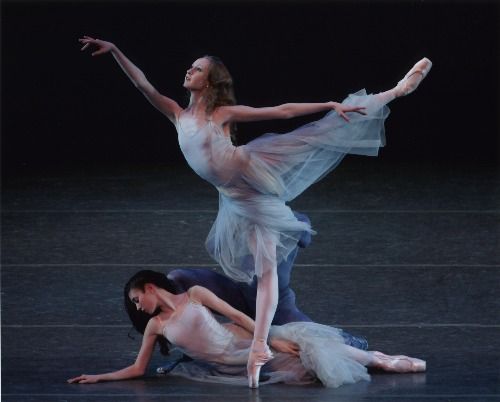 Gilliland, just turned 17, comes from Minnesota and from a distinguished matrilineage. Her grandmother, the late dancer and choreographer Loyce Houlton, founded Minnesota Dance Theater, blending the purity and lyricism of classical ballet with the deep texture of modern dance. Her mother, Lisa Houlton, who now runs that company, was herself a lovely dancer schooled in both modes. Gilliland, however, might be a changeling child. She seems to belong entirely to the ballet domain, indeed to a particularly rarefied part of it. Exceptionally tall, exceptionally slender, her small head poised like a jewel on her long neck, her spine as flexible as a young willow, she’s an ethereal, otherworldly creature. As the “Dark Angel” in Serenade, she seems to exist in a dream that is half the creation of Balanchine and Tchaikovsky, half her own fantasy. Even heading up the leg-flaunting chorus of Wrens in Union Jack, She manages to remain a little shy, luminous in her innocence. She will remind veteran observers of Allegra Kent.
I also liked Rachel Piskin’s dulcet lyricism in Serenade. Piskin, who is 16, isn’t as striking a type as Peck and Gilliland; she’s more the norm—but it’s a lovely norm that she embodies, and she seems almost guaranteed a rewarding career.
As for the men, their very number is noteworthy. Could it be that America has finally matured enough culturally to allow its young men to dedicate themselves to classical dancing? In the Harlequinade children’s divertissement, some of the “boy” roles that, of necessity, have long been played by girls en travestie, are now gender-correct in their casting, and it does make a difference. Elsewhere the guys representing the Advanced Men’s class displayed considerable native talent and well-honed skill. If I couldn’t identify with any certainty a future danseur noble among them, I was infinitely touched by one young man in Le Tombeau de Couperin. Perhaps the least proficient in skills of his seven comrades in the piece, all repeating and refracting the same steps, he possesses infinite adolescent grace. He’s still only half way to a grown man’s body, with its expanded chest and steady confidence in its bearing and gestures. He’s at that stage when, the moment a fellow has acquired some command of his rapidly lengthening body, he finds he’s grown another inch—in his sleep, surely—and things have once again fallen apart, with any single move likely to prove unreliable. Raymond Radiguet (Le Diable au corps) and Alain-Fournier (Le Grand Meaulnes) have written eloquently about young men in this phase of their development. Perhaps never again in their lives will they be so vulnerable and so beautiful. The perilous beauty of adolescence is evident everywhere at Workshop, all the more vivid because of the young performers’ unswerving dedication to the standards of mature professional artistry.
Note: Radiguet’s Le Diable au corps (1923) is available in English translation as Devil in the Flesh. In 1946 it was made into a film named for the book, directed by Claude Autant-Lara and starring Gérard Philipe and Micheline Presle. Alain-Fournier’s Le Grand Meaulnes (1913) is available in one English translation under its original French title and in another as The Wanderer. A key incident in the book served as the premise for Andrée Howard’s La Fête Étrange, choreographed in 1940 for the London Ballet.
Photo credit: Paul Kolnik: Kaitlyn Gilliland (standing) and Rachel Piskin in George Balanchine’s Serenade
Serenade choreography by George Balanchine © The George Balanchine Trust
© 2004 Tobi Tobias