


American Ballet Theatre / Metropolitan Opera House, NYC / May 10 – July 3, 2004
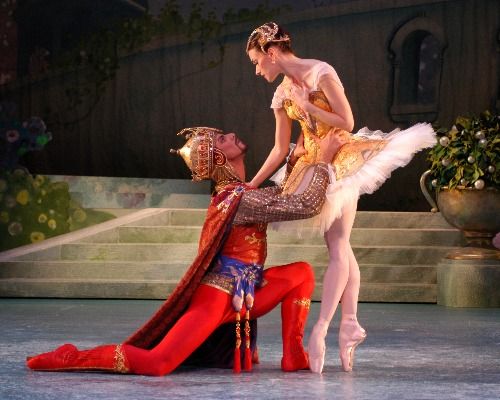
I know Raymonda—Petipa, Glazounov, 1898—is a hokey ballet. Still the dance world can’t leave it alone, its strictly classical variations, pas de deux, and small-group-of-soloists configurations being dazzling—incomparable, actually, and a veritable lexicon of the danse d’école—its score so full of pleasant, atmospheric tunes supplemented by vivacious invitations to earthy romps in heeled boots.
And so American Ballet Theatre, convinced (perhaps rightly, since it must reach way beyond hard-core dance aficionados in order to fill the Metropolitan Opera House)—convinced, as I say, that its audience craves multi-act story ballets, elaborately dressed, with scenery to match, has come up with a new production. It has been choreographed by Anna-Marie Holmes after Marius Petipa and “conceived and directed,” as the house program carefully notes, by
by Holmes and ABT’s artistic director, Kevin McKenzie. (Beware of enterprises crediting their conception.) Ormsby Wilkins adapted the Glazounov score and conducted his result on opening night. Zack Brown created the scenery and costumes. The production was undertaken in partnership with the National Ballet of Finland, which gave it its world premiere in Helsinki a year ago. (If those responsible for the staging noticed that it was deficient in any way, they’ve had plenty of time in which to improve it.)
This is a “full-length” Raymonda, though curtailed so that audience and stagehands can get home at a reasonable hour. It’s decently danced, although, overall, it sacrifices vigor and fervor on the altar of correctness. Under Wilkins’s baton, the beguiling music failed to provide the dynamic support dancing requires; let’s assume, however, that this strange flaccidity can be given a shot in the arm. The scenic investiture, if you will, caroms off multiple ill-sorted inspirations, including but not limited to: Les très riches heures du Duc de Berry; the fashion and art à la japonaise popular ca. 1920; Rouben Ter-Arutunian’s designs—trees that float upward so their roots become chandeliers—for Balanchine’s Vienna Waltzes; Islamic minarets; and Las Vegas floor shows. The little girls who study ballet and come to matinees may well find it delectable. But how any choreographer, conceiver, or director could have put on The Raymonda Show without the spine of plot and some depth of characterization is utterly beyond me.
The plot is a mess in this version. Granted, the plot of Raymonda has been a mess from the get-go, but presumably it was more capable of suspending disbelief in Petipa’s time, when ballet libretti often preferred rampant fantasy to logic. In ABT’s Raymonda, plot is almost gone, leaving confusion in its wake.
This is what the audience needs to know: It’s the Middle Ages and we’re in Provence, which is feeling close political ties to Hungary. (Already you have misgivings.) The exquisite heiress Raymonda, under the guardianship of an aunt, the Countess Sybelle (the spelling of the names in this tale is variable; I’m using ABT’s here), is slated to marry Jean de Brienne—suitably aristocratic, to say nothing of white, Christian, and a paragon of chivalric behavior. But, uh-oh, here comes trouble, in the form of the Saracen Abderakhman, a knight in his own domain, granted, but in appearance a person of color, an infidel, and the kind of guy (like everyone from his world, Petipa’s audience might have agreed) who, taking a fancy to a young lady, feels lust rather than love and, finding persuasion (gifts of glittering jewelry, a show of gaudy regional dances from his private nightclub) ineffective, segues without any problem to attempted abduction and rape.
So you’ve got drama (if only melodrama) and conflict—eventually de Brienne disposes of the Saracen in a duel so that he and his fiancée can live happily ever after. But here’s the key thing: the conflict lies not in sword versus scimitar but within Raymonda’s consciousness. She must choose between Jean de Brienne’s chaste love, which even her virginal self suspects may prove a bit dull, and the seductiveness of Abderakhman, who represents the sensual life. She meditates on this forbidden love in a dream scene; what could be more Freudian?
ABT, however, partly through its mistaken desire to keep things zipping along, has not only left the story and its underlying theme unclear, it has also conceived and directed the heroine as a blank and Abderakhman as a ludicrously exotic idiot who represents neither serious sexual appeal nor serious threat. You sit there muttering pitiably to yourself (or to the young woman sitting next to you, who has kindly plied you with much-needed cough drops), What is going on?
Well, what’s going on are these incredible passages of abstract classical dancing that surface with merciful regularity from the miasma of the muddled plot and unrealized characterizations. Endlessly inventive, they have an infallible dance logic and architectural logic as well. Beyond their beauty—and their unexpected ability to suggest aspects of temperament—they possess an intellectual dimension that makes them the very antithesis of eye candy. Balanchine and Ashton, inarguably the supreme classical choreographers of the twentieth century, rightly took Petipa’s work as a manual of instruction.
It would be an understatement to call the classical-dance excursions for the principals and soloists in Raymonda challenging, and ABT’s opening night cast acquitted itself very well, if with too much visible caution. (The cumulative result resembled a graduation performance at a world-class ballet academy.) Coached to be modulated and fluent—the incarnation of grace—as well as precise in the trickiest feats, the dancing just now looks trapped in this instruction. Take, by way of example, the performances of Raymonda’s two girlfriends: Michele Wiles’s fresh-faced American-girl daring and prowess (so like Merrill Ashley’s) have been stifled; her boldness, her leggy angularity, her frank presentation of herself as an athlete immune to balletic affectations have been softened, as if these qualilties were inappropriate to the occasion when, in fact, they define her stage persona and give it a unique appeal. And Veronika Part, late of the Kirov and thus to the manor born, seemed too calculated, though she provided the loveliest, most evocative dancing to be seen on opening night. (It should be noted that Anna-Marie Holmes, because of her own affiliations with Kirov tradition, locates the manor in Russia.)
Maxim Beloserkovsky, as Jean de Brienne, wasn’t quite up to all the technical requirements of his role, though at his best—cleaving the air in long leaps—he was very handsome. To my mind he’s a lyrical dancer, forced by life and ABT to masquerade as a virtuoso. Marcelo Gomes, a gorgeous young dancer who tends to be passive in his more outré assignments, needs to quiz Holmes or McKenzie closely on who, exactly, he is in the role of Abderakhman and what this character represents. Malleability in dancers is useful to a point; beyond that point it’s a defect. Dancers slated for the history books tend to absorb instruction and then go on to claim their roles, taking possession of them in order to infuse them with vitality and individual life.
As the ballet’s eponymous heroine, Irina Dvorovenko was entirely vacant. She has her fans—and many of them were present on opening night, cheering her on—but I am not one of them. She has a showgirl’s body and a very pretty face. Though she lacks musicality, her technical proficiency is not to be dismissed. But to my mind none of this takes the place of the kind of artistry that—selfless and fueled by an ardent imagination—ferries the spectator into worlds that are strange, potent, unforgettable.
In terms of interpretation, the current production will improve with further performance and alternative casts. Nina Ananiashvili, for example, made a sublime Raymonda, dancing in excerpts from the ballet at ABT’s opening night gala. And perhaps Martine van Hamel, as radiant in the walking role of the Countess Sybelle as she once was as the ballet’s heroine, will find a way to convey to the rising generation of Raymondas, as she did to her audience when the part was hers, the fact that sensuality can be one of a nobly born maiden’s virtues, indeed an important part of her dowry.
In its time, Raymonda has had many incarnations, both in program-length and “excerpts from” form. Balanchine went back to it repeatedly. Back in 1946, he mounted a two-act version for the Ballet Russe de Monte Carlo in collaboration with Alexandra Danilova; it was part of their rich, redolent Maryinsky heritage. Danilova danced Raymonda. How I wish I had been there! (The cast, recorded in entry no. 233 in Choreography by George Balanchine: A Catologue of Works, illuminates a critical moment in dance history.) Subsequently Balanchine thought of more efficient ways to use his Raymonda legacy. In 1955 he pared the material down to Pas de Dix, a brisk, brilliant affair that showcased the variations from the ballet’s last act, the “after Petipa” part of the choreography credit presumably best read as more “after” than “Petipa.” In 1978, he then expanded his take on the source material to concoct Cortège Hongrois, providing Melissa Hayden with an adequately lavish vehicle in which to make her farewell at the New York City Ballet. This version included some of the zesty Hungarian folk dances that, in the original, aptly set off the purely classical stuff. In between (1961), he choreographed Raymonda Variations (originally called Valse et Variations), which co-opts parts of Glazounov’s score but does without Petipa’s direct input. (The New York City Ballet is dancing it this season.)
ABT’s ventures into Raymonda territory include: a full-lengther staged by Rudolf Nureyev in 1975, starring Cynthia Gregory and Nureyev, with Erik Bruhn as Abderakhman; divertissements staged by Mikhail Baryshnikov in 1980, with van Hamel as Raymonda; the Grand Pas Classique staged by Baryshnikov in 1987 and dressed in the fur-trimmed tutus we saw when ABT unveiled bits of the current production last season, with van Hamel again as Raymonda (and, the very next year, Kevin McKenzie as Jean de Brienne); and the third act staged by Fernando Bujones in 1991. They’ll get it right yet.
Note: This column is confined to a single item because I spent the week under house arrest ordained by New York’s latest virus. Like some dance critics, it’s a mean one.
Photo credit: Marty Sohl: Marcelo Gomes as Abderakhman and Irina Dvorovenko as Raymonda in American Ballet Theatre’s Raymonda
© 2004 Tobi Tobias