


New York City Ballet / New York State Theater, NYC / April 27 – June 29, 2004
Following are some comments on the highlights of the opening week in the New York City Ballet’s spring season, Part II of the company’s Balanchine 100: The Centennial Celebration.
LA VALSE:
I come to Balanchine’s La Valse laden with memories.
Shortly after the ballet’s creation in 1951, I had the privilege of seeing Tanaquil LeClercq in the role of the doomed girl—a striking figure of innocence in the glamorous, corrupt society sweeping feverishly around her. Francisco Moncion was her apt foil, in the role of Death.
Of all the dancers I’ve known who were potent in stillness, Moncion still ranks first; his gravity and projection in this ballet as he gradually but inexorably laid claim to his prey had the effect of smooth, heavy stones dropped into a calm, deep pool.
LeClercq—unique in everything she did, with her intelligence and wit, her long-limbed angular elegance, her chiseled profile, and her inherent mystery—played the ballet’s strange heroine entirely without sentiment. She asked not that you pity her but that you allow your imagination to participate in her fate. If Death took her as his bride because she was young, untouched, lovely, she also went to meet him—with curiosity, even bravado. She accepted the shadowy cloak in which he wrapped her, the macabre accessories with which he adorned her—relishing the jet jewels and plunging her hand into the long inky gloves—not with a reluctance born of fear but first with puzzled equanimity, finally with a rapacious appetite.
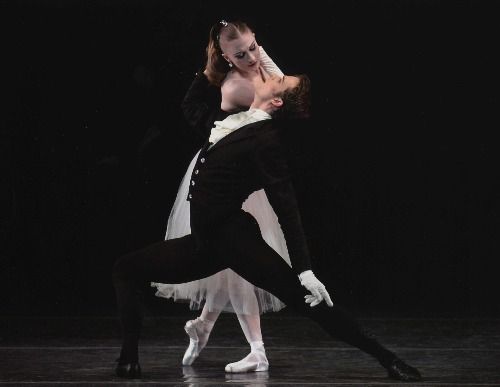 In the present production, Rachel Rutherford and Robert Tewsley (as her devoted, baffled suitor, the role created on Nicholas Magallanes), do the originals justice. Both exude the sense of place that makes the ballet potent. And both dance with real dramatic impetus, as if, for them, the story is new and vivid. Rutherford, a lovely but placid dancer, doesn’t possess anything like LeClercq’s instinct for fantasy, but she conjures up a believable and telling persona. She made me think of an adolescent, touching in her folly, who costumes herself in chic depravity and goes out on the town to risk her life.
The ensemble dancers perform handsomely enough, but, for the most part, don’t seem to know what the ballet’s about. Blame their inability to probe their material on their own (a failure common among today’s performers) or blame their coaches, as you prefer. But how can they not have heard the frantic, decadent atmosphere in the music? For the entire first half of the ballet, they seem to be enjoying themselves at a pleasant-enough ball.
And Jock Soto, I’m afraid, is all wrong as Death. He has the right physical presence for the role—solemn and striking—but he emotes too much, as self-consciously sinister as a stagy Dracula, and simply does too much, reaching out to seize the girl and rough her up, instead of luring her into his realm through his magnetic presence.
Karinska’s inspired designs for La Valse are, of course, less vulnerable to the changes time inevitably wreaks on the interpretation of choreography. One of the glories of this ballet is the ankle-brushing tutus for the soloist and ensemble women. Overskirts of pearl gray gauze veil layer upon layer of gorgeous yet somehow horrifying color—scarlet, vermilion, magenta, lavender, rose, and tangerine—each gown adhering to one of three different palettes. The hues flame and blend variously when the women whirl on pointe or unfurl their exquisite, powerful legs, as if night and death could never fully conceal the magnificent and terrible sunset preceding the end of the world.
SONATINE:
At the moment of its creation, Sonatine was disguised as a curtain-raiser, a bagatelle, a pièce d’occasion. The occasion was the New York City Ballet’s Ravel Festival of 1975. The year marked the centennial of the composer’s birth and, while Ravel hardly inspired Balanchine’s choreography as Stravinsky and Tchaikovsky did, festivals excited ticket buyers’ interest, and attention to the composer functioned as a tribute to France. (Three decades ago America was not fussing about the local name for pommes frites, but still looking to France as a model of sophistication in the realms of the intellect, the arts, and, of course, cuisine and high fashion.)
The ballet—a duet accompanied by an onstage pianist—proved to be worth keeping, though casting it once the original dancers had left the company has been a challenge. Balanchine made Sonatine for Violette Verdy, a French import, and the ballet was tightly connected to that distinctive dancer’s extraordinary musicality and her piercing intelligence. (Verdy was fittingly partnered by another French dancer, Jean-Pierre Bonnefoux.)
The choreography depicts a partnership that is the acme of civilization. It displays its dancers in a multitude of promenades and gracious bows—to each other, to an unspecified occasion. The delicacy of ornament so prominent in French art surfaces in its small, precise articulations and flourishes. Delving deeper, the piece explores the myriad ways in which two bodies can relate to each other, hands joined, and, equally, how they can relate in space when they separate. The dancers seem to enjoy a state of mutual delight—yet one that is social, not intimate or passionate. Part of their pleasure appears to lie in sharing a standard of exquisite comportment.
Oddly enough, though, the moment in Sonatine that remains unforgettable to me from its early showings is all fervid Romanticism, a vein that keeps surfacing in Balanchine’s work, one that we overlook as we concentrate on the miracles he accomplished in his neoclassical mode. The headier leitmotif proposes a man who is all ardent reverence—call him the Poet; call him Balanchine, if you dare—yearning for an unattainable woman. She is not merely the object of his desire (tangible) but also his inspiration (ineffable). Think of the exalted adoration the man expresses toward the woman who twice vanishes and returns in the final passage of Duo Concertant. Think of the numerous occasions on which Balanchine portrayed Suzanne Farrell as the muse who is the elusive object of the Poet’s worship. Now this is not the way Balanchine usually cast Verdy, whose Cartesian temperament, with its emphasis on clarity and objectivity, was neither a likely purveyor of sheer sensual allure nor a likely object of ecstatic imaginings. But in this little moment I recall from Sonatine, Verdy, for just a few seconds, became such a figure.
At intervals in the dance, the woman leaves her partner, and he, in turn, leaves her. The departures don’t seem to carry any emotional freight; they’re intrinsic to the structure of the piece, allowing for solo work to offset the duet material and offering the temporarily inactive performer a little breather. But when she goes off—I think it’s a third time—the man dances briefly alone, then suddenly crouches low, Werther-like (originally, in the concave shelter of the onstage grand piano, though the position has now been moved to center stage). His despairing attitude leads us to believe she’s gone forever. Then—lo and behold!—she returns. Cued by a shift in the music, he looks up, gazes toward the faraway corner diagonally opposite him, and there she is, just standing there, like a statue gleaming in early morning sunlight. No need for her arm to beckon or for her face to register emotion. Even in dance, there are moments when movement is superfluous. Her mere presence is his entire consolation—his reward, perhaps undeserved, surely unexpected, a stroke of Fate in one of her rare benevolent moods.
This season the company invited a pair of Paris Opera étoiles, Aurélie Dupont and Manuel Legris, to fill the Verdy and Bonnefoux roles, and they made an exquisite job of it. Their execution of the choreography was a tribute to their schooling: very pure, very powerful, very controlled—yet fleetingly inflected with all sorts of subtle shadings. More than the originators of their roles, they allowed their contact to grow increasingly rhapsodic. So much so that the ballet’s ending—they exit whirling on crisscrossing paths to opposite sides of the stage—frustrated expectation. Verdy’s demeanor, on the other hand, hinted from start to finish that Apart was inevitably lovers’ destination.
KYRA NICHOLS:
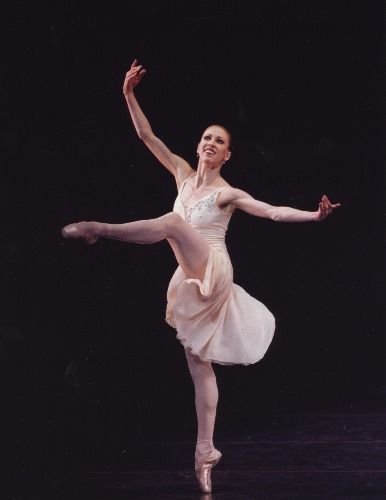
The New York City Ballet called its all-Balanchine opening night program “French Tribute,” the scores for Walpurgisnacht Ballet, Sonatine, La Valse, and Symphony in C being by Gounod, Ravel, Ravel again, and Bizet, respectively. I’ve always thought that the atmospheric Emeralds section (Fauré) of Jewels was the most deeply French of Balanchine’s ballets, but never mind, the program offered a great deal of loveliness, which, for me, reached its pinnacle with Kyra Nichols’s dancing in Walpurgisnacht.
For the last several years, Nichols has quietly and steadily demonstrated how a ballerina can comport herself with continuing grace and growing luminosity as she nears the close of her performing career. Though time inevitably eroded her phenomenal technical capability, she has never relinquished the key elements—call them principles—of her dancing: the purity, the musicality, the self-presentation so modest, so tactful, so reticent that her dancing figure, offering almost no ego, looks simply like a flowering of the music or perhaps the incarnation of Balanchine’s imagination.
Many of Nichols’s former great roles are now beyond her, but in Walpurgisnacht she was perfect, spinning her silken web, phrase after phrase exquisitely modulated, the material inflected here and there, just fleetingly, with a hint of emotion, but not one you could ever put a name to. Nothing seemed calculated or forced; she moved, despite the intricate artifice classical dancing involves, with the radiance and joy of an ingenuous child. At the ballet’s last moment, when her partner displayed her in profile, perched high on his shoulder, her unbound hair streaming down her back, she looked like a figure on a ship’s prow, guiding her vessel out into uncharted territory, confident that she would encounter fair weather.
Photo credit: Paul Kolnik: (1) Rachel Rutherford and Robert Tewsley in George Balanchine’s La Valse; (2) Kyra Nichols in Balanchine’s Walpurgisnacht Ballet
© 2004 Tobi Tobias