


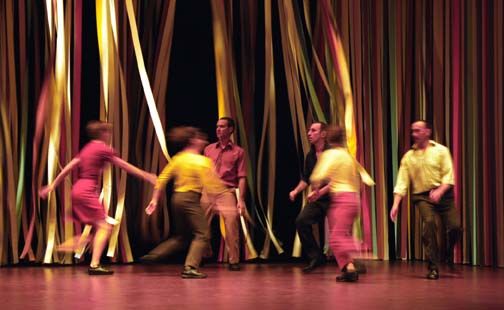
Compagnie Maguy Marin / Joyce Theater, NYC / April 6-11, 2004
A curtain of flexible strips in carnival colors screens the three walls of the stage like a vertical Venetian blind. Nine dancers—first one, then several—emerge from behind this pliant barrier, then, just as mysteriously, vanish back into the corridors it shields. Suddenly revealed, then quickly concealed, again and again, they’re figures in events without warning that occur in a territory in flux. Strong, swift, no-nonsense types (trained for the dance and dressed for the street, their faces registering nothing), they will spend 65 minutes uninflected by tale or temperament conveying the secret life of the hunted and haunted. The enigmatic name of the work is Les applaudissements ne se mangent pas (You Can’t Live on Applause). As its choreographer, Maguy Marin, indicates in her thankfully more pertinent program note, the piece springs from the horrific political and social conditions prevalent in Latin America, though the entire world, wherever power is wielded inhumanely, is implicated.
Some dancers enter by falling through the curtain, as if felled by sudden gunfire, DOAs. The others absorb the assassinations as if they were business as usual: glance down briefly, then immediately, automatically, turn away and go about their everyday affairs in which flight is prominent. The stricken bodies lie felled for a beat or two, then resurrect. One of the horrors of living in a state of siege, Marin implies, is that the events in it are infinitely recurrent.
Face to face encounters are often blank-faced confrontations. This is a society, if you can call it that, dominated by fear and the hostility that arises from chronic fear; the responses of one person to another are blunted or absent altogether. Unless they escalate to actual combat—most of it for couples, sometimes for several small groups. Without appetite or evident feeling—these people are beyond rage, emotionally anesthetized—they clamber up each other’s bodies to gain lookout posts, push one another down with a shove to the shoulder, then insult the abused body further, pushing it, kicking it, flinging it away like an unwieldy piece of trash. The roles of victim and perpetrator are interchangeable, of course. And the antagonism appears simultaneously political and personal. It infuses the climate. You can imagine the figures on stage, were they given to words, saying simply, “It’s the way we live now.”
Violence is interspersed with wary waiting. Even moments of stillness are charged with alarm.
Everywhere, people eye one another with ingrained suspicion. Trust, if indeed it ever existed, is absent from this terrain. Like spies, figures conceal themselves behind the curtain, then peek out—often, tellingly, to scan a temporarily depopulated stage space—or stealthily peer into the murky zone the curtain veils. As soon as one, looking in, proceeds to investigate what he’s glimpsed or imagined, another emerges from hiding to start a new probe. Later, one woman is left alone, abandoned by her companions who, moments later, appear to spy on her from a distance through chinks in the curtain. Elsewhere the population gathers to listen to furtively whispered secrets conveyed by a partner in an alliance that has a six-second life.
Yes, there is, fleetingly, some tenderness—a few embraces, but very few. Among the innumerable friend-or-foe? encounters, one, between two men, ends in a solemn hug. It’s motionless, just a pose, and so rare in the context that it startles. Are these the last people on earth who can remember love? Another, longer, embrace follows the most ominous group mêlée. The pair might be crying “Oh, my God, it’s you!” after some unspecific mass catastrophe had all but obliterated the hope of finding one’s significant other whole in the welter of the dead, the dying, and the debris. Even this relief lasts only a few seconds, though; the prevailing circumstances don’t allow a sense of safety to endure.
The most telling sequence in Les applaudissements goes like this: A woman falls. Another walks past her, looks down at her, then walks off. Cross-stage, three other figures, almost invisible behind the curtain, peer at the fallen body from between the slats, then go back into hiding. Seemingly close to death but not quite extinguished, the fallen woman—with the slow, fitful movements of the grievously ill or wounded—starts rolling to the opposite side of the stage as if some succor or at least shelter might lie there. Then, one after another, all the other bodies in the piece appear, recumbent like the first woman’s—feet pointing upstage, heads downstage—to roll after hers on the long horizontal path to the presumed safe haven. They make a terrible sound as they pick up speed, flesh impacting floorboard. Near corpses though they seem to be, they hurtle faster and faster, until all of them disappear to the far side of the stage—except for the last one, who doesn’t make it. A friend emerges to claim the doomed man, hold him as his life ebbs away, and remove him—to more hallowed ground, from the look of it, if, by chance, any should exist. At some point, as these events unfurl, we realize we’ve seen each element before.
Throughout the piece, the light glares and fades by turns. In the final minutes, the stage is steeped in a twilight so deep you can barely see what’s happening, yet from what you glimpse, you know. Much of it has occurred before, fully exposed. Ominous though it is, the growing darkness is merciful. By the time piece ends, you can barely make out what’s going on, but, pointedly, neither the spectators nor the figures that populate this nightmarish world are granted the mercy of a blackout. What’s going on here, Marin insists, keeps on going on.
Les applaudissements ne se mangent pas is handsomely done—with little air of contrivance. Using movement that’s rooted in a pedestrian’s vocabulary, Marin opts for the purity of the vernacular and bonds her viewers to her dancers. She manages the configurations of her stage picture as well as the continually shifting pulse of the action with an acumen a dance devotee can’t fail to admire. Even so, the piece may be difficult for the ordinary viewer to watch, let alone appreciate. Its duration—over an hour without a break—is a hurdle. And its refusal to succumb to the theatrical allurements of narrative, character, and structural patterns that offer obvious climaxes opens the door wide to monotony.
In the end, I suppose, the success of the work rests with its ability to kindle an emotional response in its audience—recognition of the universe it depicts, empathy with its inhabitants, identification with both, even incitement to leave the theater fired up to make the world at hand more pacific and just. In her own program notes, Marin describes Les applausdissements as polemical. Admirable though it is—it’s one of the most intelligent contemporary dances I’ve seen in some time—I don’t think it fully accomplishes what I take to be its humanistic goal.
Photo credit: Bruce Feeley: Members of Compagnie Maguy Marin in Marin’s Les applaudissements ne se mangent pas
© 2004 Tobi Tobias