


Paul Taylor Dance Company / City Center, NYC / March 2-14, 2004
Paul Taylor’s current two-week run at the City Center reveals the company in splendid form, dancing as if an ardent, intensified study of echt Taylor style had reanimated it. Old and recent masterworks-Aureole, Airs, Piazzolla Caldera, Promethean Fire-look reborn. And you can spend an enchanted evening focusing on any one of three stellar women: the veteran Silvia Nevjinsky, who has acquired a new softness, calm, and sculptural dimension; Annmaria Mazzini, who follows in the line of Ruth Andrien and Kate Johnson as the girl everyone adores; and Michelle Fleet, a more recent addition to the troupe, who is instantly recognizable as the Next Great Thing. The fact that the two new choreographic offerings were non-events-flops, to put it bluntly-is almost beside the point.
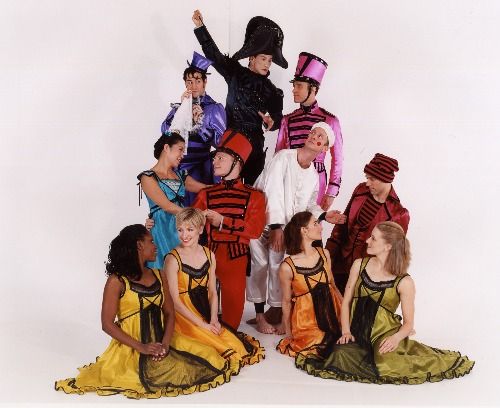 Le Grand Puppetier, being given its world premiere, takes off from Fokine’s Petrushka, a key work in the dance canon created in 1911 for Diaghilev’s Ballets Russes, which starred Vaslav Nijinsky in the title role of the puppet who proves to have an immortal soul. Ingeniously, Taylor uses Stravinsky’s pianola version of the score he created for the Fokine ballet. Then, confusingly, Taylor junks Fokine’s libretto, while appropriating some of Fokine’s characters, so that viewers familiar with Petrushka will be driven to distraction by the matches and mismatches, while viewers unacquainted with the Fokine are likely-Taylor’s plot being improbable and pointless-to remain in the dark. Why, they may well wonder, is the Emperor, as Taylor calls his Puppet Master, bent on marrying off his daughter to a gay fop? Is it likely that the Emperor’s pathetic Puppet would (1) overthrow his master’s tyrannical regime and, (2) having done so, cede control back to the dictator?
Taylor’s Emperor, dressed in a jet version of Napoleonic uniform, may be Fokine’s Charlatan, earning a living by displaying his puppets (just possibly human slaves) to a cruel audience in the market square. On the other hand, he may be: God; the autocratic Diaghilev; the founder-leader of a dance company that exists to dance that great master’s choreography (Taylor himself, perhaps); or one or another of the powerful guys dominating the news of late, who operate according to the conviction that they have the right to control how people should live (and die).
Such a puppeteer may be even worse than evil. Writing of his retirement from performing after chronic physical woes caused his collapse on stage, Taylor notes in his autobiography, Private Domain, “Once in a while it seems sad, but most times it seems comical. Our dance god, the Great Puppeteer up there in the flies, that ineffable string snipper, turned out to be an old-time prankster.”
The best thing in this excursion is the figure of the Puppet, played soulfully by Patrick Corbin, who evokes the photographic evidence of Nijinsky’s portrayal of Petrushka. Costumed in white, like a commedia dell’arte clown, Corbin is pitiably limp and disjointed, fatally pure and innocent. Taylor’s cleverest move in this piece is to have the Puppet led around, often dragged, on a long-reined leash attached to a noose-like collar. The initiated will recall another character on display in Fokine’s crude, raucous marketplace-the trained bear.
Taylor’s riff on Fokine also includes a subterranean stream of comment on homosexuality. It takes the form of the misalliance of the fop in lavender regalia and the Emperor’s minxish daughter as well as the daughter’s cavorting with her soldier paramour, not simply for their mutual lustful pleasure but to torment the Puppet. Balletomanes will recall the fact that Nijinsky was Diaghilev’s lover for a time, before a conniving woman came between them. Still, all the diverting speculation about who represents what in Le Grand Puppetier fails to conceal the fact that nothing interesting is going on dancewise.
A second new work, being given its local premiere, fared no better, though it was more fun. “In the beginning,” as the Good Book tells us, “God created the heaven and the earth.” For In the Beginning, his own typically idiosyncratic account of Creation and its consequences, Taylor takes a Classic Comics view, rendering the proceedings with simplistic, amusing charm. For musical accompaniment he’s borrowed from Carl Orff’s Carmina Burana (of all things!) and Der Mond. Santo Loquasto has provided him with natty Middle Easternish costumes and a series of backdrop projections in childlike style of the relevant geography, fruit trees, doves, and rainbow (though the choreography supplies neither ark nor flood).
Taylor’s Jehovah starts out as an Old Testament God, a strict parent who, having created the human race, is prone to rage at its inevitable transgressions. Then, with a quick shift of wardrobe from black to white, as the piece skips blithely to literature’s greatest sequel, he (He, if you will) evolves into an icon of forgiveness. The hands that were all wrathfully pointing fingers now relax to deliver blessings from palm to gratefully bowed heads.
Adam and Eve are multiples. Taylor, no mean creator himself, produces no fewer than four of each, with a matching plethora of apples. A fifth woman, listed in the program as an Eve, turns out to be Lilith, apocryphal but tempting as hell, who relishes her job of luring the others into an orgy of group sex. Their paradise lost, naked and ashamed, scared and sorrowful, our first ancestors produce a horde of offspring. (Well, how else would the world have been peopled?) With the agonies of childbirth duly documented-in caricature mode, of course-Cain and Abel pop out first. In a matter of seconds, these large, hairy neonates go from fetal position to thumbsucking to a sibling rivalry that begins in normal boys-will-be-boys roughhousing and ends (as you may have heard), very, very badly.
Finding nothing more pertinent to do, the rest of the population engages in some innocuous Israeli folk dancing, at which point Jehovah reappears. It being in his job description, he throws an irate-power tantrum strangely reminiscent of some megalomaniac solos in the repertory of the redoubtable Martha Graham, with whom Taylor once danced. Chastized, humanity duly wanders, faltering, in the desert-in a crossover before a thorny front cloth. And then-by some theatrical or spiritual miracle that leaves you saying “huh?”-the beleaguered wanderers find themselves reinstated in God’s grace. As a curtain line, the tableau seems premature.
Taylor has done terrific work before with stock stories-in the 1983 Snow White (which boasts an unforgettable apple) and the 1980 Sacre du Printemps-and, indeed, with Bible stories, as in that crazily ambitious failure, the 1973 American Genesis. In the Beginning shows little evidence of ambition, just as it yields little rigor, little substance, and little resonance. But if this piece is slim, it’s still entertaining-silly and touching by turns, with brief moments and maverick insights that furnish clear evidence of genius.
Photo credit: Paul B. Goode: Members of the Paul Taylor Dance Company assembled for Taylor’s Le Grand Puppetier
2004 Tobi Tobias
Paul Taylor Dance Company / City Center, NYC / March 2-14, 2004
Paul Taylor’s current two-week run at the City Center reveals the company in splendid form, dancing as if an ardent, intensified study of echt Taylor style had reanimated it. Old and recent masterworks—Aureole, Airs, Piazzolla Caldera, Promethean Fire—look reborn. And you can spend an enchanted evening focusing on any one of three stellar women: the veteran Silvia Nevjinsky, who has acquired a new softness, calm, and sculptural dimension; Annmaria Mazzini, who follows in the line of Ruth Andrien and Kate Johnson as the girl everyone adores; and Michelle Fleet, a more recent addition to the troupe, who is instantly recognizable as the Next Great Thing. The fact that the two new choreographic offerings were non-events—flops, to put it bluntly—is almost beside the point.
Le Grand Puppetier, being given its world premiere, takes off from Fokine’s Petrushka, a key work in the dance canon created in 1911 for Diaghilev’s Ballets Russes, which starred Vaslav Nijinsky in the title role of the puppet who proves to have an immortal soul. Ingeniously, Taylor uses Stravinsky’s pianola version of the score he created for the Fokine ballet. Then, confusingly, Taylor junks Fokine’s libretto, while appropriating some of Fokine’s characters, so that viewers familiar with Petrushka will be driven to distraction by the matches and mismatches, while viewers unacquainted with the Fokine are likely—Taylor’s plot being improbable and pointless—to remain in the dark. Why, they may well wonder, is the Emperor, as Taylor calls his Puppet Master, bent on marrying off his daughter to a gay fop? Is it likely that the Emperor’s pathetic Puppet would (1) overthrow his master’s tyrannical regime and, (2) having done so, cede control back to the dictator?
Taylor’s Emperor, dressed in a jet version of Napoleonic uniform, may be Fokine’s Charlatan, earning a living by displaying his puppets (just possibly human slaves) to a cruel audience in the market square. On the other hand, he may be: God; the autocratic Diaghilev; the founder-leader of a dance company that exists to dance that great master’s choreography (Taylor himself, perhaps); or one or another of the powerful guys dominating the news of late, who operate according to the conviction that they have the right to control how people should live (and die).
Such a puppeteer may be even worse than evil. Writing of his retirement from performing after chronic physical woes caused his collapse on stage, Taylor notes in his autobiography, Private Domain, “Once in a while it seems sad, but most times it seems comical. Our dance god, the Great Puppeteer up there in the flies, that ineffable string snipper, turned out to be an old-time prankster.”
The best thing in this excursion is the figure of the Puppet, played soulfully by Patrick Corbin, who evokes the photographic evidence of Nijinsky’s portrayal of Petrushka. Costumed in white, like a commedia dell’arte clown, Corbin is pitiably limp and disjointed, fatally pure and innocent. Taylor’s cleverest move in this piece is to have the Puppet led around, often dragged, on a long-reined leash attached to a noose-like collar. The initiated will recall another character on display in Fokine’s crude, raucous marketplace—the trained bear.
Taylor’s riff on Fokine also includes a subterranean stream of comment on homosexuality. It takes the form of the misalliance of the fop in lavender regalia and the Emperor’s minxish daughter as well as the daughter’s cavorting with her soldier paramour, not simply for their mutual lustful pleasure but to torment the Puppet. Balletomanes will recall the fact that Nijinsky was Diaghilev’s lover for a time, before a conniving woman came between them. Still, all the diverting speculation about who represents what in Le Grand Puppetier fails to conceal the fact that nothing interesting is going on dancewise.
A second new work, being given its local premiere, fared no better, though it was more fun. “In the beginning,” as the Good Book tells us, “God created the heaven and the earth.” For In the Beginning, his own typically idiosyncratic account of Creation and its consequences, Taylor takes a Classic Comics view, rendering the proceedings with simplistic, amusing charm. For musical accompaniment he’s borrowed from Carl Orff’s Carmina Burana (of all things!) and Der Mond. Santo Loquasto has provided him with natty Middle Easternish costumes and a series of backdrop projections in childlike style of the relevant geography, fruit trees, doves, and rainbow (though the choreography supplies neither ark nor flood).
Taylor’s Jehovah starts out as an Old Testament God, a strict parent who, having created the human race, is prone to rage at its inevitable transgressions. Then, with a quick shift of wardrobe from black to white, as the piece skips blithely to literature’s greatest sequel, he (He, if you will) evolves into an icon of forgiveness. The hands that were all wrathfully pointing fingers now relax to deliver blessings from palm to gratefully bowed heads.
Adam and Eve are multiples. Taylor, no mean creator himself, produces no fewer than four of each, with a matching plethora of apples. A fifth woman, listed in the program as an Eve, turns out to be Lilith, apocryphal but tempting as hell, who relishes her job of luring the others into an orgy of group sex. Their paradise lost, naked and ashamed, scared and sorrowful, our first ancestors produce a horde of offspring. (Well, how else would the world have been peopled?) With the agonies of childbirth duly documented—in caricature mode, of course—Cain and Abel pop out first. In a matter of seconds, these large, hairy neonates go from fetal position to thumbsucking to a sibling rivalry that begins in normal boys-will-be-boys roughhousing and ends (as you may have heard), very, very badly.
Finding nothing more pertinent to do, the rest of the population engages in some innocuous Israeli folk dancing, at which point Jehovah reappears. It being in his job description, he throws an irate-power tantrum strangely reminiscent of some megalomaniac solos in the repertory of the redoubtable Martha Graham, with whom Taylor once danced. Chastized, humanity duly wanders, faltering, in the desert—in a crossover before a thorny front cloth. And then—by some theatrical or spiritual miracle that leaves you saying “huh?”—the beleaguered wanderers find themselves reinstated in God’s grace. As a curtain line, the tableau seems premature.
Taylor has done terrific work before with stock stories—in the 1983 Snow White (which boasts an unforgettable apple) and the 1980 Sacre du Printemps—and, indeed, with Bible stories, as in that crazily ambitious failure, the 1973 American Genesis. In the Beginning shows little evidence of ambition, just as it yields little rigor, little substance, and little resonance. But if this piece is slim, it’s still entertaining—silly and touching by turns, with brief moments and maverick insights that furnish clear evidence of genius.
Photo credit: Paul B. Goode: Members of the Paul Taylor Dance Company assembled for Taylor’s Le Grand Puppetier
© 2004 Tobi Tobias