


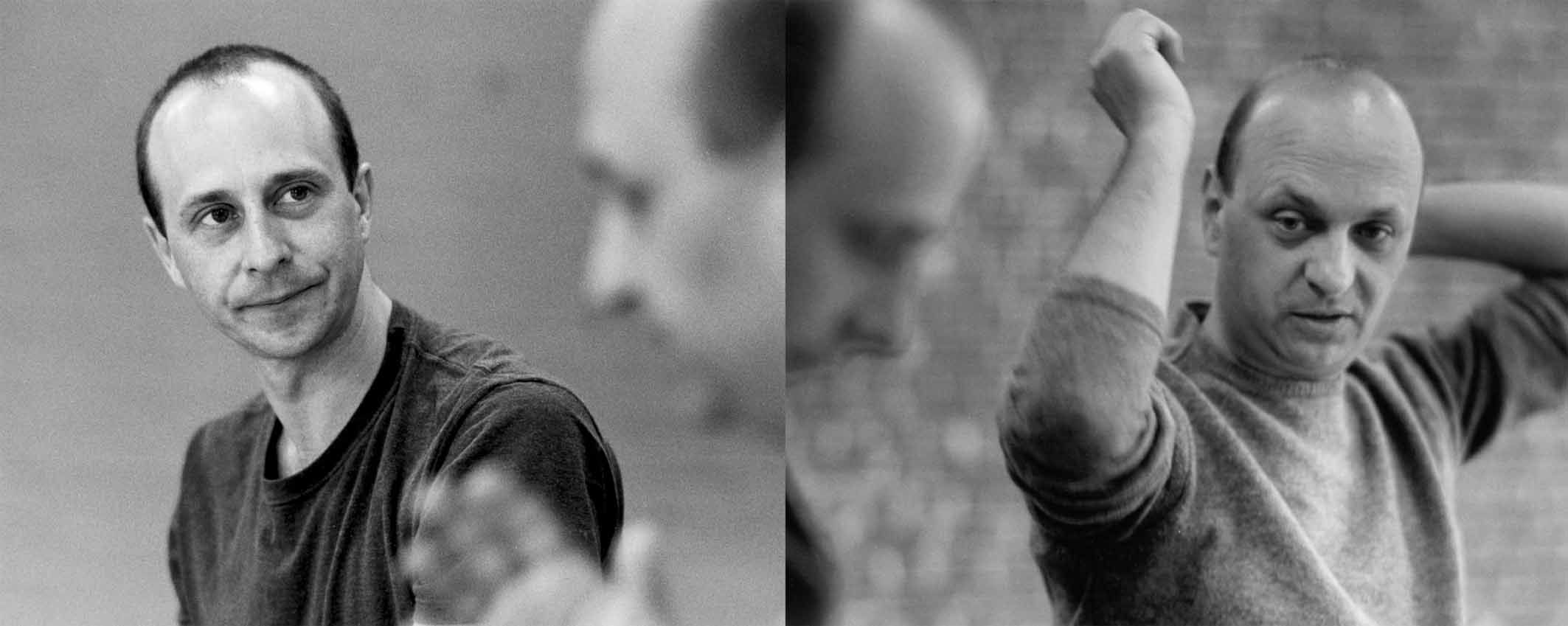
Jonathan Burrows/Matteo Fargion / The Kitchen, NYC / March 11-13, 2004
Is less more? Answer: Yes, when we’re talking about Jonathan Burrows and Matteo Fargion’s Both Sitting Duet. Performing the 45-minute piece they invented, the two guys sit on battered regulation-issue wooden chairs smack in the middle of a bare, black-box stage space. The chairs are congenially angled toward each other, as if set up for conversation. The men, who have a certain physical resemblance, are early middle-agers with compact bodies and keen, worn faces. Their costume—no-nonsense jeans, nondescript shirts and shoes—is the epitome of ordinary. You’d pass them on any urban street without a second look.
Each man has, at his feet, a notebook scrawled with words and symbols that he eyeballs regularly, as a musician does his score. Fargion is a musician; Burrows, a ballet-trained dancer and choreographer. Shortly after they’ve launched into their 45-minute tour de force of arm and hand jive, you can tell from their movement—even though they’re executing the same gestures in unison, in canon, or as rapid-fire Q & A—who comes from which art. Burrows’s execution is the more sharply focused, projected toward a presumed spectator. Fargion’s, with its softer edge, seems inner-directed, has a slightly more subtle rhythm. Burrows powers his arms from his gut, while Fargion operates mainly from the shoulder, his midsection lax.
Here’s what they do: shake their hands wildly in front of their chests, so their fingers look like sparklers; use one hand to count the fingers of the other with a child’s deliberation, as if the answer might be in doubt; stroke their palms along their trousered thighs; palpate the floor with their fingertips; curl their fingers into vivid mudras that yield no explicit meaning; extend their arms in semaphore signals or (Burrows alone, while Fargion softly claps out a tempo) classical ports de bras.
A couple of times they stand up for a few seconds, even go so far as to turn in place, repeating a raucous cry; once they shift the position of their chairs so that one lies in the other’s shadow. Such departures from what they’ve set up as the parameters of the piece have the impact of high drama—violent and haunting.
Most of the time they remain seated, their movement largely confined to their arms and hands, torso and head just going along for the ride. They make a lot of eye contact, though, and run through a gamut of facial expressions that suggest a ping-pong exchange of ideas and a brotherly relationship that’s both challenging and complicit.
Will you believe me if I tell you this wasn’t tedious? Far from it. Just the opposite. The more things remained, so to speak, the same—one man’s move copied by the other, a single gesture repeated again and again by both—the more fascinating the whole business became. The secret—an open one, to be sure—lies foremost in the small, canny variations in rhythm with which the performers inflect each unit of basic material. Example: Delivering a rapid three-gesture phrase for one hand, the pair begins by working in unison, then lets its individual articulations go slightly out of synch in a loop that keeps returning to the original unison and departing from it again. It’s like the hypnotic action of windshield wipers with a slight glitch in their mechanism.
Another part of the secret: The repertory of moves is adeptly structured, alternating between the small and the large, the fierce and the delicate, the agitated and the serene, the sounded (slaps, claps, pats, occasional stomps or monosyllabic cries) and the silent. In the silence—the piece has no conventional musical accompaniment, and the audience was rapt—the very scratching of a reporter’s pen on her notepad seems an intrusion.
And then, rewarding one’s alertness, there’s the message (you might even call it the moral) of the piece: A close focus on replication paradoxically allows differences to emerge, minute states of otherness growing immense in scale or suggestive power.
Here’s what Both Sitting Duet made me think of: Pairs of Parisian intellectuals, sitting in cafes, exchanging abstruse ideas for the fun of it. My uncles hunched over a card table, playing infinite games of pinochle at my grandmother’s house, every Sunday afternoon of my childhood. Deft practitioners of American Sign. Obsessive-compulsives. Language teachers demonstrating the gestures that accompany voluble Italian. Merce Cunningham.
Photo credit: Herman Sorgeloos: Jonathan Burrows (left) and Matteo Fargion in their Both Sitting Duet
© 2004 Tobi Tobias