


New York City Ballet / New York State Theater, Lincoln Center, NYC / January 6 – February 29, 2004
George Balanchine (Mr. Neoclassicism) did time on Broadway and in Hollywood and—always one to rise cheerfully and inventively to the particular nature of an occasion—produced some fetching work for the popular theater. As a souvenir of those ventures, the New York City Ballet’s Balanchine 100 Centennial Celebration offered the Slaughter On Tenth Avenue ballet he made for On Your Toes. Jerome Robbins, NYCB’s No. 2 choreographer, may well have been in his most congenial element on Broadway. Think of his dances for West Side Story and The King and I; remember that On the Town grew from his evergreen ballet Fancy Free. So it’s not incongruous that the company should have invited Susan Stroman (Ms. Broadway) to create a program-length showpiece for NYCB to premiere on the day after Balanchine’s 100th birthday. Maybe there’s even a message (or an omen) here—“This is the first day of your second hundred years, George. Enjoy!”
 Peter Martins, the NYCB’s artistic director, frankly told an interviewer for the New York Times that he wanted the Stroman work because it will sell tickets. I’m baffled by this artistic policy. Is Double Feature, as Stroman’s two-part creation is called, a fund-raising device to support the company’s more balletically inclined work? Or is it supposed to lure its audience back to the New York State Theatre for an evening of Balanchine and Robbins, Martins and Wheeldon? Using an annual six-week run of The Nutcracker—for loot and luring purposes makes sense. The Stroman venture does not. The Nutcracker, in Balanchine’s unbeatable version, is a real ballet that happens to have achieved a crazy degree of popularity. The part of the audience that goes to see it because it has become a winter- solstice ritual gets to see a classical ballet and may be tempted see others. The logical equivalent of what the audience for Double Feature sees would be another flashy, overmiked Broadway show.
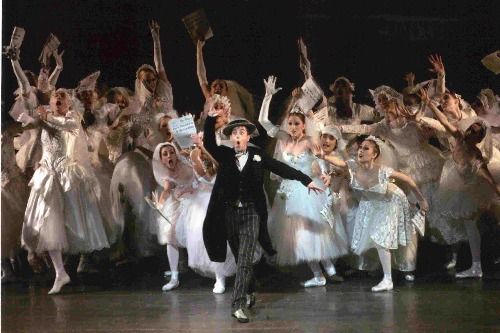
As its title indicates, Double Feature is a two-part deal inspired, if that’s the word, by silent films. “The Blue Necklace” is a melodrama—about a hoofer who abandons her illegitimate infant, becomes a movie star while the babe grows to nubility (much put upon by a nasty foster mom), and reclaims her daughter once the maiden is recognized through her genetically determined gift for dancing. “Makin’ Whoopee!” is a melocomedy based on the play that inspired the movie Seven Chances, starring Buster Keaton, who could elevate slapstick to a divine plane. The plot concerns a fellow too shy to propose to his sweetheart, who eventually gets his gal after severely farcical circumstances offer him dozens of brides at once, a horde of ravening white-skirted wilis, many of them played by gentlemen of the ballet en travesti. In the hands of another choreographer, the material co-opted for Double Feature might provide opportunities for charm and good fun. Stroman, however, is largely immune to such mild enticements and opts for dazzling cleverness that is all bright, tough surface, like the finish of an exceedingly expensive car.
Knock-your-eyes-out ensemble numbers, with their escalating energy, are what Stroman does best. Granted, her big ballroom scene looks embarrassingly vacant in a repertory where “ballroom” is defined by La Valse, Liebeslieder Walzer, and Emeralds. But the chorus line of femmes in sheer black tights that opens the show and the rushing flock of wannabe brides that closes it are duly effective. The way it’s set up, though, Double Feature depends on lots of intimate vignettes to tell its tales, and it’s here that Stroman reveals her lack of a large and subtle imagination. Either she dreams in clichés or thinks her audience does and cannily gives them what she believes they want. This is an example, in little, of the way American commerce works. Ballet, being esoteric, used to be somewhat immune to it.
Stroman uses the classical ballet vocabulary—and some of its sleekest executants—like a youngster fascinated with a fabulous new toy. Oddly, though she deploys them with a lavish hand, she can’t make the steps add up to dancing. Except in the rawest ways, they serve neither plot nor character; they’re not even interestingly connected. And of course dancers trained to the highest level of balletic achievement, steeped in a repertory requiring just that, lack the gustiness—the texture, the grasp of the lowdown—that makes the Broadway gypsy unique, indeed indispensable to popular theater.
The score for Double Feature is a medley of eternally engaging songs by Irving Berlin and Walter Donaldson that are barely recognizable shorn of their lyrics and souped-up by the “original” (I’ll say!) orchestrations of Doug Besterman and Danny Troob. On the other hand, the stylized sets by Robin Wagner and the costumes by William Ivey Long—fittingly in black, white, and sepia—prove to be the best part of the show.
The large cast, including children from the School of American Ballet and a trained dog, did their best under circumstances essentially unsuited to what they are—either by nature or nurture. The pervading enthusiasm made me think of Balanchine’s comment on a another occasion: “This was not high art, of course, but we tried to do it merrily and professionally.” In “The Blue Necklace,” Kyra Nichols danced the mean mom with great (albeit misplaced) emotional sincerity, as if she’d wandered into the Tudor repertory. Damian Woetzel, as the Guy of Her Dreams, transformed his crudely pyrotechnical solo, endowing it with grace, wit, and Astairean charm. In “Makin’ Whoopee!,” Tom Gold fell short of the sweet pathos required of the hero, but Alexandra Ansanelli was delectable as his intended, though given very little to dance. Albert Evans shone in a secondary role, being an ideal crossover dancer, every bone in his body theatrical.
Photo credit: Paul Kolnik: Tom Gold and company in “Makin’ Whoopee!” from Susan Stroman’s Double Feature
© 2004 Tobi Tobias