


New York City Ballet / New York State Theater, Lincoln Center, NYC / January 6 – February 29, 2004
Scotch Symphony and Donizetti Variations are thought of as Balanchine’s Bournonville-influenced ballets, the first because its situation borrows from the Danish master’s Romantic-era La Sylphide, the latter because its buoyant step combinations with their petite batterie recall Bournonville technique, which derives from French sources. (Balanchine operated most often in the Russian vein, from which he developed a unique American style.)
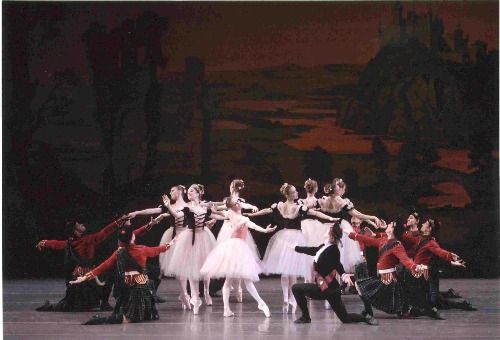 The 1952 Scotch Symphony, which has just entered the Balanchine 100 Centennial Celebration repertory, capitalizes on Highland local color—the valiant kilted men; the unobtainable female spirit haunting the foggy landscape; the portents of doom. With a modicum of effort you can match the figures in Balanchine’s semi-abstract gloss to those of Bournonville’s Sylphide, though you can never make the whole business come out quite even.
Each ballet has a hero who’s tempted by a sylphide–an ideal woman evoked, no doubt, by his imagination. Balanchine doesn’t bother to suggest reasons for his hero’s desire; his hero is only a cipher, a foil for the object of desire. Bournonville, on the other hand, suggests rich layers of motivation. Essentially, his James is a poet, aspiring to a joy found only in dreams and visions, fatally dissatisfied with the ordinary, which includes an appropriate fiancée.
Balanchine’s stalwarts in kilts, who form phalanxes to separate the Sylph from her suitor, match the lusty bagpipe-playing, reel-dancing fellows who, with their consorts, represent for Bournonville the community and its guarantee of life’s bourgeois blessings. Scotch Symphony’s Highland lass, traditionally a small, sturdily built woman with fleet feet and a bounding jump, who vanishes from the proceedings after her dazzling solo work, can be considered the equivalent of La Sylphide’s Effie, the really nice down-to-earth girl with whom a more sensible James would settle contentedly and raise a family.
Balanchine provides no equivalent of Madge, the witch who’s the lynchpin of Bournonville’s vivid narrative. Balanchine needs no witch because he needs no fatal curse. (He saves fatal curses for ballets like Divertimento from “Le Baiser de la Fée,” in which doom is not personified, but immanent in the very air his unfortunate lovers breathe.) In Scotch Symphony all’s well that ends well, and the male clan—paired with sweethearts whose airy costumes suggest they may themselves be tamed sylphs—obligingly forms an architectural frame for the wedding picture. Balanchine’s happy boy-gets-(no longer impalpable) girl ending—to a tale he has only implied—contrasts drastically with Bournonville’s tragic resolution. This is particularly interesting since Balanchine had a marked appetite for tragedy, Russian style, while all of Bournonville’s other extant ballets steadfastly take joy as their goal and realize it.
La Sylphide is top-drawer Bournonville and has earned a place in the repertory of ballet companies worldwide. Scotch Symphony claims to be nothing more than a pleasant diversion, but it, too, has endured. Why? First, its setting is recognizable, and attractive in its romance-of-legendary-Scotland way (think Sir Walter Scott). This ingratiates it with the part of the audience that may find ballets like Concerto Barocco and Agon repressively severe, complex, or unfathomable. Balanchine never forgot his obligation to entertain. Then it is—what Balanchine choreography is not?—deeply musical. And, while it may not pierce the mind or heart, it offers appealing images.
Some of these images borrow from the Scottish military tattoo and Highland dancing, with a group of equals arranged in grid formation, facing the audience straight on with fresh-faced frankness, torsos quiet, feet deftly drumming the floor. Others come from nineteenth-century Romantic ballet’s obsession with the ineffable and its prototypical heroine, a chaste temptress whose seductive wiles center on a tantalizing elusiveness: Come hither, but don’t touch me.
The current production delivers many of the images, but, as has become NYCB custom, without rubato and without their essential perfume. The corps de ballet is neat and lively, practicing exactitude adorned, in the women’s case, with empty smiles. As the tomboyish virtuosa, Carrie Lee Riggins is technically amazing. Period. Nilas Martins is embarrassingly miscast as the hero in terms of physique, presence, and sheer dance capability. Kyra Nichols, whose career is enjoying a luminous twilight, is surprisingly disappointing as the Sylphide. No longer wholly equal to the demands of the choreography, she’s chosen to rely on a style that’s too Taglioni-ish—etiolated to the point of spookiness. As a pair, Martins and Nichols are absurdly ill-matched. Anyone could have predicted that; what could management be thinking?
I had been looking forward to my favorite Scotch Symphony moment. Two of the kilts lift the Sylphide high—she seems to be standing on air—and toss her, still vertical, into her ardent suitor’s arms. “She sails forward as if the air were her natural home,” Walter Terry wrote in 1957, “and [her partner] catches her high on his chest as if she were without weight.” I recall the exquisitely gentle Diana Adams in that moment. For two unforgettable seconds, she seemed to be not falling but floating—softly, lazily, serenely, swept crosswise by an idle breeze. It didn’t happen last night. They didn’t even attempt it. I wonder if whoever is setting the ballet even knows that moment existed. Or cares.
Photo credit: Paul Kolnik: Kyra Nichols, Nilas Martins, and ensemble in George Balanchine’s Scotch Symphony
© 2004 Tobi Tobias