


New York City Ballet / New York State Theater, Lincoln Center, NYC / January 6 – February 29, 2004
The trap in talking about Balanchine’s A Midsummer Night’s Dream—with which the New York City Ballet has just opened the winter repertory season of its Balanchine 100 Centennial Celebration—is comparing it to Frederick Ashton’s The Dream. (Balanchine’s take on Shakespeare’s play and Mendelssohn’s music was created in 1962; Ashton’s, in 1964.) The discussion quickly becomes a contest of merits—and Ashton usually wins. His one-act ballet is not merely more succinct and cohesive, it also harbors more emotional resonance. But what if we considered the delights of the Balanchine—and they are many—on their own?
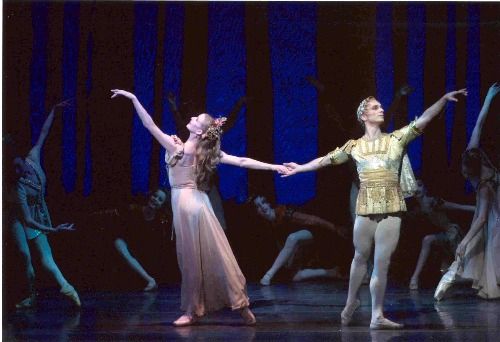 The atmosphere Balanchine invokes—of a fairyland that can absorb human incursions and is itself fully capable of folly—is big on charm. A happy choice for matinees or early summer evenings, the ballet embodies a sweetness and light that never cloys. Think, for instance, of the child corps de ballet of insects and butterflies skimming through two acts more lithely and lightly than any of their seniors could manage, then reappearing at the close, airily wafting their arms, the tiny lights they’ve hastily fastened to their hands between one entrée and the next glimmering like stars against the soft descending darkness.
For pure dance highlights there is, first, the brilliant scherzo in which Oberon becomes a perpetuum mobile of fiendishly swift jumps and leaps. And then, as the climax of the second act’s celebration of connubial bliss, there’s the pas de deux performed by dancers who arrive anonymously, having had no role in the ballet’s narrative. They’ve come to make manifest what all couples aspire to, whether they be of the fairy kind, of the earthly aristocracy, or just plain bumbling folks committed to their passion. Traditionally performed by mature stars, this sublime duet seems to be proof that ideal love—the perfect accord of two quite different beings—exists, if only on an abstract plane.
Balanchine didn’t hold much with mime, yet when it was required he could produce it effectively. The trick, as he demonstrates in Midsummer, lies in the timing. Titania and Oberon’s argument over the ownership of the changeling child and the courting mishaps of the quartet of human lovers owe their vividness and vitality to the fact that Balanchine, consummate musician that he was, knew how clocks tick and hearts beat.
As for the delineation of characters, the exquisite Titania’s willfulness owes much to Shakespeare, but the endearing pathos of Bottom turned ass, more tempted by a handful of succulent grass than by the joys of romantic or erotic love, is Balanchine’s creation. Balanchine was, of course, inspired to a degree by the dancers on whom he chose to create the ballet’s roles. The feral quality that Arthur Mitchell brought to Puck, for instance, preventing the virtuoso feats of the role from looking coarse, has never been replicated. In any story ballet, much of the characters’ character is dependent on the dancer playing the role at a given moment, and that’s one aspect of Midsummer that’s at stake today.
The opening night performance was exuberant (almost to a fault) and at least intermittently magical. Three roles were magnificently done. The veteran Peter Boal created an Oberon who was a golden king—in deportment as well as costume. Though the role is usually assigned to an airy high-flyer, Boal—all grave nobility in his mime, all clear, weighty shape in his dancing—was a ruler of fairyland whose prime quality was gravitas. As always, Boal projected the seriousness, purity, and modesty that seem to be part of his own character.
Dancing Puck, another veteran, Albert Evans, recaptured some of the creaturely quality that dominated Arthur Mitchell’s portrayal, fashioning it to fit his own style. The result was an engaging mix of nature spirit and show biz.
In the love-in-the-abstract duet, Miranda Weese, masterfully partnered by Jock Soto, offered an immaculate example of classical dancing at its most objective—cool, calm, flawlessly beautiful. Weese, now at the peak of her career, though sadly underused, might prove to be an apt successor to Kyra Nichols as the company’s custodian of pure style.
Darci Kistler, once a perfect Titania, served as a rueful reminder that no magic lasts. Her former dance power now depleted, she was forced to overemphasize the steps and phrases she can still bring off and to rely a little too heavily on her native sweetness. Her efforts are valiant, and not without effect. When they flagged, I comforted myself with memories.
In smaller (though not lesser) roles there were two stand-outs. James Fayette devised a Bottom who was equally unique, funny, and lovable as an unlettered human laborer given to amateur theatricals and a docile if occasionally stubborn ass bewildered by his transformation. In a higher social niche, Rachel Rutherford made a delicious Hermia, the girl who is too much loved.
Where would critics be without complaint? The fault I found in this Midsummer was that it was too punched up. The mime, brisk and sharp-edged, was several degrees too vehement and indeed the whole production suffered from a frenetic air. The School of American Ballet pupils in the children’s roles looked as if they were trying to jump out of their skin. Perhaps everyone will relax a little in subsequent performances and allow the choreography a more generous breathing space in which to exercise its spell.
Photo credit: Paul Kolnick: Darci Kistler and Peter Boal in George Balanchine’s A Midsummer Night’s Dream
© 2004 Tobi Tobias