


Rosas (Anne Teresa De Keersmaeker) / BAM Howard Gilman Opera House, NYC / November 12-17, 2003
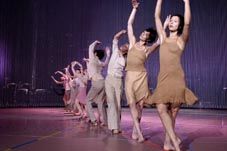 Anne Teresa De Keersmaeker’s Rain, performed by her Belgium-based company, Rosas, draws upon defining devices of early postmodern dance—the inventions and innovations of the late 1960s and the 1970s—and gives them a sleek, forceful theatricality. Indeed, it makes them fit for an opera house—the venue, laden with tradition, on which postmodernism originally turned its back in contempt. Such a development is both ironic and inevitable—the mainstream is a magnet for the work of its rudest antagonists—and De Keersmaeker’s piece is very handsome indeed.
The pictorial aspect alone is stunning. The setting, designed and lighted by Jan Versweyveld, is a circular amphitheater demarcated by a curtain of hanging cords. It might be a field of prowess or combat; a stage, like the Greeks’, for theatrical endeavor; or perhaps the planet Earth, surrounded by a nebulous cosmos. The lighting bathes the structure in a pale golden glow, a cross between the qualities of sun and moon. The scene darkens several times, in response to the course of events, but never looses its immanence.
The dancers’ simple, casual costumes—by the Belgian couturier Dries Van Noten—echo the neutral pallor at first. Unobtrusively, as the piece progresses and the energy of the dancing intensifies, their palette shifts to include livelier colors: bright raspberry, flame, and damped-down tangerine. It shifts again as the dance winds down, subtracting the brighter hues and substituting the sheen of ivory satin, the glitter of metallic thread, as if to indicate that the wearers have earned celestial status.
Seated in a ring behind the cord curtain, visible as through thin-bladed half-open window blinds, black-clad members of Ictus and Synergy Vocals perform Steve Reich’s Music for 18 Musicians, a hypnotic score typical of those used by pioneer postmodern choreographers, once they capitulated to using music at all.
Rain opens with movement that looks very natural—well, choreography-style natural—emphasizing running and loosely flung limbs. It builds gradually but inexorably, adding to its modern-ballet base gymnastic feats and inflections from foreign climes—capoeira and the like—all relying on elastic joints and quick reflexes. Buoyed by the mesmerizing music, the action goes on for seventy minutes without a break, accreting into one of those feats of sheer endurance that audiences love to greet (and did on opening night at BAM) with standing ovations.
The piece begins with a longish stretch of ensemble work in which all of the figures have equal importance. Eventually the group of ten dancers (three men, seven women) breaks down into smaller units—septets, trios, duets, even brief solo turns—woven with masterly skill into the picture of the whole population. Midway, a long passage suggests the community’s selecting one of its young women for a rite-of-spring-style sacrifice. Instead of building to fever pitch, though, the idea is deliberately allowed to blur. The victim is excused and allowed rejoin the clan, another is chosen, and then the whole matter is dropped, almost absent-mindedly, the myth seemingly depleted of its significance, given the current climate of the imagination.
Another, more specifically erotic motif succeeds the sacrificial-virgin idea. Men carry off women in Rape of the Sabines style, and images of intercourse–earlier brief, casual, and affectionate—mount to an extended explicit coupling of some violence that both participants appear to relish. (Is there a pc agenda at work here?) Still, the motif of the anonymous ensemble, activated but essentially purposeless, recurs frequently, often as a lineup of the full cast moving across the stage like a windshield wiper, clearing it of specific events and feelings. And yet, and yet . . . even in these essentially uninflected lines, you spy a couple arm in arm, because humanity can’t do without one-on-one bonding and can’t help telling stories (or at least, to the watcher, appearing to do so).
Watching is RAIN’s watchword. At intervals the dancers arrange themselves in a flat frieze and gaze directly at the audience. There’s nothing confrontational in this; it’s just an acknowledgement that they know you’re there—freighted, however, with the implication that, if you weren’t there watching, they and their doings wouldn’t exist. The audience might be God; the dancers, the world s/he created. The performers keep stopping for a nanosecond to look frankly and pointedly at one another, too, and seem pleased by what they see. Adam and Eve? Whenever the choreography focuses on the doings of just a few of the group, other members of the little tight-knit tribe gather on the sidelines to observe. The lookers-on are neither sympathetic nor cruelly impassive; they are simply there, bearing witness with enigmatic calm. (Oddly enough, there are similar happenings in Balanchine’s Serenade, but that is another story.)
About three-quarters of the way through De Keersmaeker’s venture, the dancers begin to emit wordless cries of exertion and excitement. These raw, guttural vocals lead to their escaping from their cage. They plunge recklessly through the cord curtain that contained them to invade the musicians’ space, then surge back into their own, as if the original boundaries agreed upon for performance had proved inadequate or artificial, limits crying out to be destroyed. As the dancers’ behavior grows more and more transgressive spatially, their dancing aspires increasingly to Dionysian intensity, until the music climaxes and halts. Stilled by silence, they animate the curtain that enclosed them with one final wave-like slash and vanish, perhaps en route to an alternative universe.
The message here would seem to be that, ultimately, the life force can’t be controlled, not even by whatever gods may be. De Keersmaeker, though, is clearly in control—she’s a deft calibrator—and it’s this evident calculation in the staging, this canny use of both traditional and postmodern theatrical devices, that makes Rain more a clever synthesis of latter-day dance theater explorations—a summary of and perhaps even a conclusion to them—than a blazing, gratifyingly discomfiting breakthrough.
Photo credit: Stephanie Berger: Anne Teresa De Keersmaeker’s Rain
© 2003 Tobi Tobias