 Benny Golson celebrates his 80th birthday today. At the same time, he releases a new CD with a band in the mold of the Jazztet that he and Art Farmer led beginning in 1960. The Jazztet’s success put Golson’s composing and arranging abilities into the consciousness of listeners who may have been unaware of his history. He played a key role in the revitalization of Art Blakey’s career. At 28, when he was seasoned but mainly known only in the jazz inner circle, Golson took over as music director of the drummer’s Jazz Messengers in 1958. The band had been generating excitement, but Golson persuaded Blakey that its lacked substance. Golson told me the story when I was writing notes for Art Blakey And The Jazz Messengers, Paris1958. Their relationship began with a telephone call.Â
“It was my hero,” Golson says. “Art Blakey was on the phone. One of his guys was having trouble getting a cabaret card from the police and he asked me to come In and sub for a night. ‘Oh, my God,’ I said to myself, ‘Art Blakey.’ He didn’t know it, but I would have played for free. And I went down and played, and I noticed that although the band had been together for a while, not much was happening; just tunes. But, on a personal level, he just laid me out. I’d never played with a drummer like that before.”Â
Blakey asked him back a second night and then for the weekend. By now, Golson though to inquire about money, and when he found out how little the band was making,

he took his leader aside for a little chat.
“I said, ‘Art, you’re a great man. This pay is nothing for you. It makes me sad.’ And he looked at me with his sad, beautiful cow eyes and said ‘Can you help me?’ And I can’t believe what came out of my mouth, this young upstart who hadn’t been in New York too long.
“I said, ‘Yes, if you’ll do exactly what I tell you.’Â
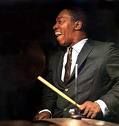
“How dared I?” Golson asks, laughing. “But he went for it. He said, ‘What should I do?’ And I said, ‘Get a new band.'”Â
He agreed, gave the men notice and on Golson’s recommendation hired a new set of Jazz Messengers, all from Benny’s home town. On trumpet was Lee Morgan, barely 20 years old, a fellow alumnus of the Gillespie big band. Morgan had sat in with the drummer in Philadelphia as a prodigy of 15, and the previous year had recorded two pieces with an expanded version of the Messengers. The pianist was 26-year-old Bobby Timmons, and on bass was Jymie Merritt, at 31 three years older than Golson and like him a veteran of the Bull Moose Jackson rhythm and bues band of the early 1950s.Â
“What’s all this Philadelphia stuff?’ Blakey said. I told him ‘Trust me.'”Â
The edition of the Messengers that Golson remade was a landmark group in the evolution of what came to be known as hard bop, in great part because of Golson’s stewardship and the compositions and arrangements he contributed. It was also the point of departure for change in Golson’s playing. He told me that before his Blakey experience, his improvisation was “smooth and syrupy.” Others have called it stiff. Blakey did not abide stiffness in his band. He used his press roll on sluggish soloists the way a Marine Corps drill instructor I knew intimately used his rifle butt on the rear ends of recalcitrant officer trainees. By the time he moved on after more than a year with Blakey, Golson was a considerably tougher tenor player.Â

Â