an blog | AJBlog Central | Contact me | Advertise

Dreams For A Bigger Hirshhorn: The Response Was Mostly Con

The reaction to my Cultural Conversation with Richard Kohalek, published two weeks ago in The Wall Street Journal, proved fascinating, not unexpectedly. While few people wrote comments for publication – only two at the WSJ site and none at my post here — several contacted me privately.
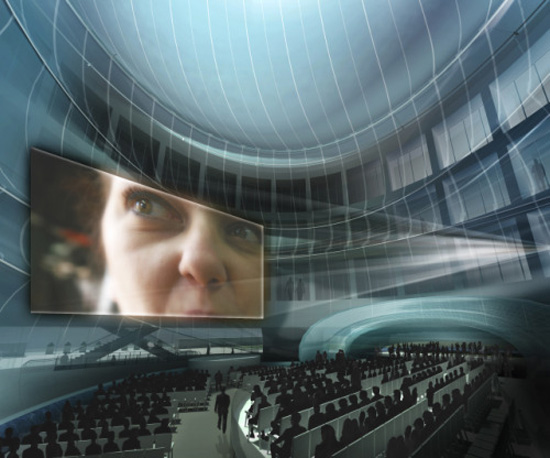
Thumbnail image for hirshhorn06.jpgThe article outlined Koshalek’s plans to erect a seasonal bubble at the Hirshhorn Museum, which would serve as an event space, where the museum would convene forums on topics of interest to the arts and of relevance to national and world affairs.

Among those approving, one man wrote:

Your piece on Richard Koshalek captures a man of imagination, experience, and excitement. Let us hope it is encouragement for others in the space and indeed for all of us.

But there were far more negative comments. One man wrote from Menlo Park:

My guess is that the people that Koshalek is roping into this kindergarten prank don’t know anything about art and maybe he doesn’t either. Art saving the world? If it hasn’t done it yet then it never will and it wasn’t meant to. It is meant to give our personal lives meaning. This guy needs to be ridiculed not reported on.

When I asked if he would post his comment on either the WSJ site or here, I never heard back from him.

Likewise, another man wrote:

What a bs artist. “Look at me, look at me” is his message. I thought he was running a museum. Where is the adult supervision?
These comments, and most of the other feedback I’ve received, hinge on the definition of an art museum. One prominent art-world official, who spoke to me privately, had looked up the Hirshhorn’s mission statement. So had I, before I wrote both pieces. It states:
 
The Smithsonian’s Hirshhorn Museum and Sculpture Garden is a leading voice for contemporary art and culture and provides a national platform for the art and artists of our time.  We seek to share the transformative power of modern and contemporary art with audiences at all levels of awareness and understanding by creating meaningful, personal experiences in which art, artists, audiences and ideas converge. We enhance public understanding and appreciation of contemporary art through acquisition, exhibitions, education and public programs, conservation, and research.
Thus it does give Koshalek room to do this, and he told me that his trustees and the Smithsonian hierarchy are all behind him.
 
Still, there’s a nagging feeling among many that he shouldn’t do it, that the money would be ill-spent, and the effort lead to nothing tangible.
 
When I asked Koshalek about the impact he sought, he cited the deals that grew from contacts made at the World Economic Forum. We won’t know for years whether the Hirshhorn forums lead to such deals — and maybe never.
 
Photo Credit: Courtesy Diller Scofidio + Renfro

Comments

  1. Dirk Sutro says:

    Very interesting commentary.

  2. The critical remarks of the two who responded to your article in the Wall Street Journal and the two whose negative opinions you quote here suggest that the comments of at least a few of those who had something to say hinged not on the definition of an “art museum,” as you declare, but on the definition of “art.”
    Louis Torres, Co-Editor, Aristos (An Online Review of the Arts) and Co-Author, ‘What Art Is: The Esthetic Theory of Ayn Rand’ – http://www.aristos.org

  3. I’m a little surprised that no one has made much of the fact that Koshalek’s grand plans for the art center college of design in pasadena (which were equally grand in scale) resulted in his not amicable dismissal, but also that he had a successful run with his Isozaki-designed MOCA from the 80s. Readers would gain perspective by understanding the historical context of his architectural ambitions, both realized and unrealized, esp because the critiques of the Hirshorn project are basically the same as the Art Center – unwieldy architectural plans detracting from core mission as well as the uncomfortable and questionable benefit factor (do you really need a diller scofidio bubble to have a conference? do you need a frank gehry snake building for a library at art center in pasadena?) The Hirshorn is simply the next step in a trajectory that is more about building cool things than functionality or mission or art, frankly. Would it be a stretch to suggest that this late career director wants to “go out” on a good note after the Art Center debacle, so he’s bringing his grand scheme to DC?
    He’s definitely in the Museum Director mold of Tom Krens, who was also more about international/nation ideas driving a museum program, then a curatorial driven one. The Guggenheim didn’t need all of those branches, the Hirshorn doesn’t need this bubble. This is in contrast to museum directors who expand museums because of the need for more collection space, etc. to serve the mission. You mentioned today that the bubble could, technically, fit into the mission. After reading that broadly worded mission, though, it seems like anything could fit into it!
    A couple of other unanswered questions: why should art museum visitors have to buy into his extremely unarticulated Aspen/Davos-like vision of art and society? I don’t go to museums for that. I’ve got nothing against the uber wealthy Davos crowd with whom he mingles, but I don’t know if his relationships in those circles behoove museum visitors who visit the Hirshorn for the art.
    Honestly, I feel another Pasadena Art Center situation unfolding: curators/staff watch their declining resources frittered away on architectural drawings, fundraising events, and travel budgets and begin to resent him and his deputy Erica (who has been with him all of these years, and was equally resented in pasadena). Audience and board members begin to question the value of such a plan in our economic times. Slowly, the thing becomes an albatross, just like the Art Center, and you have a staff revolt or people start resigning, because they’d rather work at place where their work is supporting a curatorial vision or art-centered mission, not someone’s personally driven dream. (By they way, I don’t recall reading anything from the staff – have there been no interviews with them? I wonder if they have been warned about speaking with the press – there was a kind of nasty email to staff that was leaked earlier this year that Tyler Green posted.)
    Also, everyone is making a huge deal of the $1 million bloomberg gift. Ummm, that is like 1/15th of the capital costs. Where in heck is the rest coming from? and why does 1/15th qualify bloomberg for naming rights? sorry, but in fundraising terms it sounds like the hirshorn got owned.
    Finally, is this even a good looking project? Does the concept meld old and new in an interesting way? Or is it just plain awkward? I’d go with the latter, and I’m a DillerScofidio fan. This just feels like something they are doing to get on the National Mall…the envy of any architect.
    OK, I say all of this and now I mention that I actually really like Richard. I think he’s smart and funny and an innovative guy. My interactions with him have always been positive and he’s been an encouraging person to me. However, I also watched the Pasadena thing go down in flames from a distance, and thought it was unneccesary. He could have scaled things back, made some comprises, etc., but in the end, the grand architectural vision trumped student concerns, faculty fatigue, funding challenges, and frankly, reality.
    SO there’s my 2 cents. I love your blog and read it religiously. Keep up the good (and level-headed) work.
    (ps I’m also really interested in the post you made a few weeks ago about the level of public interest/awareness in the arts. You are on to something there, and I hope you will make more posts about that in the future.)

  4. Thanks for your comments. All valid. Let me respond to a couple of things:
    1) I didn’t mention Pasadena in my article for several reasons: 1, it was well-covered when RK got the Hirshhorn job; 2, he was there 9 years, so it’s not as if he were incompetent; 3, a museum is different from a college of design. 4, I had space constraints, and something had to go.
    2) Re: MOCA, I was around when Koshalek sold the Temporary to David Geffen for a mere $5 mn. and I have reminded him of that mistake. I hope he has not sold this temporary structure for too little, but I do also know that the Bloomberg name will last only as long as the gift’s tenure — not in perpetuity.
    3) Re: arts and the public, thanks – I agree. and in fact I think that subject is related to Koshalek’s vision.

  5. cecilia wong says:

    Has anyone noticed the word ‘learning’ popping up on museum websites in the last few years? From MoMA in New York to MOCA in Los Angeles. The latest trend may have started with museums in the UK, from the British Museum to the National Portrait Gallery, since about 2006 – 2007. The Tate museum in London appointed its first director of learning earlier this year.
    Art is inseparable from culture. Contemporary artists especially make art about the human condition, from global warming to the atrocities of war and conflict. Artists are deeply affected by the economy, by public policy and they respond by making art. They engage any medium, from painting, sculpture to film, performance , even protest and political action, not to mention interactive media. The current Campaign Against Funding Cuts in the UK is a case in point. Over a hundred artists, from David Hockney to Damien Hirst, Anthony Caro to Howard Hodgkin have joined to make art pieces to protest proposed deep arts funding cuts by the Conservative government.This week’s piece by Cornelia Parker shows the gigantic Angel of the North sculpture by Antony Gormley with one wing clipped. http://www.bbc.co.uk/blogs/thereporters/paulinemclean/2010/10/a_pie_and_a_pint.html
    If museum is a place of learning, then idea exchange is a very natural step.
    Many curators and museum directors today no longer view themselves as sole purveyors of artifacts and art knowledge. They see themselves as professionals in visual literacy, and the museum as a place to make its contribution to the larger social debate. Truly opening up the collection and sharing it.
    I also believe this trend is a response to our current phenomenal advance in brain and cognition research, especially in the neurobiology of learning and memory. In fact, the whole history of 20C art, from abstraction to minimalism to conceptual art, I believe follows the artists’ intuitive attempt to push art from the ‘primitive,’ non-conscious part of the brain towards the higher cognitive areas.

  6. I have to say that if you like it or not, great to see emotion and action on the part of enthusiastic art lovers. Perhaps if we fought more for the arts themselves in schools rather than debate about these sorts of things, there would be more of it for us to appreciate..

Speak Your Mind

*

an ArtsJournal blog