
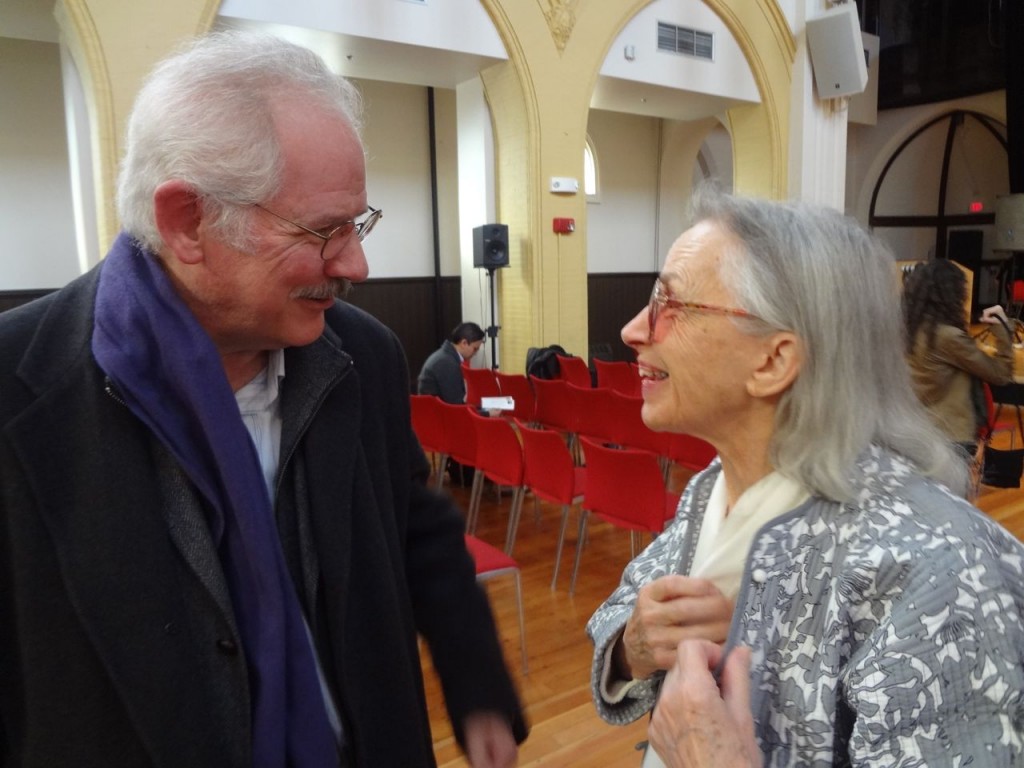
My old friend Tony DeRitis, composer and chair of music at Northeastern University, took the above nice photo of me and Carolyn Brown at that school’s Earle Brown symposium over the weekend. Long-time Merce Cunningham dancer and Earle’s first wife, Carolyn was making some meltingly gratifying comments about my 4’33” book. The previous day she had publicly presented a touchingly personal story of her life with Earle: he had fallen in love with her at age 12 (she was 11) in Lunenberg, Mass., where she was his best friend’s sister. Carolyn’s parents practically adopted Earle, took him along on vacations, and in his late years Earle said that if it hadn’t been for Carolyn’s mother (herself a dance teacher), he would never have become a composer. So we got his bio from 1939 on, from an eye witness. Never heard another composer’s life story anything like it.
And the story that emerged of Earle Brown’s music was equally fascinating. The second wife, Susan Sollins-Brown (and it dazzled everyone having a conference about a dead composer with both his wives present), has set up an amazingly efficient archive of the complete works and sketches, and scholars are flocking to it. I will post my keynote address on the subject somewhere in the near future, but the short version is that Brown’s music is far more intricately structured than most of us knew about, and that the Schillinger-style thinking is evident everywhere. Unlike his friends Cage, Feldman, and Wolff, he’s very analyzable.
I do have to make one gripe about the musicology community in general, and perhaps it won’t fall on deaf ears. Scholars seem to get endlessly fascinated by the early, simple, seminal works of innovative composers, and dwell on them even when they’re not very interesting in themselves. In Earle Brown’s case it was the graphic score December 1952, which we heard way too many performances of and far too much about. Sure, it was an important breakthrough piece for Earle, but it was important because it eventually enabled him to write much better, more interesting works much later. Same thing goes, at other conferences, for Steve Reich’s It’s Gonna Rain, La Monte Young’s “Draw a straight line and follow it,” and Feldman’s early graph paper pieces. Those pieces aren’t fantastic because they’re fantastic, they’re interesting because those composers went on to do infinitely more beautiful things later, and to study those ad infinitum at the expense of the great later pieces is a recipe for dullness. Perhaps I am similarly guilty in having written a book on 4’33”, but that’s what I was asked to write about, and you’ll never find me saying it’s one of my favorite Cage pieces (much rather listen to the String Quartet in Four Parts, In a Landscape, Hymnkus, Sonatas and Interludes, Europeras, 74).
So it got so I had to walk out whenever December 1952 was trotted out again (even Earle resented the overemphasis on it during his lifetime). But as compensation we heard sparkling performances by the Callithumpian Consort of Available Forms I and Sign Sounds, two middle-period pieces I’d never heard, and wonderful, sketch-oriented analyses of Cross Sections and Color Fields by Frederick Gifford and of the Calder Piece by Elizabeth Hoover. I’ll be glad to hear Brown’s pre-1961 music again someday when performances of his exhilarating mature music have become so common that a little perspective would be nice.