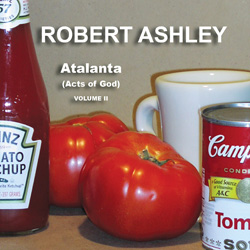
This unparaphraseable self-dialogue from Atalanta illustrates something of what I love so much about Robert Ashley's music:I said, "Is the struggle with the law manifested in every aspect of the making of music, or are there law-abiding aspects and others that are confrontational only because of indiscretion on the musician's part - because of a transgression?"He said to me, "Music is the enactment of the manifestation of the struggle with the law on a scale of continuous attempts; that is, where the attempts are related to each other … [Read more...]
Offended by Expertise
In an interview on Slate, Wikipedia cofounder Larry Sanger (who left the organization) confirms the very reasons I quit having anything to do with the web site: Q. Why did you feel so strongly about involving experts? A. Because of the complete disregard for expert opinion among a group of amateurs working on a subject, and in particular because of their tendency to openly express contempt for experts. There was this attitude that experts should be disqualified [from participating] by the very fact that they had published on the … [Read more...]
Center of the Universe
We live eight miles from where Chelsea Clinton is getting married this weekend. I walked into my local copy shop, and Jerry asked, "Have you gotten your invitation to the big wedding yet?" I said, "Mine must have gotten stuck in the mail, it hasn't arrived." Jerry said, "Yeah, it's probably sitting next to mine." No boats are allowed to sail in this stretch of the Hudson for the weekend. The biplanes at the Aerodrome, a popular local attraction, are grounded for the duration. The fairgrounds have been emptied out, because that's where the … [Read more...]
Ashley in the Rear-View Mirror
Robert Ashley's 1983 opera Atalanta is actually three operas: one about the painter Max Ernst (uncle of Bob's wife), one about the jazz pianist Bud Powell, and one about Bob's uncle Willard Reynolds, the family story-teller and, as Bob calls him, shaman. Any given performance is made up of one act about each hero, and the acts are interchangeable, so one performance will contain one set of stories and the next night a different set of stories. As Bob writes in his "Future of Music" lecture, At the opera I am transported to a place and … [Read more...]
Scholarship After Google
In the penultimate scene of Robert Ashley's Improvement: Don Leaves Linda, Linda keeps singing about "Twenty-eight million, two hundred and seventy-eight thousand, four hundred and sixty-six people...." That's 28,278,466. So I Google the number. I pull up a hundred random sites, invoice numbers, auction IDs, and so on. And there on page three I see the name: "Blue" Gene Tyranny. And "Blue" Gene has written an article in which he mentions Ashley's early ONCE festival piece Public Opinion Descends Upon the Demonstrators, in which sounds from the … [Read more...]
The Serious 1950s String Quartet
A dutiful part of my research on Ashley has involved listening to music by his composition teachers, Ross Lee Finney, Leslie Bassett, and Wallingford Riegger. For the most part, it is well-crafted, relentlessly earnest, dour, unpersonable music, much of it for string quartet or quintet. I was glad to get that part over with. And then I run into Ashley's own characterization, in an unpublished but wonderful lecture he gave at UCSD in 2000: ...I like dance music. I like America. I like our innocent people. I am one of them. But I have … [Read more...]
Now That’s Musicology
Here's an author's query for you. One of Robert Ashley's biggest influences in college was a piano teacher named Mary S. Fishburne. She was listed, with an M. Mus., as Assistant Professor of Music in the Univ. of Michigan catalogue from 1949 to 1956, at which point she vanishes from history. I can't find any details about her. If anyone (among my older readers, presumably) has heard of her and has any idea what happened to her, I'd love to hear about it.I spent much of last week in Ann Arbor researching Ashley's early life, doing a kind of … [Read more...]
When Worlds Collide
On an Overgrown Path has put up a flattering piece pairing me with Gustav Holst on account of our shared astrological concerns. Even nicer, this Sunday (our Independence Day on this side of the Pond) host Bob Shingleton is going to present a radio show comparing four of Holst's Planets with the same four of mine - and, in a gentlemanly touch, he is leveling the playing field by playing Holst's not in the usual technicolor large orchestra version, but in a rare two-piano version (that I'd love to hear). Holst strikes me as having been a nice … [Read more...]

Recent Comments
mclaren on Ives, Caught Between Two Caricatures
Once again we get a high-octane musician slamming a composer for producing "naïve" work. And what, I ask you, is...Bob Gilmore on Ives, Caught Between Two Caricatures
Agreed. I love Ives 1, terrific piece. But I'd have to say my favourite of all the symphonies is the...M. on Ives, Caught Between Two Caricatures
Mr. Plush has already written, in his first sentence, what I would have liked to. Consider it seconded.Bill B on Ives, Caught Between Two Caricatures
You can hear it without going to it. The concert is streamed live over WQXR, as are all of...Vincent Plush on Ives, Caught Between Two Caricatures
Kyle, you have just reminded us (as if we needed reminding) why we regard you as one of the most...Steven Ledbetter on Minimalism Invented in England, It Turns Out
Sullivan did, indeed, brilliantly solve the problem set him by Gilbert's lyric, but he didn't find it easy. In fact...Paul Schleuse on Minimalism Invented in England, It Turns Out
The additive process is clearly there, but the harmony isn't really static. The alternation between D and D maj7/sus4 is...Gene on Minimalism Invented in England, It Turns Out
"Das Rheingold" opens with six minutes of tonic, not dominant. KG replies: But after six minutes of E-flat the curtain opens...Juhani Nuorvala on Minimalism Invented in England, It Turns Out
The minimalist I'm most reminded of by that Gilbert and Sullivan piece is Tom Johnson. - For additive process, there's...Ian Stewart on Minimalism Invented in England, It Turns Out
For additive precedents there is also the the folk song "Green Grow the Rushes, O". I also believe that the big...