When school ended I had been asked for new pieces by three people, and I have now finished two and a half of them. This morning I put the final touches on a piece for viola and piano, Scene from a Marriage, for my Bard colleague, violist Marka Gustavsson. I also completed, this afternoon, a tentative first draft for a 25-minute string quartet in one movement, titled The Summer Land of Time, for a concert Carson Cooman is organizing at Harvard. And yesterday I reached the halfway point in a new piano piece. It's 38 minutes of music since the … [Read more...]
Chance vs. Serialism Redux
In my recent post How to Care How It Was Made, I did not at all mean to invoke, as a couple of commenters suggest I did, the old canard about serial music and chance music being indistinguishable. Boulez, in his letters to Cage, absolutely rejected chance as a legitimate musical technique. I find it odd that, having said so so stridently, he was at that very time using pitch techniques that were theoretically just as groundless and arbitrary. This does not mean that I think Le Marteau sounds like chance music, nor that it sounds like Cage. The … [Read more...]
Please to Leave My Glass Alone
I just learned that the final movement of my Implausible Sketches for two pianos, "Don't Touch My Pint," received its world premiere in Belgrade on May 23, by students of pianist Nada Kolundzija. Other composers on the concert: Glass, Cowell, Cage, Reich, Ligeti, Pärt, Nyman, Dusan Bogdanovic, Marjan Mozetich, and Milos Raickovic. Nada had mentioned the possibility to me, but I had no idea it had happened. "Don't Touch My Pint" is based throughout on a 5-against-4 rhythm, which explains the title. Um... the, uh British [oops!] Irish mnemonic … [Read more...]
How to Care How It Was Made
I mentioned that I find myself working Sudoku puzzles lately. My other spare-time hobby, relentless nerd that I am, is analyzing the 12-tone pieces I'm using for my 12-tone analysis class in the fall. The two activities - tone-row searching and Sudoku - are kind of alarmingly similar, so much so that I can forget at times which I'm doing. (Is that "aggregate" filled up yet? Am I looking for 12 of something, or 9 of something?) I do like understanding things, though, so that I get a real childlike kick out of teasing out the structure of a piece … [Read more...]
“Success Is Just Another Form of Failure”
Allow me to sharpen the source of some of the disillusionment I expressed in my last entry. Part of what I'm going through is the perceived failure of a project on which I've spent much of my life's energy. And yet it hasn't failed: it has been victorious - and now that it has succeeded, I can see how circumscribed that success necessarily is. As John Cage liked to say, "Success is just another form of failure." I have been called "the Downtown academic" - I am hardly the only one to merit the title, but for many years we were few and far … [Read more...]
Almost All Is Vanity
[TWO UPDATES BELOW] I don't submit many scholarly articles to journals anymore. I figured out I can put my research in some journal and only three people will ever read it, or I can post it here on my blog and hundreds will read it, and comment, and link to it. I'm certainly not going to hand the scores of my music over to some publisher so he can take half the royalties and tie up the copyrights. My music gets around much faster as PDF scores on my website, and with no appreciable loss of potential income on my end. Likewise, I've been … [Read more...]
Bounce to Disc
One more thing about composing, since these theme columns tend to come in threes. This is a guilty secret. When composing, I usually imagine more how the piece will sound on recording than in live performance. There is, as we classical types all too seldom recognize, a difference. I love listening to Feldman's For Samuel Beckett on disc; I can just melt into it. But I heard it live once (John Kennedy conducting at Lincoln Center), and I felt nearly suffocated, sonically claustrophobic. Ten minutes into it I had an impulse to flee the hall - but … [Read more...]
What “Composing the Music You Hear” Means
Since people seemed to like the subject of keeping the performer in mind while composing, it's been on my mind, in response to a couple of comments, to hopefully blow apart a notion I regard as superficial and misleading: that the composer "writes what he hears." Creative activity is virtually infinite in its forms, and I would never claim that no composer does this, but I think it must be fairly rare. Of course, in a sense I certainly do write the music I want to hear (my ability to relisten to my own CDs verges on narcissism), and I do … [Read more...]
Vicarious Pleasures of the Web
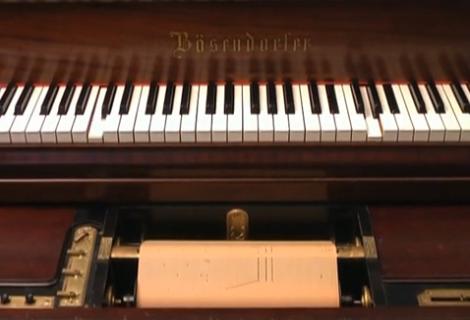
I've always said that the optimum way to experience Nancarrow's Player Piano Studies was "live" and close-up, being able to watch the piano roll go by. It's a roller-coaster experience: you can see the notes coming before they get there, anticipate their crash into audibility a split-second before it comes, and it adds to the excitement. Well, Nancarrow's piano technician Jürgen Hocker has put up You Tube videos of (almost) the complete Studies, including a couple outside the official canon (I say almost because I don't see No. 41 yet, but … [Read more...]
Placating the Postminimal Performer
One of the issues I deal with every day as a composer (every day I get to compose, that is), is the tension between what I want to hear and what's "grateful" for the performer to play. I suspect a lot of us are in this boat now. It started with minimalism. There are a lot of postminimal pieces I love listening to, and then I open the score and see page upon page of streaming 8th-notes without rests, or multiple tied whole-notes for wind players, or intricate permutational passages within small ranges, and think, "Boy, I love hearing it, but I'm … [Read more...]
The Composer’s Guide to History
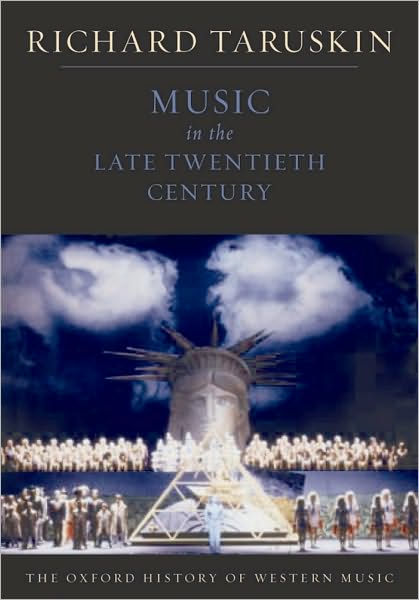
My summer hobby, as it turns out, pursued in-between writing a string quartet and finishing my Ashley book, will be relearning the history of music at the feet of Richard Taruskin. That is, from his five-volume Oxford History of Western Music. I should have bought it earlier, and I know what a brilliant writer he is, but I thought it would be full of things I already knew, perhaps kind of a super-Grout (and no former music student will need to be told that I am referring to Donald J. Grout's omni-required and stultifying A History of … [Read more...]

Recent Comments
mclaren on Ives, Caught Between Two Caricatures
Once again we get a high-octane musician slamming a composer for producing "naïve" work. And what, I ask you, is...Bob Gilmore on Ives, Caught Between Two Caricatures
Agreed. I love Ives 1, terrific piece. But I'd have to say my favourite of all the symphonies is the...M. on Ives, Caught Between Two Caricatures
Mr. Plush has already written, in his first sentence, what I would have liked to. Consider it seconded.Bill B on Ives, Caught Between Two Caricatures
You can hear it without going to it. The concert is streamed live over WQXR, as are all of...Vincent Plush on Ives, Caught Between Two Caricatures
Kyle, you have just reminded us (as if we needed reminding) why we regard you as one of the most...Steven Ledbetter on Minimalism Invented in England, It Turns Out
Sullivan did, indeed, brilliantly solve the problem set him by Gilbert's lyric, but he didn't find it easy. In fact...Paul Schleuse on Minimalism Invented in England, It Turns Out
The additive process is clearly there, but the harmony isn't really static. The alternation between D and D maj7/sus4 is...Gene on Minimalism Invented in England, It Turns Out
"Das Rheingold" opens with six minutes of tonic, not dominant. KG replies: But after six minutes of E-flat the curtain opens...Juhani Nuorvala on Minimalism Invented in England, It Turns Out
The minimalist I'm most reminded of by that Gilbert and Sullivan piece is Tom Johnson. - For additive process, there's...Ian Stewart on Minimalism Invented in England, It Turns Out
For additive precedents there is also the the folk song "Green Grow the Rushes, O". I also believe that the big...