
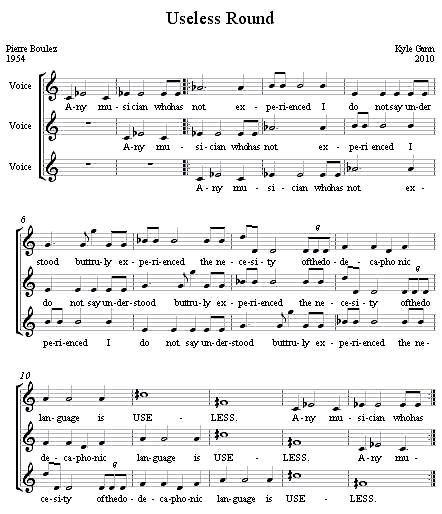
Four days into the summer, I’ve completed my first piece. Larry Polansky publishes an expanding book of rounds, and for years he’s been bugging me to write one, so I finally did. Dodecaphonically. [UPDATE: Larry's put a better copy on the web here, and you can also see a lot of the other rounds in his collection.] [MIDI piano version here.]
Lovely!
(And witty.)
But what will Boulez do with *his* share of the royalties???
KG replies: Thank you, I thought it was pretty clever, myself – I got the idea upon coming across a tone row in which every series of three consecutive notes created a triad (though one is diminished and one is augmented; I don’t think there’s one that works out all major and minor).
But You’ve made me realize – if I register this with ASCAP, Boulez really WILL have to get half the money! He can’t say I never did anything for him. (Thanks for the great belly laugh.)
When I was a student a friend of mine used to reduce us all to hysterical laughter by improvising, at the piano, settings of passages from “Boulez on Music Today” in the style of Gilbert and Sullivan, or occasionally Rogers and Hammerstein, and singing in falsetto. I wish to God I had recordings.
I don’t think there’s one that works out all major and minor
As I’m sure you figured out, the only way to try and construct this would be with interlocking major and minor triads, which won’t fill out the aggregate without repeating pitches (like C E G B D F# A C# E G# B D#/Eb Gb Bb D F).
This row is just like the one in Chromatic Canon.
KG replies: This row is [037]-generated like Tenney’s, but his – B D# G# G C E A# F# C# D A F – links the disjunct trichords with dissonances.
Do people actually sing “99 Bottles of Beer on the Wall” moving down a half-step each time?
KG replies: They might if it was 12-tone.