Erasing the Timeline

Thus spake Bob Ashley:  

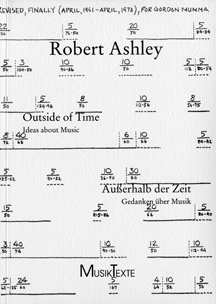
ashley-outside.jpg
We have recently - about fifty years ago - come upon a new idea in thinking about music, but I think it is not even approached in theory. This new idea does not use the timeline score.... 

By timeline music I mean music having any number of parts, a piano score or an orchestra score, that are coordinated by bar lines. This music must, by definition, be "linear."... 

Curiously, the most famous proponents - for Europeans and Asians as well as Americans - of a new kind of music among American composers, John Cage and Morton Feldman, could not escape from the timeline practice. They made wild (sometimes seemingly desperate) attempts to make a new kind of music, but their attempts were fundamentally still trapped in the timeline way of thinking. (I don't mean that their music was unsuccessful... I mean that to attribute to these two composers the kind of radical departure that one recognizes in Wolff or Brown, Behrman, Lucier, Amacher, Niblock, my own music and a few younger composers, is wrong.) 

For everybody else who appeared around 1960 and is still around - Babbitt, Wuorinen, Reynolds, and countless others - there is no question that they ignored the message and continued exploring the timeline. 

The first evidence of the non-timeline music came around 1960. (Typically, it was around earlier - especially in Wolff and Brown - but it really began to "flower" after 1960. It is hard to know whether Wolff or Brown realized what they were doing to the history of music. This is not to detract at all from their work - or their intelligence about their work - but, as I have maintained, the manifestation of an idea seems to happen before the idea is recognized and described....) 

Another "historical" fact to be recognized is that the reaction to the practice of non-timeline music, particularly in the form of "minimalism" and "postromanticism," came not more than ten years after a lot of composers started doing non-timeline music. In other words, non-timeline music was very important and, in the case of the reaction to it, something perhaps to be feared. As if some composers were leading us in the wrong direction and things had to be corrected. 

It's true, of course, that "time" passes while music is being played and while it is being listened to. But in non-timeline music (the drone) the time passing is not "attached to" the playing or the hearing. Time passes in the consciousness of the listener according to internal or external markers. 

The feeling of timelessness can be created in a traditional timeline score using an extreme version of the timeline technique. That is, by pushing the timeline technique to an extreme of what can be written in a timeline score, I remember this, without being able to cite examples, from certain Earle Brown scores. The one example I can cite is Somei Satoh's Kyokoku. In this score for voice and orchestra Satoh uses a very slow tempo (twenty beats per minute) and allows that in certain sustained sections the conductor can slow the tempo even more, or can stop the tempo entirely. In these sections the feeling of timelessness is evoked.... 

Non-timeline makes no attempt to keep the attention of the listener. It exists as if apart from the attention of the listener. The listener is free to come and go. When the listener attends to the music, there is only the "sound." The sound is everything. When the listener is away, the music exists anyway. This is certainly a new idea.... 

I have called this new idea the "drone," because there is no better term that is not a neologism - like non-timeline music. I have said that I use the term "drone" to mean any music that seems not to change over time. Or music that changes so slowly that the changes are almost imperceptible. Many composers make this kind of music. The best known to me, offhand, are Behrman, Lucier, Radigue, Tone, Payne, Bischoff, Hamilton, along with others. 

Or music that has so many repetitions of the same melodic-harmonic pattern that the pattern is clearly secondary to another aspect of the form. Philip Glass's early music is a good example. (Glass recently has more and more reverted to the timeline style.) 

The non-timeline concept has permeated my music, though because of my deep involvement with speech rhythms and opera, I have not composed much music that is pure non-tineline. My early music - prior to 1980 - is much more clearly exploring the non-timeline concept. After 1980, when opera became the most important fact of my work, I began using certain aspects of the traditional score to coordinate many performers' actions (musical events) at any moment in the linear time pattern. I am still trying to escape from that constraint, but so far unsuccessfully.... 

What is in the nature of non-timeline music in the operas is the technique of allowing the harmony to continue for so long in a particular aria that harmony loses its traditional meaning.... 

The purpose is to create an intense self-consciousness in the listener, a kind of "meditative" state of mind. Of course, as in meditation, as I understand it, the attention in the listener will change constantly and is the responsibility of the listener. The composition exists "apart from" the listener, a musical fact to be observed and appreciated at the will of the listener.... 

In a simplistic explanation of "non-timeline" music the composer's purpose is dedicated to the sound of the work. The sound is everything. The sound has no temporal dimensions. It exists apart from the listener's participation. In non-timeline music nothing happens. The sound is simply there. [Variations on the "Drone," 2004; pp. 114-124] 

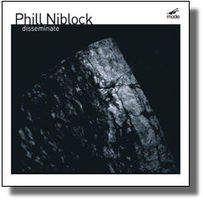
And again, from Ashley's liner notes to Phill Niblock's Disseminate CD (Mode 131): 

Thumbnail image for 131niblock.jpg
The "drone" is one of the special contributions to musical technique in the second half of the 20th century. I use the term "drone" - though most composers who will be named below will resent the term - because I can't invent another term or phrase that is not just musical jargon and that is not more understandable. 

The drone has two pronounced characteristics. The first and most obvious is an unchanging, or barely changing, pitch. This characteristic, notably, is also the rarest among various composers' "signatures." Most composers moved away from the unchanging pitch technique almost as soon as they got involved with the drone.... 

Fundamentally the drone disregards pitch change. And so the musical time seems to stop. This lack of eventfulness is a challenge to the listener that the composer of any form of drone music must live with (and/or "solve" by some other technique).... 

A second characteristic of the drone, but I think part of the same tendency, is a quality of unchanging tonal "color"; that is, an unchanging instrumental sound, regardless of what other elements of musical composition are employed. One could name any number (a large number) of composers who work in this area. These composers have abandoned the "narrative" or "dramatic" notion of the orchestra as a collection of "characters"....

The drone seems peculiarly American. The reasons are probably many. 

No American ensemble would play any living composer's music in the 1950s, and so any new technique that deviated from the performer's conservatory training was discouraged. One could call that situation a form of poverty (for the composer) and a deciding factor in the invention of a new technique. But, of course, historically poverty has produced a lot of changes in music. 

Another reason, I believe, was the American composer's unusual interest in the music of other cultures, particularly (because they were available on records) the various musics of Southeast Asia, the various musics of Africa and the various musics of the marginal black and marginal white isolated cultures in the United States. And all of these musics seemed to have fewer "changes" and a simpler "architecture" than the music we had inherited from the concert stages of Europe. 

But most important, I think, was the advent of electronic music. Prior to the use of electricity the energy source for music was physical (human) and the limitations on that energy source had to be accommodated in the music. The music had to rest, had to be softer for awhile, had occasionally to be texturally less dense. With a new source of energy coming from the local utility company all of that changed. Conceptually, the music could go on at any level of intensity forever.... 

I hope that by excerpting from much longer articles I haven't created a false impression of any of Bob's ideas. Those inclined to criticize might want to consult the complete originals before so doing. We have a paucity of narratives for what's happened in music in the last 60 years, and this one, from one of the era's major players, is particularly valuable. I've written my own narrative, of course, which Bob's conflicts with at several points. Of particular interest is that, having come from the revolutionary, score-rejecting ONCE festival scene of the '60s, he lumps much minimalist music into the conservative reaction against that scene. Coming along myself in the '70s, I think of the '60s, '70s, and early '80s as the great liberal era in music's history, whereas for Bob the '70s were already a turning back towards comforting convention. Not having been there, I can only honor his perspective.

Of particular importance is his concept of the drone, which does indeed draw a sharp line through the group of composers lumped into the generic term minimalism, separating traditional timeline composers like Andriessen and Adams off from the more radical composers like Niblock and Behrman (and Charlemagne Palestine? though Bob never mentions him) who compose unchanging (or slowly changing) sounds. This division is one the Society for Minimalist Music will want to confront at some point. I hope to bring this Ashleyan critique to bear in my contribution to our 2011 conference in Leuven. Whenever someone tells me that someone they know in academia is "sympathetic to minimalism," I always wonder: you mean simply that they've learned to re-accept diatonicism in timeline music? or have they realized that a piece of music need not contain any events? If only the first, I'm not impressed.

(Of course, my own music is less radical than the music Bob champions in these descriptions. After some early forays into Riley-like free repetition, I became rather addicted to the timeline. I've always been more interested in refining our perception of pitch and rhythm within a conventional format than in larger exploration of form and modes of listening. And yet I sometimes - I could cite my pieces Solitaire, Kierkegaard Walking, Implausible Sketches, Time Does Not Exist, Cosmic Boogie-Woogie - use the timeline to create what I think of as a drone-like effect, in which the continuing sound of a melodic complex changes internally but not externally, and the linear succession of sound complexes, if any, is almost arbitrary, as in the old joke "Time is God's way of keeping everything from happening all at once." Bob's categories are different from mine but compelling, and give me a lot of food for thought. I hope they do for you too.)


February 7, 2010 11:30 AM | | Comments (8) |

Categories:

8 Comments

Drone for Carole

1. A continuous activity is an environment
A foreground of actions is presented (fixed as present, given presence) in this setting
While it exists (continuing time, continuing space) it is inconceivable as non-existent

2. commercial radio
marriage
tonic (classical indian music)

11/4/70

Unless you have done this already, would you kindly blog more specifically about the differentiation between timeline and non-timeline music (especially as relating to the minimalist tradition)? I think I have a general understanding, but I am interested in your thoughts on the categorical split between these two ideas (with examples hopefully). The idea of non-timeline music (or drone as he calls it, I have seen the term non-teleological elsewhere) seems to me to be the most revolutionary in western musical thought: eliminating time as a compositional determinant. The ramifications of this thought are far-reaching, and it does not surprise me that many academics find this frightening and therefore ignore it. Thanks.

KG replies: Uh-oh, I was hoping *you'd* know. They're Ashley's terms, and the article's only been out a few weeks, and I'm not terribly clear on them myself. For instance, the terms drone and non-timeline music don't exactly strike me as co-extensive. (I used to hear the term non-teleological a lot in the late '70s, and considered it helpful, but I get the impression it's gone out of style.) In another place he seems to mostly equate non-timeline music with graphic and instruction scores. For instance, his early In memoriam pieces use graphs in which the performer can start at any point; each performer has to follow a strict discipline, but no two performances will be alike. I've put up a page from In memoriam: Crazy Horse (Symphony) here:

http://www.kylegann.com/CrazyHorse-page.pdf

Things happen, but no segment of the piece is functionally differentiated from any other. David Behrman has pieces with no score, just a circuit or piece of software that will react in certain ways when triggered by sounds from an instrumentalist. (I may not even be saying this right. My imbecility in electronics is one of my Achilles' heels in this area, which is why I don't write much about Lucier or Behrman or Mumma.) I assume that Dennis Johnson's November, which I've written a lot about, for instance here:

http://www.artsjournal.com/postclassic/2009/06/notating_dennis.html

is a classic example of both a drone piece and a non-timeline piece. Or Lucier's Vespers, in which the performers use echolocation to explore a space. On the other hand, I don't yet understand why timeline notation must be taken to extremes to create a drone piece. I assume that Ashley's piano piece Van Cao's Meditation (available with Lois Svard on a Lovely Music CD) is a perfect drone piece - extreme in its pitch limitations, unpredictable on any detailed level, yet rather conventionally notated on a continuous ten-line piano staff. Within minimalism, there's In C, which is unconventionally notated, with an elastic time element. Niblock's pieces, which virtually define drone music, are often notated only in frequencies, but could maybe be written out on a staff if anyone wanted to take the trouble. In other words, I have a hard time thinking there's a one-to-one correlation between the notational style and the listening experience, though some such correlation seems to be posited.

I can accept that Ashley, having lived through all this wealth of experience, has a firm idea of these distinctions. (Just as I have a pretty firm idea of the differences between postminimalism and totalism, though it's taking me years to document them to anyone else's satisfaction.) But it's not his job to write books about other people's music, and so he's given the musicologists an interesting nut to crack here.

I'm not sure about Andriessen but John Adams definitely has some pieces where the time-lines aren't locked -- his Shaker Loops, for example. In a few interviews he did mention that he worked in those types of "experimental" styles during the 60s and 70s but largely abandoned it since it wasn't getting what he wanted -- mainly, the idea of development and dramatic expressiveness.

If you're writing something with intricate counter-point you definitely need to specify a time-line because you can't really rely on chance producing that type of effect for you. If you look at masters in this area -- say, Bach, Bartok, Schoenberg, maybe even Carter, you'll probably see that they make every beat count, exhausting all possible harmonic combinations within the small amount of material they start off with. I mean, I guess you could take that stuff and layer them "freely" to try to produce new rhythms, but a good composer has already thought through all of the possible outcomes and chooses to ink the paper with the one they feel expresses what is needed in the shortest amount of time. A lot of it has to do with efficiency and making most use of the musician's and audience's efforts for being there.

On the other hand, I'm also fan of slow-moving music since I like ambient music and the type of sounds that the Cold Blue records have been putting out. Seems like this tends to work better as recordings or as background music toward other events since you can tune them out and focus your attention elsewhere as necessary. It gets a little awkward when you put it in the concert hall because the system is set up in such a way that you're forced to pay attention to what's happening up front -- if there isn't anything really happening, it sort of makes it hard to justify placing that level of demand on the listener.

I'd be sort of interested in hearing about Brian Eno's relationship to experimental notation -- I think the aesthetic of stasis in ambient music is kind of similar but he seems to have abandoned the score format entirely and instead turned to the recording to capture his ideas. The score/recording thing seems to be something that created a huge divide in the music world in various different places so I think it'd be a pretty interesting topic to talk about.

KG replies: In one passage I didn't quote, Ashley states that timeline music is intrinsically contrapuntal, implying that non-timeline music isn't. And you're right, Shaker Loops seems to be a kind of In C-like piece that he finally fully notated because he couldn't handle the chance/improvisatory element. I went through the same transition myself after a disaster with a 1981 piece called Sweeney Adrift that was the successor to Long Night.

I'm somewhat confused by Ashley's referring to minimalism on the one hand as being a reaction against non-timeline music, and then by his characterizing Philip Glass's early music as non-timeline in nature. I'm curious as to exactly what kind of minimalism Ashley is referring to here, and where exactly he sees Glass's music as moving from being non-timeline to timeline in nature.

On the subject of drone, any recommendations for particular noteworthy pieces? For whatever reason I've been slow to get into drone (as opposed to "conventional" minimalism). However on a whim I just downloaded and am right now listening to Charlemagne Palestine's "Schlingen Blängen", and am loving it. Recommendations for other worthy works similar in nature would be appreciated.

Regarding Ashley's comment on electronic music and drone: He mentions electronic music and then electricity. Strictly speaking these are two different things, given that electricity could be used as a source of sustained power for non-electronic instruments; indeed this is exactly what Charlemagne Palestine is doing with the pipe organ in "Schlingen Blängen". However I suspect that Palestine would have not had the idea of doing extended organ drones in a world where electronic music didn't exist and no one had yet had the experience of listening to pure sine tones of potentially infinite duration.

KG replies: Besides Charlemagne, the masters of drone music are Phill Niblock, David First, Ellen Fullman, Eliane Radigue, and, in a different way, Arnold Dreyblatt. Some of First's music is pop, but see if you can find his Good Book's Accurate Jail of Escape Dust Coordinates. Niblock's recent stuff is fantastic, as are Radigue's Adnos and Trilogie de la Mort.

Ashley does seem a little ambivalent about Glass. Aren't we all, a little?

"David Behrman has pieces with no score, just a circuit or piece of software that will react in certain ways when triggered by sounds from an instrumentalist. (I may not even be saying this right. My imbecility in electronics is one of my Achilles' heels in this area, which is why I don't write much about Lucier or Behrman or Mumma.)"

I think you're saying it accurately, in fact. I engineered Behrman's "Figure In A Clearing", which was a realtime recording with David Gibson playing cello into Behrman's Kim-1 computer and which is available on Lovely Music. There was, in fact, no score, just a list of 6 pitches for Gibson to play and to which the Kim responded. Gibson's part was essentially improvised, although there were a number of rehearsals beforehand so Behrman and Gibson could determine what kind of performance would be most effective with the Kim. So the piece was really a free improvisation between two players, Gibson and the computer.

Great stuff! The Ashley passage that jumped off the screen for me was “...in non-timeline music...the time passing is not "attached to" the playing or the hearing.” What an elegant way of saying that the composer or performer is not in control of the narrative. But I don’t think “drone” is a general enough term to suggest all of the ways in which that can happen, which include both sensory deprivation and sensory overload. The key is to depart from that middle ground of information-flow that all of our music traditionally inhabited. Both extremes of informational quantity and/or rate of change force the listener to make choices, including choices involving selective attention or, as Bob points out, inattention.

This was very interesting to me. The way I understand Ashley's take on timeline erasure, it has more to do with the ultimate effect upon listening to the music than it does with any structural or notational elements. In other words, a piece whose timeline has been erased could still have every single note composed and notated, from beginning to end. I appreciate this idea. My first experience with such music was Feldman's Piano and String Quartet piece. It was eye-opening.

I'm also interested, though, in pieces which approach the erasure of time from a more structural perspective, ie aleatoric/text/graphic scores. Pieces that specify events but leave the order of events open to the performer (so-called "mobile" pieces), or pieces that specify a macro structure but provide for great degrees of freedom within sections (as in some structured improvisations), works with electronics that respond to a performer's improvisation (as Richard mentioned), and works that are entirely interpretive, in every parameter, including duration (like some graphic scores).

I wonder if you could touch on these, or if Bob does in his book (which I haven't read yet but you've inspired me to buy it!)?

did you turn comments off for the newest posts?

KG replies: Yep. The people who used to leave the great comments don't seem to check in anymore, and life's too short.

Sites To See

Postclassic Radio! - Kyle Gann's internet radio station that accompanies the blog; see the playlist at kylegann.com

American Mavericks - the Minnesota Public radio program about American music (scripted by Kyle Gann with Tom Voegeli)

Kalvos & Damian's New Music Bazaar - a cornucopia of music, interviews, information by, with, and on hundreds of intriguing composers who are not the Usual Suspects

Iridian Radio - an intelligently mellow new-music station

New Music Box - the premiere site for keeping up with what American composers are doing and thinking

The Rest Is Noise - The fine blog of critic Alex Ross

William Duckworth's Cathedral - the first interactive web composition and home page of a great postminimalist composer

Mikel Rouse's Home Page - the greatest opera composer of my generation

Eve Beglarian's Home Page - great Downtown composer

Just Intonation Network - a meeting place for people interested in alternative tunings

Erling Wold's Web Site - a fine San Francisco composer of deceptively simple-seeming music, and a model web site

The Dane Rudhyar Archive - the complete site for the music, poetry, painting, and ideas of a greatly underrated composer who became America's greatest astrologer

Utopian Turtletop, John Shaw's thoughtful blog about new music and other issues

About this Entry

This page contains a single entry by PostClassic published on February 7, 2010 11:30 AM.

How to Read was the previous entry in this blog.

Internalizing Absurdity is the next entry in this blog.

Find recent content on the main index or look in the archives to find all content.

AJ Ads


AJ Blogs

AJBlogCentral | rss

culture
About Last Night
Terry Teachout on the arts in New York City
Artful Manager
Andrew Taylor on the business of arts & culture
blog riley
rock culture approximately
critical difference
Laura Collins-Hughes on arts, culture and coverage
Dewey21C
Richard Kessler on arts education
diacritical
Douglas McLennan's blog
Dog Days
Dalouge Smith advocates for the Arts
Flyover
Art from the American Outback
Life's a Pitch
For immediate release: the arts are marketable
Mind the Gap
No genre is the new genre
Performance Monkey
David Jays on theatre and dance
Plain English
Paul Levy measures the Angles
Real Clear Arts
Judith H. Dobrzynski on Culture
Rockwell Matters
John Rockwell on the arts
State of the Art
innovations and impediments in not-for-profit arts
Straight Up |
Jan Herman - arts, media & culture with 'tude

dance
Foot in Mouth
Apollinaire Scherr talks about dance
Seeing Things
Tobi Tobias on dance et al...

jazz
Jazz Beyond Jazz
Howard Mandel's freelance Urban Improvisation
ListenGood
Focus on New Orleans. Jazz and Other Sounds
Rifftides
Doug Ramsey on Jazz and other matters...

media
Out There
Jeff Weinstein's Cultural Mixology
Serious Popcorn
Martha Bayles on Film...

classical music
Creative Destruction
Fresh ideas on building arts communities
The Future of Classical Music?
Greg Sandow performs a book-in-progress
Overflow
Harvey Sachs on music, and various digressions
PianoMorphosis
Bruce Brubaker on all things Piano
PostClassic
Kyle Gann on music after the fact
Sandow
Greg Sandow on the future of Classical Music
Slipped Disc
Norman Lebrecht on Shifting Sound Worlds
The Unanswered Question
Joe Horowitz on music

publishing
book/daddy
Jerome Weeks on Books
Quick Study
Scott McLemee on books, ideas & trash-culture ephemera

theatre
Drama Queen
Wendy Rosenfield: covering drama, onstage and off
lies like truth
Chloe Veltman on how culture will save the world

visual
Aesthetic Grounds
Public Art, Public Space
Another Bouncing Ball
Regina Hackett takes her Art To Go
Artopia
John Perreault's art diary
CultureGrrl
Lee Rosenbaum's Cultural Commentary
Modern Art Notes
Tyler Green's modern & contemporary art blog
Creative Commons License
This weblog is licensed under a Creative Commons License.