
The Things You Can Steal from Students

As you may know, I love using Sibelius to generate wacky rhythms, but one of my students, Ben Raker, showed me some in a piece of his today (50 minutes long!) that I'd never tried. For some reason I've generally shied away from tuplets-within-tuplets, but Ben had come up (accidentally, he admitted, by punching the tuplet button twice instead of once) with a scheme for a quasi-irrational but actually elegantly geometric acceleration and ritard:
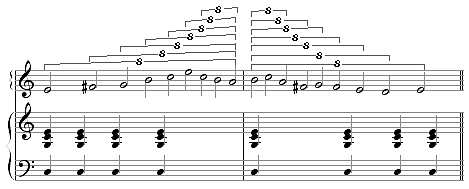
Nested1.jpg

Hear the result here.

I quickly realized you could get more gradual patterns with larger numbers:
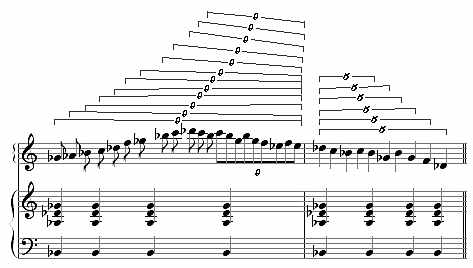
Nested2.jpg

Hear the result here.

- not to mention more complex quasi-irrational sequences:
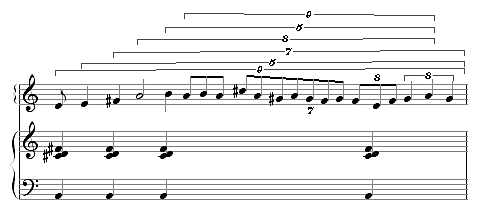
Nested3.jpg

Hear the result here. Looks like it's back to the Disklavier for me. Oh, Henry Cowell, had you only lived to hear this.


September 15, 2009 6:45 PM | | Comments (10) |

Categories:

10 Comments

It probably makes me some kind of super-dork for knowing this off the top of my head, but nested tuplets are in the Sibelius manual, and are the accepted method for accel/ritard when using feathered beams.

Ah, you've discovered that one. Taking it farther, have you noticed that you can approximate infinite series that approach a limit by changing the numbers in the tuplets?

For example 11 with 10 atop it then 9 atop it then 8 atop it, etc. This infinite continued series approached phi, 1.6180339. Now, one of the fun things you can do is to look up various continued fraction denominators and figure out that you can get different terminating values depending on the sequence of numbers -- you can approach asymptotically any value you want to with the right sequence of tuplets. 13 with 11 atop it with 9 atop that with 7 atop that, and so on down to 1, or 81 with 27 atop that with 9 atop that with 3 atop that, and so on. Unlimited opportunities for rhythmic exploration here.

Even more fun, but completely unnotatable: different types of broken tuplets in the same sequence. At this point we've not only broken completely with Western notation, we've shattered the entire concept of meter.

For example:

Suppose you have a sequence of durations like Q Q Q 5 5 Q Q 7 7 7 Q Q Q 9 9 Q Q 11 11 11. What meter is that in? (Q = a regular quarter note, 5 = a 5 in the time of 4 quarter note, 80% length, 7 = a 7 in the time of 6 quarter note (6/7 the length of a regular quarternote), 9 = 8 in the time of quarter (8/9 of the length of a regular quarternote), 11 = an 11 in the time of 10 quarter note (10/11 of the length of a regular quarter note).

Now suppose you overlay that rhythm with an entirely different set of durations made up different broken tuplets -- say, Q Q 3 3 Q Q Q 4 4 4 Q Q 6 6 Q Q Q and so on. (Where Q = a regular quarter note, 3 = a triplet quarter note, 4 = a 4 in the time of 3 quarter note, length 75% of a regular quarter note, 6 = a 6 in the time of 5 quarter note, 5/6 of the length of a regular quarternote.)

The result teases the ear with a non-cyclic but constantly repeating pattern aking to a Penrose tiling sequence, but in rhythm rather than visually.

The only drawback of such wholly unnotatable rhytms involves the fact that they must be entered by hand, as step sequences in MIDI using clock ticks (480 ticks per quarter note works well).

When you combine this with varying levels of accelerating acceleration and decelerating deceleration, lotsa fun. (To get an accelrating acceleration speed up the tempo linearly in a steady sequence of notes, then play it back from one MIDI sequencer into another one, then perform the same speedup on the second recorded MIDI sequence. This can be repeated to get third derivative accelerations, fourth derivatives, fifth derivatives, and so on.)

KG replies: The Q Q 3 3 Q Q 5 5 5 Q Q and so on idea was suggested by Cowell in New Musical Resources, and I used that one in my Folk Dance for Henry Cowell:

http://www.kylegann.com/FolkDanceforHC.pdf

It was easy in the old Encore program, I don't know a way to do it in Sibelius.

This might be a little dim of me, but wouldn't it be easier to either write everything with feathered beams, or put the irrational-y figure in a box with "accel" and "rit" arrows over the relevant portions? This certainly is the most clever way I've seen to actually get feathered beam effects to play back in MIDI, but if anyone put this score in front of me to play I'd claw my eyes out.

Just saying, it all sounds vaguely cadenza-like to me anyway, so why not notate it that way?

KG replies: The reason for not using accel. and rit. is so you can have a measured acceleration or deceleration against a steady beat, which was an idea that Cowell proposed and one that Nancarrow loved using. And by doing it this way, you can have more control over several accelerations or decelerations at once. It's not for live performance, but for MIDI playback. I hate it when performers claw their eyes out, gives me the creeps.

acc/rit against a steady beat is what Chopin is supposed to have used for his rubato playing, right?

KG replies: Allegedly, but not having a Disklavier, he couldn't have been able to get it mathematically precise. :^D

UPDATE: And on further reflection, what attracts me about the first two examples is that they *don't* sound free and cadenza-like. I can hear that the first and last notes are triplet halves (or the quintuplet quarter), I can hear the steady triplets in the middle, and the progression in the second one is too even to sound improvisatory. I love those examples because they sound like some strict process that I can't listen quickly enough to catch. Replacing them with performer freedom wouldn't do it for me. (The third I don't care for as is - something more interesting could be done there.)

Regarding feathered beams, with Sibelius 6, nested tuplets are no longer required for that.

However, in older versions Sibelius was wrong to encourage the use of them for accelerando beams because though the playback is "correct," it resulted in the notes being spaced closer together as they get faster -- which violates standard accepted engraving principles for feathered beams (in which the notes should be evenly spaced).

regarding your upated comment on my previous post -

"I love those examples because they sound like some strict process that I can't listen quickly enough to catch. Replacing them with performer freedom wouldn't do it for me."

Now that is a very interesting comment to me, a performer. I listened to your excerpts and it was precisely the way the relation between upper and lower staff was "executed" too strictly that made me think. I would guess that most performers would "make" the examples sound more fluent than they are written out. You would then have to make sure that they understood this was specifically not desired.

I'd be interested in knowing what your expriences are in this regard. This type of music might necessitate a performance practice that is not yet part of a tradition.

KG replies: Well, LOL as they say, I guess my experiences are spending four years analyzing all of Nancarrow's player piano studies, and then writing ten of my own.

Wow. I was put off notation software years ago because it didn't want to let me do anything fun. I generally don't write for human beings so I've avoided using notation software anyway, preferring instead other programs which can give you more direct control over your data.

Now you're telling me I wasted all those years punching in numbers and writing scripts in a MIDI editor when I could have just been drawing cool shapes in Sibelius?

KG replies: I'm telling you you've wasted all those years your way, when you could have been wasting them *my* way.

Here's a link to an interesting article written by Steve Vai on tuplets (the second half is more extreme): http://www.vai.com/LittleBlackDots/tempomental.html

P.S. 1. I don't know if this article would actually interest you (I'm a beginning composer), but I hope I'll be able to give something back to you as thanks for all the interesting things I've learned from your blog. Thanks for writing! Been listening to "Composure" lately, wonderful stuff!

2. English is not my native language, so excuse me if I sound weird.

Ciprian (from Romania)

KG replies: Thanks for the interesting article, Ciprian. Your English is better than that of many American musicians.

Fun post.

Oddly, the shareware I use, Harmony Assistant, allows for "folk dance style" tuplets but not nested ones.

That Folk Dance piece was terrific. I have played around the idea of splitting tuplets myself, (e.g. QQ 55555 QQ 555 QQ 55 where 5's are quint 8ths) but didn't really get off the drawing board.

And then there's always the ruler and punch -- thank you Mr. Nancarrow.

Leave a comment

Sites To See

Postclassic Radio! - Kyle Gann's internet radio station that accompanies the blog; see the playlist at kylegann.com

American Mavericks - the Minnesota Public radio program about American music (scripted by Kyle Gann with Tom Voegeli)

Kalvos & Damian's New Music Bazaar - a cornucopia of music, interviews, information by, with, and on hundreds of intriguing composers who are not the Usual Suspects

Iridian Radio - an intelligently mellow new-music station

New Music Box - the premiere site for keeping up with what American composers are doing and thinking

The Rest Is Noise - The fine blog of critic Alex Ross

William Duckworth's Cathedral - the first interactive web composition and home page of a great postminimalist composer

Mikel Rouse's Home Page - the greatest opera composer of my generation

Eve Beglarian's Home Page - great Downtown composer

Just Intonation Network - a meeting place for people interested in alternative tunings

Erling Wold's Web Site - a fine San Francisco composer of deceptively simple-seeming music, and a model web site

The Dane Rudhyar Archive - the complete site for the music, poetry, painting, and ideas of a greatly underrated composer who became America's greatest astrologer

Utopian Turtletop, John Shaw's thoughtful blog about new music and other issues

About this Entry

This page contains a single entry by PostClassic published on September 15, 2009 6:45 PM.

The Outside-One's-Ism Student was the previous entry in this blog.

A Slope of Rugrats is the next entry in this blog.

Find recent content on the main index or look in the archives to find all content.

AJ Ads

Introducing
AJ Arts Blog Ads

Now you can reach the most discerning arts blog readers on the internet. Target individual blogs or topics in the ArtsJournal ad network.

Advertise Here

AJ Blogs

AJBlogCentral | rss

culture
About Last Night
Terry Teachout on the arts in New York City
Artful Manager
Andrew Taylor on the business of arts & culture
blog riley
rock culture approximately
critical difference
Laura Collins-Hughes on arts, culture and coverage
Dewey21C
Richard Kessler on arts education
diacritical
Douglas McLennan's blog
Dog Days
Dalouge Smith advocates for the Arts
Flyover
Art from the American Outback
Life's a Pitch
For immediate release: the arts are marketable
Mind the Gap
No genre is the new genre
Performance Monkey
David Jays on theatre and dance
Plain English
Paul Levy measures the Angles
Real Clear Arts
Judith H. Dobrzynski on Culture
Rockwell Matters
John Rockwell on the arts
Straight Up |
Jan Herman - arts, media & culture with 'tude

dance
Foot in Mouth
Apollinaire Scherr talks about dance
Seeing Things
Tobi Tobias on dance et al...

jazz
Jazz Beyond Jazz
Howard Mandel's freelance Urban Improvisation
ListenGood
Focus on New Orleans. Jazz and Other Sounds
Rifftides
Doug Ramsey on Jazz and other matters...

media
Out There
Jeff Weinstein's Cultural Mixology
Serious Popcorn
Martha Bayles on Film...

classical music
Creative Destruction
Fresh ideas on building arts communities
The Future of Classical Music?
Greg Sandow performs a book-in-progress
On the Record
Exploring Orchestras w/ Henry Fogel
Overflow
Harvey Sachs on music, and various digressions
PianoMorphosis
Bruce Brubaker on all things Piano
PostClassic
Kyle Gann on music after the fact
Sandow
Greg Sandow on the future of Classical Music
Slipped Disc
Norman Lebrecht on Shifting Sound Worlds

publishing
book/daddy
Jerome Weeks on Books
Quick Study
Scott McLemee on books, ideas & trash-culture ephemera

theatre
Drama Queen
Wendy Rosenfield: covering drama, onstage and off
lies like truth
Chloe Veltman on how culture will save the world

visual
Aesthetic Grounds
Public Art, Public Space
Another Bouncing Ball
Regina Hackett takes her Art To Go
Artopia
John Perreault's art diary
CultureGrrl
Lee Rosenbaum's Cultural Commentary
Modern Art Notes
Tyler Green's modern & contemporary art blog
Creative Commons License
This weblog is licensed under a Creative Commons License.