Kyle Gann on music after the fact
Just as Harry Partch called himself a "philosophic music man seduced into carpentry," I'm a composer seduced into musicology... Read More…
So classical music is dead, they say. Well, well. This blog will set out to consider that dubious factoid with equanimity, if not downright enthusiasm [More]
Kyle Gann's Home Page More than you ever wanted to know about me at www.kylegann.com
PostClassic Radio The radio station that goes with the blog, all postclassical music, all the time; see the playlist at kylegann.com.
American Mavericks - the Minnesota Public radio program about American music (scripted by Kyle Gann with Tom Voegeli)
Kalvos & Damian's New Music Bazaar - a cornucopia of music, interviews, information by, with, and on hundreds of intriguing composers who are not the Usual Suspects
Iridian Radio - an intelligently mellow new-music station
New Music Box - the premiere site for keeping up with what American composers are doing and thinking
The Rest Is Noise - The fine blog of critic Alex Ross
William Duckworth's Cathedral - the first interactive web composition and home page of a great postminimalist composer
Mikel Rouse's Home Page - the greatest opera composer of my generation
Eve Beglarian's Home Page- great Downtown composer
David Doty's Just Intonation site
Erling Wold's Web Site - a fine San Francisco composer of deceptively simple-seeming music, and a model web site
The Dane Rudhyar Archive - the complete site for the music, poetry, painting, and ideas of a greatly underrated composer who became America's greatest astrologer
Utopian Turtletop, John Shaw's thoughtful blog about new music and other issues
an ArtsJournal blog

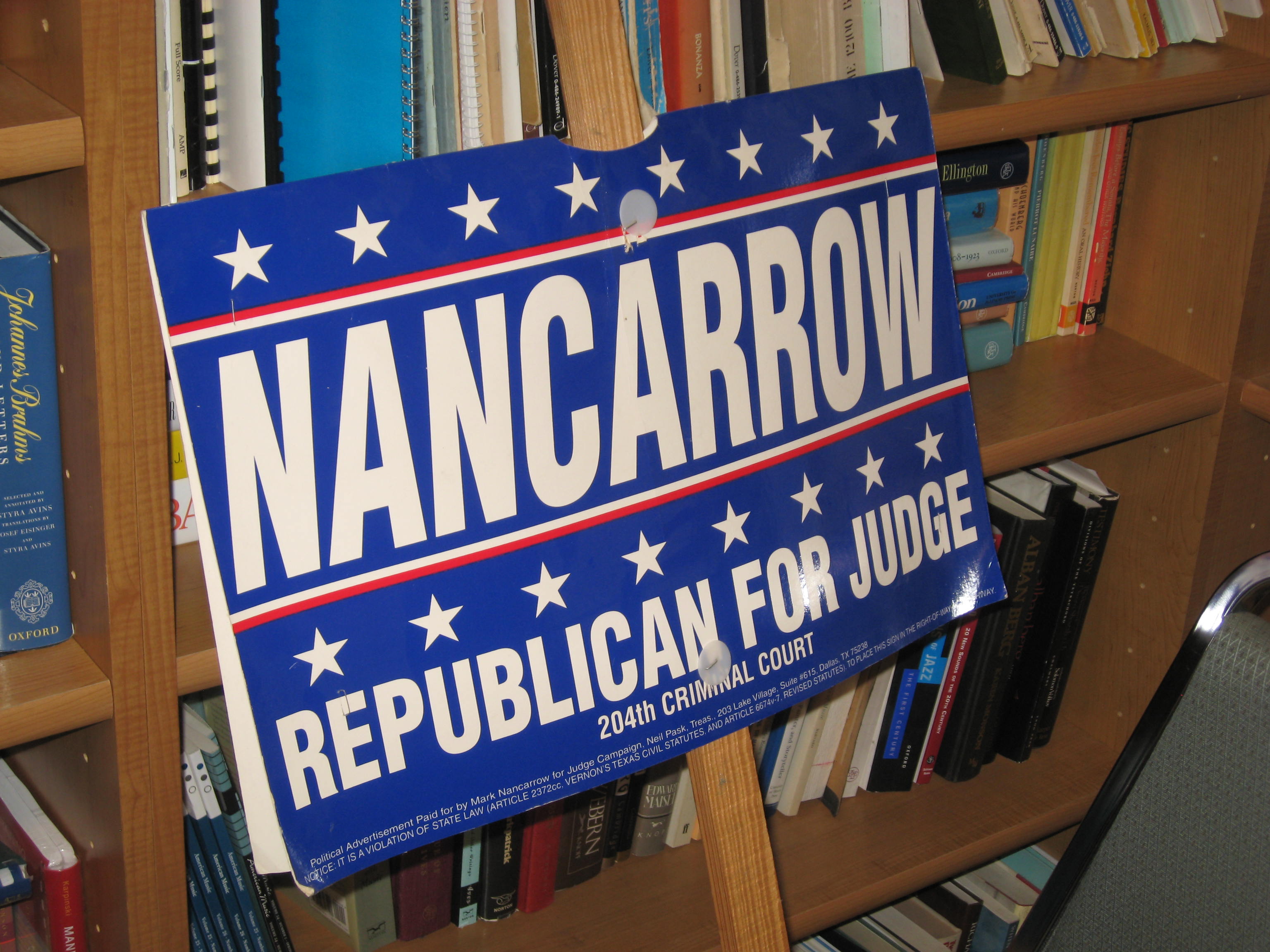
A weird coincidence that (according to that link to the article about the judge) Judge Nancarrow born and lived his early years in Spain (and Spanish was even his first language).
KG replies: I noticed that – very peculiar. I suppose they moved back to Texarkana because they had family there. But I think Charles, when I knew him, had never yet married (though he might have afterward, very late in life), and I don’t know the exact relation with this cousin.
Recently in Texarkana, I visited the local museum, a few feet on the Texas side of the state line. I was pleased to see an exhibit referring to three great musicians from the tri-state area: Nancarrow, Scott Joplin, and Leadbelly. A disparate trio, you must admit. Pushbuttons would let you listen to musical excerpts by all three. I wonder how many Joplin or Leadbelly fans try some Nancarrow, and what they think.
KG replies: Wow, glad to hear someone at the museum is that much on the ball.
“people who don’t know about my Nancarrow (which includes almost everyone)…”
He Kyle, is that a hyperbole? I would be schocked if it were true that many people in your invironment (which includes a very decent college near a cultural world-class metropole, the Cage Trust, etc.) would be ignorant of Nancarrow. It’s not as if no book, articles, festivals, CDs are keeping his name in the game. In Europe he’s an icon – why (really) is it that the US cannot at least recuperate that. Can you tell us the reasons for which you think CN is underestimated in the US?
L
KG replies: Well – he’s certainly not well-known among undergrads. I didn’t mean to make the situation sound quite so dire. Among the people likely to wander into my office, he’s certainly known to the composition faculty and a few of the student composers. But the student voice majors, classical violinists, faculty from other departments, jazz pianists, and pop singers (who tend to end up with me as their adviser because I’m pop-friendly) don’t know the name, and most of the students haven’t heard of Schoenberg until I mention him. I will say that the Columbia psychology professor who lives across the street knew all about Nancarrow, and my very first year, 1997, I was addressing the incoming freshmen when one raised his hand and asked, “Are you the guy who wrote a book about the composer who wrote music for player pianos?” I think my immediate surroundings can be easily accounted for by the dearth of arts education in high schools. As my friend Bill Duckworth likes to say about his undergrads, “Everything you tell ‘em’s news.”
Remember, the Republicans have to prevent money from going to the school systems, because an educated populace would have let the Republican party wither away decades ago.
Hopefully I’m not derailing too much but I’m always fascinated that before Southern Democrats and Republicans divided and conquered with race-baiting tactics and the like, much of the South (“Real America” lol) were hotbeds of various strains populist agrarianism, socialism, syndicalism and so on – would it be fair to say Conlon Nancarrow came out of this milieu or did his winding up in the Abraham Lincoln brigades come through other means?
KG replies: Interesting question, but one I’m not confident I can answer. He joined the Communist Party in Boston, as so many artists did during that era. I get the impression that he was in total revolt against his conservative father, so it seems unlikely that he was positively influenced by any early association, but I guess it’s possible. I grew up among the ’60s Dixiecrats, but it sounds like you know more about the pre-’50s South than I do.