
Recognize the style?
Kyle Gann on music after the fact
Recognize the style?
Just as Harry Partch called himself a "philosophic music man seduced into carpentry," I'm a composer seduced into musicology... Read More…
So classical music is dead, they say. Well, well. This blog will set out to consider that dubious factoid with equanimity, if not downright enthusiasm [More]
Kyle Gann's Home Page More than you ever wanted to know about me at www.kylegann.com
PostClassic Radio The radio station that goes with the blog, all postclassical music, all the time; see the playlist at kylegann.com.
American Mavericks - the Minnesota Public radio program about American music (scripted by Kyle Gann with Tom Voegeli)
Kalvos & Damian's New Music Bazaar - a cornucopia of music, interviews, information by, with, and on hundreds of intriguing composers who are not the Usual Suspects
Iridian Radio - an intelligently mellow new-music station
New Music Box - the premiere site for keeping up with what American composers are doing and thinking
The Rest Is Noise - The fine blog of critic Alex Ross
William Duckworth's Cathedral - the first interactive web composition and home page of a great postminimalist composer
Mikel Rouse's Home Page - the greatest opera composer of my generation
Eve Beglarian's Home Page- great Downtown composer
David Doty's Just Intonation site
Erling Wold's Web Site - a fine San Francisco composer of deceptively simple-seeming music, and a model web site
The Dane Rudhyar Archive - the complete site for the music, poetry, painting, and ideas of a greatly underrated composer who became America's greatest astrologer
Utopian Turtletop, John Shaw's thoughtful blog about new music and other issues
an ArtsJournal blog

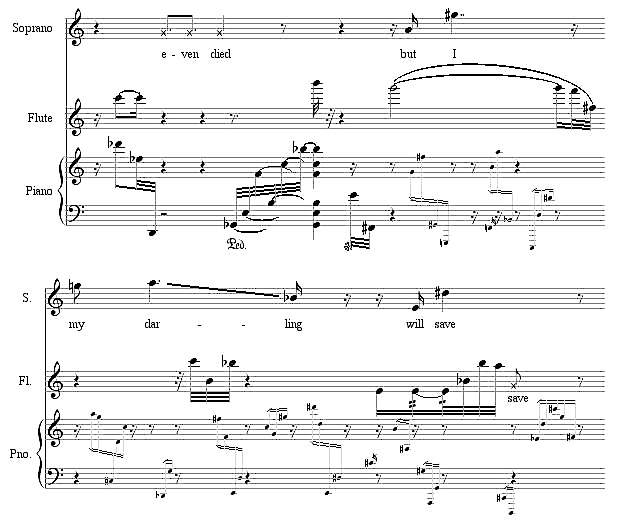
Everytime I read you speaking about having “piled up major sevenths and minor ninths” all around your previous compositions I try to imagine them – and I think I got quite near this excerpt you’re showing us.
Though there are even a few major seconds and minor sevenths…
Good post. I liked in particular the recognition that your youthful composition was about being “as dissonant”…”as possible”. I don’t think you should destroy it, but celebrate it, as certainly it’s a milestone in your own development. I like the notion from science that even the wrong avenues, pursued to lack of fruition, can advance the whole by showing where not to go
.
So many of the challenges of microtonal composition are no longer medium-based.
Any reasonable synthesizer or digital audio workstation allows one to affect the formulae of pitch pretty much at will. It’s no longer a
complex math game. I’ve been surprised, in a way, that we have not seen more little movements to pronounce this new microtonal scale or that as either “more pleasing” than the conventional scale or even as a new esperanto.
“obedient modernist”
Now I’m curious about what you wrote before you got into college. Was it really a case of being “obedient”, or more a sign of the times?
But, where are the ‘irrational’ rhythmic brackets, and, goodness, there are no dynamics! Already, the roots of your downtown minimalism are apparent.
This is an important historical document.
KG replies: How obedient I was being, and to whom, seems like too profound a question to address in a blog, let alone a comment. I was certainly going along with what the professional composing world was encouraging, which was, Fuck the audience, let’s do something wild and dissonant and complex! I also had plenty of that adolescent spirit I see in my students, when they first discover modern music and say, You can *do* that?, and then write the weirdest music possible. So on one side it’s rebellion against the tame world of one’s upbringing, but the extent to which academia supports that particular rebellion takes a lot of the risk out of it. You start out trying to shock your parents or high school friends, and end up trying to join the club your college teachers belong to. Now, admittedly, Oberlin was a place where nothing would have shocked anyone, so my change couldn’t have been interpreted as disobedience – in fact, Oberlin let me do whatever I wanted, then I left and was astonished to find that there was a lot of antagonism toward minimalism elsewhere. So I don’t get any credit for defying my teachers, and never suffered any negative consequences for my stylistic choices until a few years after grad school. In fact, the controversial aspects of my musical life didn’t really sharpen until I got to New York – the Midwest just has a different dynamic, and, at least back then, had a lot more tolerance, more live and let live. The visiting artists who came to Oberlin and looked down their nose at minimalism were East Coasters like Davidovsky. (On the other hand, there were faculty at Northwestern convinced that Cage and Ashley were charlatans – good thing I didn’t have to study with them.) Had I continued on the path I’d started with The Knife, though, I would have found myself drifting into very different circles – circles in which obedience is demanded. It would have looked like obedience in hindsight, I guess.
You’re right, there are no dynamics here – not enough for the style, I freely concede – but there are a lot earlier in the score. The piece is also filled with those Crumb non-parallel note-beams that go smoothly from 8th-notes to 32nd-notes, but I don’t know how to do them in Sibelius, because I’ve never used them since this piece, so I didn’t use that part. I have a couple of pieces up that I wrote in high school and still like:
http://www.kylegann.com/CommentaryonHope.pdf
http://www.kylegann.com/FantasyonProtestantHymns.pdf
The clear influences are Ruggles and Ives. By college I was actually showing off with my Berio imitation; most of my peers were just discovering serialism. Thanks for provoking so much thought – more than you intended, perhaps.
I still have a warm place in my heart for Crumb (And from time to time been known to use the “feathered” 8ths-32nds notation. I can do that on Finale). But my experience in school showed me that most fire-breathing “euro”-modernists hated him. He was a turncoat with all those tonal references. Of course, he wasn’t as evil as Rochberg after the Conchord Quartets.
KG replies: Yeah, it wasn’t easy squeezing Berio and Crumb influences into the same piece, but I was a hard worker.
You can do the “feathered” notation on Sibelius, it’s just sort of a pain. I’m not sure about earlier versions, but starting with Sibelius 5 you can make them (and have them play back sort of correctly) using the (fairly complex) method detailed on pages 75-76 of your user’s manual. Oh boy!
I like George Crumb also, and was very into him when I was about eighteen. I’ve never understood why so many people put him down. His very best work, which I think is roughly 1962-72, has a very particular poetry like no-one else and a gorgeous imagination for sound. A sense of spaciousness, and night, and memory, and a special way of placing those exquisite moments (the last minutes of Night of the Four Moons, for example, with the offstage musicians doing a quasi-Mahler reminiscence). There are half a dozen works of Crumb, at least, that I think are among the greatest achievements of his generation.
KG replies: One of the nicest guys in the business, too. He was at a music festival at a school where I gave a talk spouting my usual Downtown ideas and the entire music faculty quit speaking to me, but Crumb ran up afterward and said, “That’s it, give ‘em hell.” Then he invited me to his hotel room after dinner and we had a long, friendly conversation. I was so obsessed with Black Angels and Eleven Echoes of Autumn as a freshman that it embarrasses me to think about it now, which is probably why I no longer listen to him much.
Eric — One of the new features in Sibelius 6 is that the feathered beams can (finally!) be made automatically, without following that old somewhat ridiculous nested tuplet procedure from the user’s manual. (The advantage, however, of the nested tuplets was that they played back somewhat correctly.)
However, the nested tuplets had the effect of placing the notes closer and closer together as they get faster — which makes sense, one would think — but every single engraving text and typesetting expert says that feathered beams are supposed to be typeset with the notes equally spaced, not getting closer as they get faster (or further as they get slower).
Anyway, in the new Sibelius 6, you just enter the whole thing as the highest speed and then just click the feathered button and and it automatically does the beam for you. It’s only taken 9.5 years for them finally add it — but it’s there now.
Like you, my infatuation with Crumb has cooled down (though sometimes I’ll listen to “Ancient Voices..” when I’m in the mood, which i8s more than I can say for Babbit). The “new-agey” titles are a little dated and corny. But some of his sounds are truly delectable. Chalk this one up as a guilty pleasure.