
A Cautionary Example

If you have a friend who's considering becoming a microtonal composer, and you are frantic to spare him a life of agony and unfulfillment, I'm about to do you a big service: just have him read this. All day yesterday and this morning I spent hours filling my little sketch book with pages of notes and numbers like this:
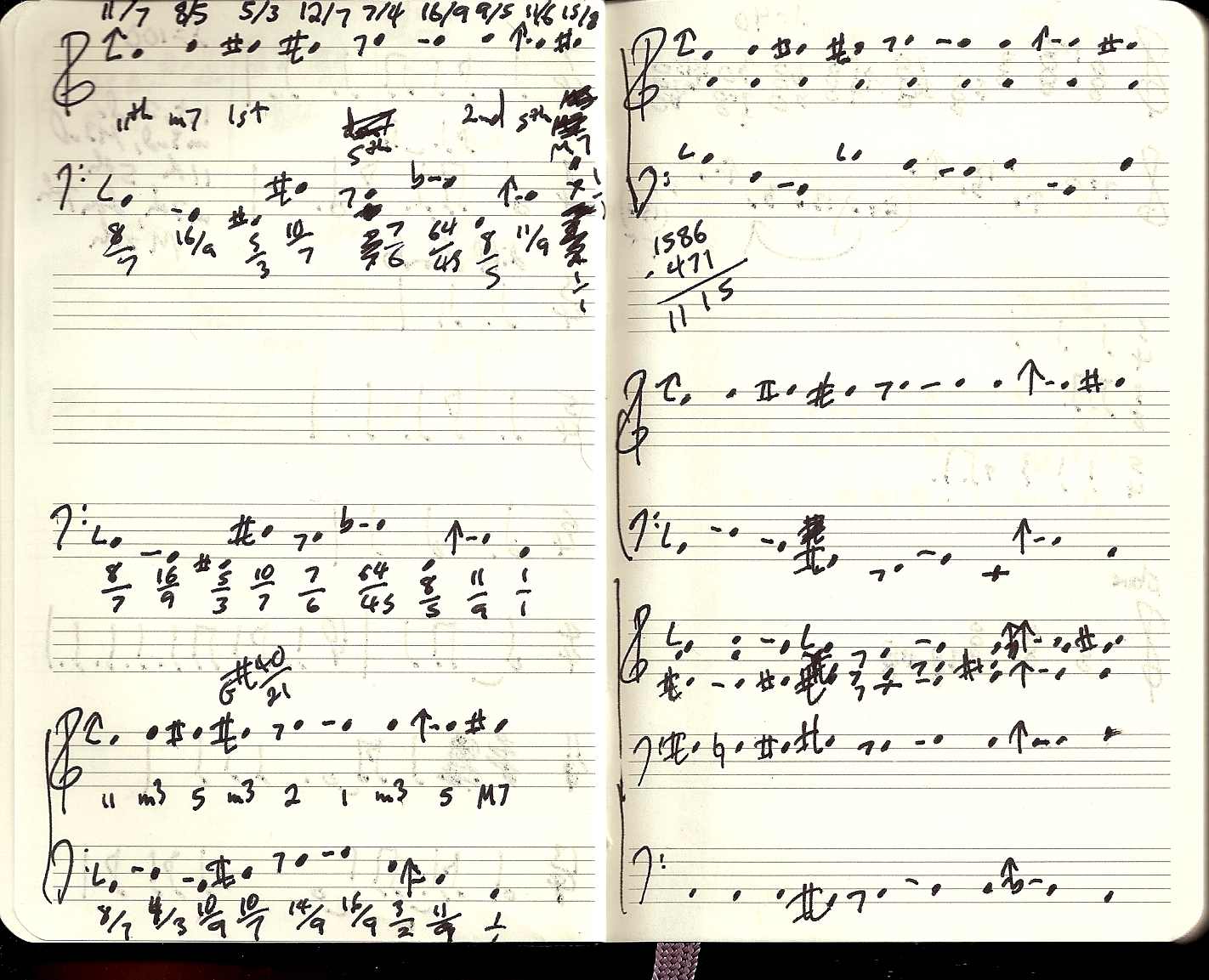
Microsketch.jpg

I was looking for a series of fractions between about 1.5 and 1.9, and then trying out different ways of harmonizing them so that 1. you don't get any parallel chords close together in the series, 2. the same chord roots don't get repeated, 3. a variety of different kinds of 7th chords are available, and 4. the harmonies use the smallest-number fractions conveniently available. I think of it as kind of like a four-dimensional sudoku puzzle. Yesterday I ended up with the scale from complexity hell, that was going to require maybe 80-something different pitches. This morning I woke up with all these numbers in my mind, along with a sound: and that sound gave me the key to simplifying the principle of the scale. So I jumped out of bed and compiled a new, far more economical, more tonally-centered scale with only 29 pitches (because the more centered a microtonal scale is around a certain tonality, the more different pitches can serve as pivot notes among different harmonies). Having made another few pages like the above, I ordered the pitches and compiled them into a MIDI chart:
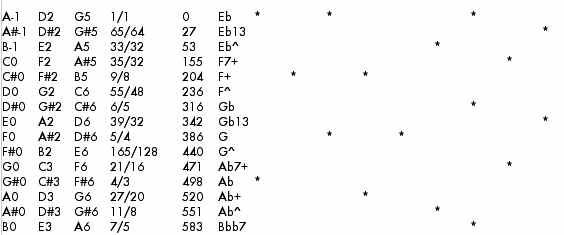
Microchart.jpg

I generally seem to end up with scales of 29 or 30 pitches. With the kinds of harmonies I favor, more than that and I start to have pitches closer together than 15 cents, which I've found are a pain to work with, and when they're within five cents (a 20th of a half-step), I just merge them, unless one is part of a perfect fifth I need in tune. Then I had to write out my MIDI-scale correspondences in musical notation:
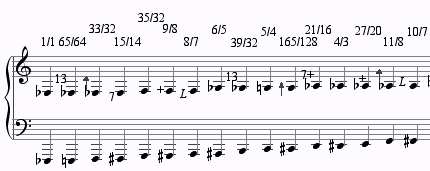
Microscale.jpg

and then group them into harmonic areas. In this case, upon doing so I realized that I had come up with two chords parallel and only 27 cents apart, a fourth of a half-step: too small to make meaningful distinctions between even in my music. I took a few hours off, doodled with fractions on the back of someone's business card at dinner (you'd be amazed at how much of my composing takes place on the back of business cards and on restaurant napkins), and after an hour or two of analyzing gaps in the scale (a gap being anything more than 60 cents), I came up with a substitute chord - after which I had to take some pitches out of the scale, add new ones back in, and go through all but the first couple of steps all over again. 

It used to be so much worse. At least now, with Lil Miss Scale Oven software, I can generate the scale and hear it played on a Kontakt softsynth in less than a minute; this part alone used to take about an hour. But I have to do all this before I can compose a note, and I still haven't done the grouping into harmonics areas yet, which I leave for tomorrow. That's not always true, because occasionally, as with my recent piece New Aunts, I just start composing in Sibelius, adding pitch bends to the notes and figuring out what pitches I want as I go along, though I tend to get greedy and end up with too many pitches that way, and have performance problems. (Also, those Sibelius pitch bends don't always catch the onset of a note, so the audio result is full of irritating tiny glissandos.) In this case, I wanted a closed gamut for a longer, more involved piece. If you're a microtonalist, also being a postminimalist helps. 

But I love it. I have enough experience to savor in advance the pungent pitch-shifts I'll get between harmonies, and the sound of the piece in my head really does guide me toward the right numbers, through a convoluted logical process. If you don't have the head for this, and an intimate feel for numbers, you shouldn't try it. I started studying just-intonation microtones with Ben Johnston in 1984, and didn't finish my first microtonal piece until 1991, filling multiple notebooks during those years with hundreds of pages of fractions. I figure it delayed my composing career at least five years. I can't even play you a sample yet because I'm several hours of work away from hearing the chords I've been hearing in my head. I guess it's a little like the weeks of pre-planning the total serialists went through in the '50s and '60s, except that once I finish all the math work I can start composing freely from the chords and scales I have available. Often I compose from the charts without really knowing what pitches I'm using, just knowing what melodic contours and harmonic shifts will work, sort of like painting with seven-foot-long brushes and your back to the canvas - and mirabile dictu, it almost always sounds the way I'd imagined. Every microtonal piece I write takes about an intense week of all this before I can actually write notes. Afterward, it's inspiring feeling that I'm doing something no one's ever done before: but boy, is it obvious why no one's ever done it.

July 7, 2009 9:42 PM | | Comments (7) |

Categories:

7 Comments

In case you have somehow missed this. Here is Erv Wilson Scale tree.

  • http://anaphoria.com/sctree.PDF The region between 1.5 and 1.9 you can click on and take the simplest ratios formed from the series of harmonic medients. I only work with scales that have every interval subtended by the same number of steps that way I can ‘transpose any material anywhere is unique yet subtle variations in intonation. The further advantage of scales like this is that they easily map onto a generalized keyboard with every note looking exactly the same on the keyboard as well as the closest match from any one pitch.
    Ptolemy thought the 45/44 was the smallest note he could use melodicly. It is somewhere in that region depending on context. I do have smaller one that if one is running up the scale with the properties mentioned above they fit in well with the continuity.
  • KG replies: That wuss Ptolemy would only go down to 39 cents? I like 31-cent steps myself, though I've used 81/80 [20.5 cents] melodically.

    Thanks for the chart, I'll print it out. It's a nice visual aid, though I've also got other criteria like wanting one harmony with 7 in the denominator against another with 7 in the numerator, same for 11 and so on. Nothing I come up with would be as consistent as you describe, though I do like your idea of transposition. That's the great thing about microtonality, no two people approach it the same way, and your approach seems to indicate how your brain is hard-wired. These days I go back and forth between 11-limit and 13-limit. Working the 13th harmonic into chords doesn't quite work for me, but I love 16/13 and 13/10 as melodic intervals.

    thanks for the interesting insights into "a day in the life of a microtonal composer". to me it´s rather inspiring than deterrent :-)
    are you familiar with the (JI) microtonal accidentals marc sabat designed? i find them very useful and they work great in sibelius too.
    (plainsound.org)

    KG replies: No, I'm not. I use a Ben Johnston font designed by Andrian Pertout, who also studied with him. But they don't affect playback. Do Sabat's? A student designed me a plug-in allowing me to put a fraction over the note and change the tuning, but I'm a little afraid to use it for some reason. Everyone comes up with their own shortcuts, still always tedious, but I'll look for Sabat's.

    I agree that in the range of 30 cents seems to be good range as a guide.
    As for my brain being hard wired, it is more a question that my instruments are. Every scale I make has to be capable of the most far reaching approaches a single tuning can devise. What I make I use and reuse for years if not the rest of my life. There is no turning back as one can only build so many ensembles of instruments, and it is ensembles and not individual instruments work toward.
    Partch’s tuning can be viewed as having these same properties as I mentioned if one uses it in the context of a 41 tones scale with two alternates. Erv Wilson's work with him witnessed him constantly using it in this fashion.

    KG replies: That's the advantage of being all thumbs: having no carpentry skills, I was never seduced into it, and so never had to commit myself to a tuning. But I do enjoy your instruments.

    @kyle gann: no, they don´t affect playback, although it´s probably possible to program them so that they do. i usually use other programs for playback. i don´t know johnston´s system that well and i´m not sure how it relates to sabat/scwheinitz´, but i imagine that there are some common denominators. it would be interesting to know how the meanings of the symbols overlap, hope i can find time to look it up.

    KG replies: I looked up the Sabat system a few years ago, and seem to recall there being a lot of conceptual similarity to Johnston's. As how could there not be, I guess, the whole number series being what it is.

    One of the wost extensive and far reaching investigations into notation was done by George Secor and Dave Keenan which was the result of much imput from all types of microtonalist from all over.

    http://users.bigpond.net.au/d.keenan/sagittal

    It includes also many of the sources which might in certain situations have advantages.

    Arnold Schoenberg the microtonalist says: “That we name the interval c – g, five, does not mean that c – g is actually, in every context, five; our usage comes from the fact that in our present scale – our scale – exactly three tones come between c and g. But what if there had been four or two? And there could have been, and it would have been right, too; for nature lends herself to a far greater variety of interpretations than [do] our secrets.” -Harmonielehre, pp. 318-19

    KG replies: Yeah, Schoenberg talked the talk, but he never walked the walk. I actually enjoy his essays much more consistently than I do is music.

    I've made a working set of Johnston accidentals with playback in Finale. Each symbol has its own pitch bend value. In addition to that, the basic chromatic scale has to be tuned in JI with some other method than pitchbend (.scl, .tun etc.) because of the two sizes of whole tones in the 5-limit root scale. I use LMSO for that and most often I use LMSO's simple Cupcake synth for playback. Multiple symbols could be added to a note but since the pitch bend values do not add up, I have to find a separate symbol for each combination such as b-, 7+ etc.
    My question is: is this impossible in Sibelius? I've been told it is but now I see mention of pitch bends and plug-ins with fraction symbols. I'm not a fan of Finale but have been under the impression that this complex microtonal playback would not work in Subelius.

    KG replies: Nice to hear from you, Juhani, it's been a long time. I imagine it is possible in Sibelius, because a student of mine made me a plug-in that would let me put a fraction over a note, and the pitch would bend accordingly. I'm in awe of people who can figure out how to do these things.

    Leave a comment

    Sites To See

    Postclassic Radio! - Kyle Gann's internet radio station that accompanies the blog; see the playlist at kylegann.com

    American Mavericks - the Minnesota Public radio program about American music (scripted by Kyle Gann with Tom Voegeli)

    Kalvos & Damian's New Music Bazaar - a cornucopia of music, interviews, information by, with, and on hundreds of intriguing composers who are not the Usual Suspects

    Iridian Radio - an intelligently mellow new-music station

    New Music Box - the premiere site for keeping up with what American composers are doing and thinking

    The Rest Is Noise - The fine blog of critic Alex Ross

    William Duckworth's Cathedral - the first interactive web composition and home page of a great postminimalist composer

    Mikel Rouse's Home Page - the greatest opera composer of my generation

    Eve Beglarian's Home Page - great Downtown composer

    Just Intonation Network - a meeting place for people interested in alternative tunings

    Erling Wold's Web Site - a fine San Francisco composer of deceptively simple-seeming music, and a model web site

    The Dane Rudhyar Archive - the complete site for the music, poetry, painting, and ideas of a greatly underrated composer who became America's greatest astrologer

    Utopian Turtletop, John Shaw's thoughtful blog about new music and other issues

    About this Entry

    This page contains a single entry by PostClassic published on July 7, 2009 9:42 PM.

    The Composer's Code of Polite Silence was the previous entry in this blog.

    Some Composers Are Not Islands is the next entry in this blog.

    Find recent content on the main index or look in the archives to find all content.

    AJ Ads

    Introducing
    AJ Arts Blog Ads

    Now you can reach the most discerning arts blog readers on the internet. Target individual blogs or topics in the ArtsJournal ad network.

    Advertise Here

    AJ Blogs

    AJBlogCentral | rss

    culture
    About Last Night
    Terry Teachout on the arts in New York City
    Artful Manager
    Andrew Taylor on the business of arts & culture
    blog riley
    rock culture approximately
    critical difference
    Laura Collins-Hughes on arts, culture and coverage
    Dewey21C
    Richard Kessler on arts education
    diacritical
    Douglas McLennan's blog
    Dog Days
    Dalouge Smith advocates for the Arts
    Flyover
    Art from the American Outback
    Life's a Pitch
    For immediate release: the arts are marketable
    Mind the Gap
    No genre is the new genre
    Performance Monkey
    David Jays on theatre and dance
    Plain English
    Paul Levy measures the Angles
    Real Clear Arts
    Judith H. Dobrzynski on Culture
    Rockwell Matters
    John Rockwell on the arts
    Straight Up |
    Jan Herman - arts, media & culture with 'tude

    dance
    Foot in Mouth
    Apollinaire Scherr talks about dance
    Seeing Things
    Tobi Tobias on dance et al...

    jazz
    Jazz Beyond Jazz
    Howard Mandel's freelance Urban Improvisation
    ListenGood
    Focus on New Orleans. Jazz and Other Sounds
    Rifftides
    Doug Ramsey on Jazz and other matters...

    media
    Out There
    Jeff Weinstein's Cultural Mixology
    Serious Popcorn
    Martha Bayles on Film...

    classical music
    Creative Destruction
    Fresh ideas on building arts communities
    The Future of Classical Music?
    Greg Sandow performs a book-in-progress
    On the Record
    Exploring Orchestras w/ Henry Fogel
    Overflow
    Harvey Sachs on music, and various digressions
    PianoMorphosis
    Bruce Brubaker on all things Piano
    PostClassic
    Kyle Gann on music after the fact
    Sandow
    Greg Sandow on the future of Classical Music
    Slipped Disc
    Norman Lebrecht on Shifting Sound Worlds

    publishing
    book/daddy
    Jerome Weeks on Books
    Quick Study
    Scott McLemee on books, ideas & trash-culture ephemera

    theatre
    Drama Queen
    Wendy Rosenfield: covering drama, onstage and off
    lies like truth
    Chloe Veltman on how culture will save the world

    visual
    Aesthetic Grounds
    Public Art, Public Space
    Another Bouncing Ball
    Regina Hackett takes her Art To Go
    Artopia
    John Perreault's art diary
    CultureGrrl
    Lee Rosenbaum's Cultural Commentary
    Modern Art Notes
    Tyler Green's modern & contemporary art blog
    Creative Commons License
    This weblog is licensed under a Creative Commons License.