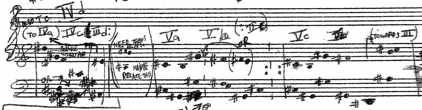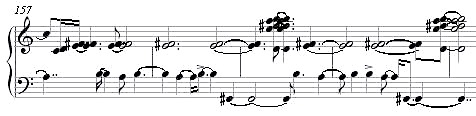
I’m almost done transcribing and analyzing Dennis Johnson’s November, the ostensively six-hour 1959 piano piece that La Monte Young says inspired him to embark on The Well-Tuned Piano. I’ve listed some of November‘s innovations elsewhere. If it was indeed the first multi-hour continuous minimalist piece, the first tonal very slow work, the piece that pioneered additive process – and it may have been all that – those in themselves are enough to make it worth reviving and getting into the history books. But beyond that, I’ve become more and more impressed with its internal logic, which is almost mathematical (and Johnson left music to become a mathematician). The piece is organized into families of motifs based on the same pitches, which can proceed improvisatorily to other families of motifs at specified points. Johnson begins each new pitch field additively, bringing in one note or chord, then another, then another until they’re all present. But the overall formal concept is not simply additive but more like a series of circles, as each pitch field has a point of entry and exit, and within each section one can go back and forth among the motifs in that field. It’s really elegant, and in its glacial way makes a certain large-scale sense to the ear. Feldman’s wonderful masterpiece Triadic Memories (a much later work, 1981) is similar in its reminiscent effects and equally intuitive, but November is generally diatonic rather than chromatic, and its logic lies a little closer to the surface. I thought that in September Sarah Cahill and I would be re-premiering a kind of crazy, off-beat experiment of the late ’50s; instead I’m thinking we’ll be unveiling a whole new formal paradigm that deserved to have more of an after-history than it’s had.

Looks like an interesting piece! Just wanted to add (hopefully not in a too douche-y way), Triadic Memories is dated I believe 1981, from Feldman’s late “crippled symmetry” period, not 1976 which would put it in his mid-70′s “still life” period. Point taken, though, way later than “November”, obviously!
KG replies: That’s some epic kind of laziness, isn’t it, depending on my readers to supply dates when I’m only a couple clicks away from Googling it and making sure, didn’t even need to get out of my chair? Thanks, I changed it in the text.
Aptly illustrates the length bigotry of recorded music. Anything that exceeds the amount of time possible on a single CD or LP tends to get written out of history.
What’s really startling is the fact that, today, with mp3s of unlimited length possible for downloading at places like iTunes, the length bigotry still persists. You have to wonder how many pieces like this have existed but been totally ignored by the contemporary music establishment because no one could hear ‘em?
Someone should start a record label consisting only of compositions that can’t fit on a single CD and only sell ‘em as mp3 downloads. In fact, such a record label should deliberately commission pieces of contemporary music composed so that they can’t fit on a single CD, and can only be heard via such mp3s. When faced with bigotry, time to sit at the lunch counter and let the other diners pour sugar and coffee on your head.
And do you have any news tracking down the composer? I read the 2007 post and learned about his withdrawal from on-line world.
Listening to the recording made me enjoy the piece as well as remember about my (and friends’) own home recordings with upright pianos that sound… that way
KG replies: Yes, Daniel Wolf had a contact for Dennis Johnson, who kindly sent me the score.
An amazing bit of music. Thanks so much for making it available. To better understand your (and Ashley’s) terminology, would be interested in hearing where you would put it on an “eventfulness” vs. “out of time” spectrum. Does “very slow” overlap non-eventfulness?
KG replies: Seems to me one might bleed into the other.
Where did you track down the original score? In your “Remembering November” post you say that Johnson has disappeared and any score seems to have gone with him, possibly in a California forest fire.
I’m noticing that “November” relies more on repetition than on drones, which also seems like something of an innovation. “Trio for Strings” is all about the drones, and the Terry Jennings 1958 “Piano Piece” is all about notes decaying. The Jennings moves at a roughly comparable rate, but the meaning behind the slowness seems different. Johnson seems to be making you wait for the next pitch in a slow melody, whereas Jennings seems to be asking you to listen to the evolution of one set of sounds before he gives you the next set.
I’m really looking forward to the performance. I’d also love to get my hands on the original recording and score–I love the hiss-filled, underwater sound of it.
KG replies: Hi, Galen – you must have missed the comments thread in which Dan Wolf offered me contact info for Dennis Johnson. I contacted him and got a copy of the score.
Wow, did that come from an LP? I love the non-intentional wobbly pitch element the recording provides. Good luck!
KG replies: Reel-to-reel, I believe.
Is there any way to obtain a recording of “November”? I can’t find any information online about the piece. That snippet was fantastic.
KG replies: I’ll try to put up more of the piece closer to the conference.
I love this. When and where in September?
KG replies: September 6, UMKC, minimalism conference.
mclaren, that’d be a great recording project/company. I’m sure you are right that there are lots of pieces that never get heard or written about because of their length.
I’m seriously curious about whether what you’re calling “length bigotry” is bigotry or a result of the practical issues with performing and recording exceptionally long works. There are the extreme physical demands some pieces make on the players; there are the issues of renting space for enough time to rehearse and perform such pieces; there are the market issues involved with finding an audience, not to mention whether performers will commission pieces that make challenging demands.
I should note that yes, there is an audience for this music; yes, there are venues for performing unusually long and difficult pieces. But it’s a smaller audience than for [your choice of music here; lots would fit]; the venues are more likely to be private homes or small college or community concert halls or churches than [big venue here]. And, stating the obvious, it’s a big job mustering the concentration and physical focus to either play or listen to anything for six hours.
(Hence the need for a recording company dedicated to such works…)
Any chance on getting some biographical info with a list of works for this forgotten composer? He hardly seems to exist on the internet or in most of the music history books.
KG replies: Agreed. Somebody needs to go visit him and go through his archives. But not me.