
Friday I drove to Hartford to hear the Fourth Symphony of one of my oldest friends. It sounds strange to say that: Fourth Symphonies are written by dead composers in the history books, or at least by gray eminences who are living out their fame in European seclusion. But it’s true, my old chum Robert Carl has written four of them now, the latest played by the Hartt Symphony Orchestra under conductor Christopher Zimmerman. Robert is chair of composition at the Hartt School of Music.
Robert and I keep trying to remember how we met, which was almost thirty years ago, but we can’t pin it down; he was finishing his doctorate at the University of Chicago, I across town at Northwestern. Aesthetically, we come from rather opposite sides of the tracks, but our lives keep intersecting and paralleling. We’re both transplanted southerners. He studied with Ralph Shapey, and as a critic at the Chicago Reader I championed Shapey (somewhat to the chagrin of my NU music professors) and published a long interview with him, which I still think is good enough to reprint someday. Robert also studied with George Rochberg, whom I’ve found myself championing lately, enough to receive thanks from his widow. We both had brief student experiences with Morton Feldman. I used to write for Fanfare magazine, as Robert does now, which I believe I got him into (or was that Scott Wheeler?). I just completed a book on Cage’s 4’33”, and Robert is about to publish one on Terry Riley’s In C, on the basis of which we’ve invited him to give a keynote address at the Minimalism Conference at UMKC next September (of which, more news soon). And luckily, Robert and I both moved east to schools only a couple of hours apart and both deeply appreciate fine bourbons and single-malt scotches, so you can imagine the rest.
Generally speaking, Robert’s music is far more angular and dissonant than mine, and oriented toward Romanticism rather than Minimalism, but that superficial characterization is misleading. A few years ago I gave a paper for an Ives festival on younger composers influenced by Ives, and Robert was, if not Exhibit A, at least B or C – and we certainly have that much in common. Robert’s music covers a wide stylistic range, with occasional forays into jazz harmony, minimalism, and even Downtown-type sound installation, but he does have a central, most quintessential style which I can only describe in terms of yearning and transcendence. He has little relation to the music that most people would call New Romanticism, even less to neo-, but there is in his music a kind of aspiration to transcend mundane things, such as one might find parallels for in late Beethoven, Messiaen, Ives’s quieter moments like the finale of his Fourth Symphony – and perhaps in Shapey. Robert’s and my educations and preferences overlap considerably, but we’re opposite personality types: I write a cool, steady music in an attempt to calm myself down, and he writes a music of feeling so urgent that it seems to want to burst the boundaries of its sonic container – perhaps to heat himself up? Between the two of us, he is certainly the more easy-going personality.
I think it’s taken Robert a long time to clarify what is truly Carlesque in his music amid the Ruggles-like angularity (his dissertation was on Sun Treader), the Ivesian layering, the Rochbergian style schisms, the Shapeyesque pitch usage, and it’s been exciting to hear it emerge ever more clearly in each new work. His Fourth Symphony was his clearest, most incisive work yet. It was 23 minutes long, in five movements played continuously, though easy to hear as a varied one-movement work. The opening alternated between soft chords in the strings and winds and a jaunty rhythmic texture in the percussion, and you could eventually tell that the string chords were trying to grow, to turn into a theme, against the percussion’s complacent interruptions. This drew the audience into the work by giving us something to identify with and root for. Impressively, the piece built up its argument without the usual continuity devices of themes or (as in so much minimalist-based work) ongoing propulsive patterns, but through textural blocks juxtaposed against one another in a kind of architectural choreography. It’s a technique unrelated to the usual American styles, and I think ends up in what one might call East-European territory. Unlike comparison pieces by Erkki-Sven Tüür, Aulis Sallinen, and others, however, every gesture was musical rather than sonic, if you know what I mean; Robert never goes for abstract effects, but couches each texture with lyrical specificity, and his sense of rhythm is entirely American. It’s a very original work, so engaging that it seemed to go by too quickly, and I’m looking forward to hearing the recording, which I’ll post here for you to hear it too. [UPDATE: Here it is.]
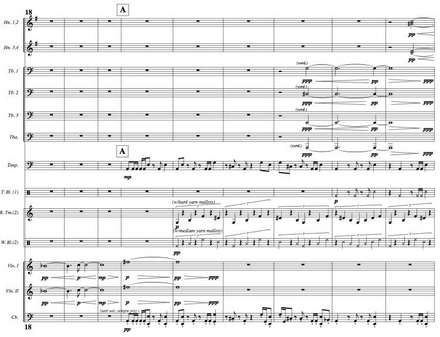
Robert thinks this is the best he’s done at creating a multimovement “symphonic argument” that emerges over the course of the piece. I certainly hear what he means, as I intuit what it means in symphonies by Beethoven, Bruckner, Mahler, Nielsen, and that crowd. I think it’s probably not something I could come up with myself. I haven’t written a symphony, but I secretly consider my Transcendental Sonnets a choral symphony, and my Implausible Sketches for two pianists the symphony I didn’t bother to orchestrate. From those and my clarinet sonata I gather that I feel multimovement form as a group of fairly self-contained movements all related to a center – more than a suite, the order not arbitrary, but not really symphonic, either. The only other friend of mine who writes symphonies, I think, is Gloria Coates (15 so far), and she doesn’t really aim for that sense of cumulative development either. (My friend Peter Garland got so tired of waiting for an orchestra commission that he wrote a long, wonderful symphony for flute, clarinet, and trombone.) My pieces each gradually explore a soundworld that’s felt to be all present from the beginning, which I guess means my music is more about being, and Robert’s is about becoming. Perhaps that sense of becoming, separable into stages, is what’s needed to be a real symphonist. In any case, I’m proud to have such a long-time friend adding original examples to a true symphonic repertoire.
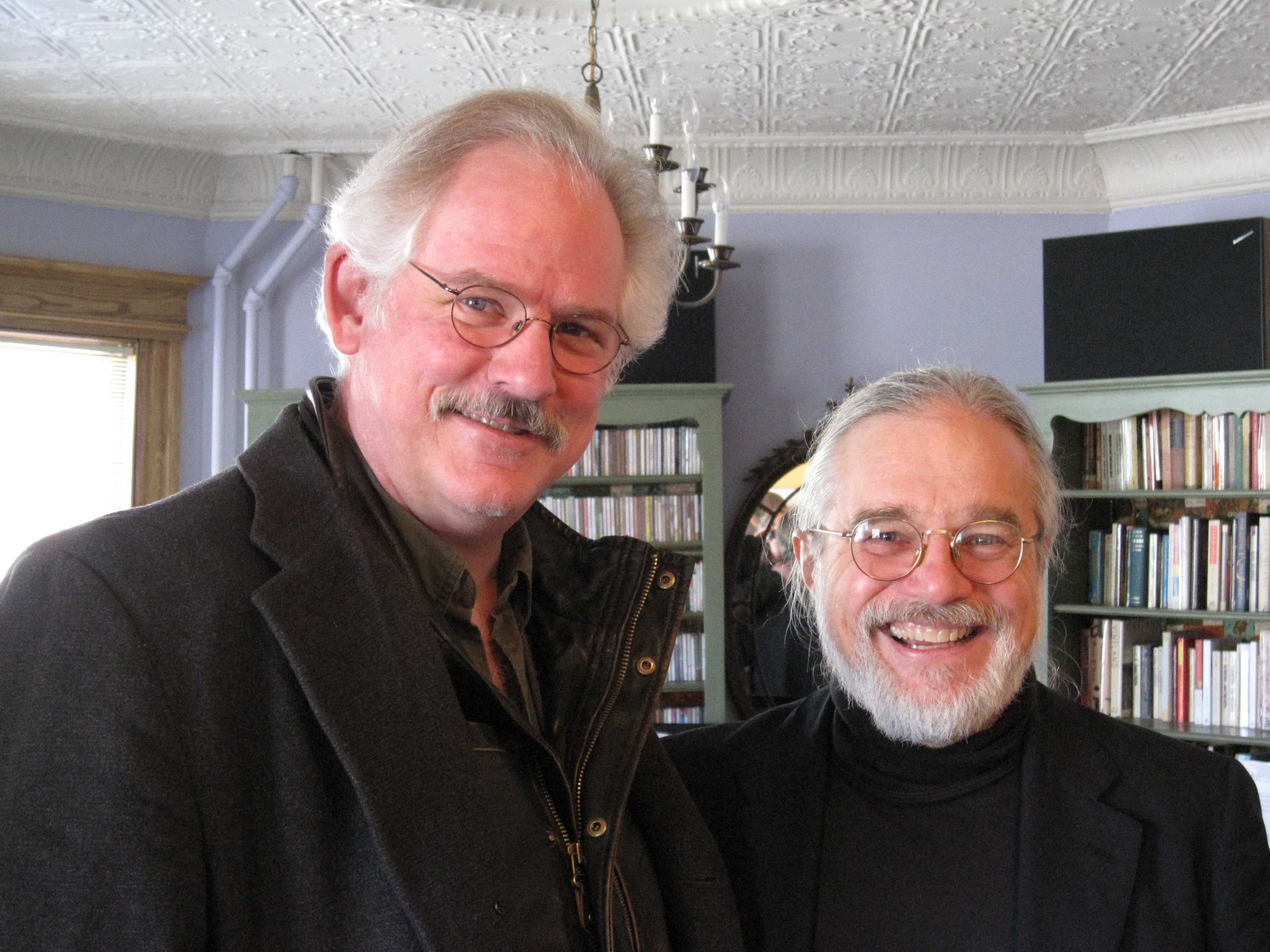
The melancholic, the sanguine: me and Robert Carl (photo by his partner, the sculptor Karen McCoy).