
Like millions of others, I’m feeling the effects of the financial downturn, and, looking around for expenses I can cut down on, my eyes light on PostClassic Radio. The cost of running it has doubled since I started it (to over $600 a year), and I haven’t had time to replenish the playlist lately anyway. I know there are some devoted listeners, to whom I’m grateful, but the listening statistics aren’t very impressive – anywhere from 2 to 20 listening hours a day lately, with the average around 9. I can still put up mp3 music examples on my web site when I need to. I’m proud of my playlist, which I will leave up as a repertoire of hundreds and hundreds of postclassical pieces since 1970, and thankful to all the musicians who allowed me to play their work. Subsidizing the music of others was an important thing to do when I started it, but I don’t think it’s a cost-effective strategy anymore, and I’d appreciate not having that hole in my budget next month. Don’t worry, I won’t quit the blog, which costs me nothing. Thanks to all those who listened (it’ll be up for a few more days if you’re trying to record things), and let’s look forward to the next phase.
Archives for February 2009
The Symphonic Temperament
Friday I drove to Hartford to hear the Fourth Symphony of one of my oldest friends. It sounds strange to say that: Fourth Symphonies are written by dead composers in the history books, or at least by gray eminences who are living out their fame in European seclusion. But it’s true, my old chum Robert Carl has written four of them now, the latest played by the Hartt Symphony Orchestra under conductor Christopher Zimmerman. Robert is chair of composition at the Hartt School of Music.
Robert and I keep trying to remember how we met, which was almost thirty years ago, but we can’t pin it down; he was finishing his doctorate at the University of Chicago, I across town at Northwestern. Aesthetically, we come from rather opposite sides of the tracks, but our lives keep intersecting and paralleling. We’re both transplanted southerners. He studied with Ralph Shapey, and as a critic at the Chicago Reader I championed Shapey (somewhat to the chagrin of my NU music professors) and published a long interview with him, which I still think is good enough to reprint someday. Robert also studied with George Rochberg, whom I’ve found myself championing lately, enough to receive thanks from his widow. We both had brief student experiences with Morton Feldman. I used to write for Fanfare magazine, as Robert does now, which I believe I got him into (or was that Scott Wheeler?). I just completed a book on Cage’s 4’33”, and Robert is about to publish one on Terry Riley’s In C, on the basis of which we’ve invited him to give a keynote address at the Minimalism Conference at UMKC next September (of which, more news soon). And luckily, Robert and I both moved east to schools only a couple of hours apart and both deeply appreciate fine bourbons and single-malt scotches, so you can imagine the rest.
Generally speaking, Robert’s music is far more angular and dissonant than mine, and oriented toward Romanticism rather than Minimalism, but that superficial characterization is misleading. A few years ago I gave a paper for an Ives festival on younger composers influenced by Ives, and Robert was, if not Exhibit A, at least B or C – and we certainly have that much in common. Robert’s music covers a wide stylistic range, with occasional forays into jazz harmony, minimalism, and even Downtown-type sound installation, but he does have a central, most quintessential style which I can only describe in terms of yearning and transcendence. He has little relation to the music that most people would call New Romanticism, even less to neo-, but there is in his music a kind of aspiration to transcend mundane things, such as one might find parallels for in late Beethoven, Messiaen, Ives’s quieter moments like the finale of his Fourth Symphony – and perhaps in Shapey. Robert’s and my educations and preferences overlap considerably, but we’re opposite personality types: I write a cool, steady music in an attempt to calm myself down, and he writes a music of feeling so urgent that it seems to want to burst the boundaries of its sonic container – perhaps to heat himself up? Between the two of us, he is certainly the more easy-going personality.
I think it’s taken Robert a long time to clarify what is truly Carlesque in his music amid the Ruggles-like angularity (his dissertation was on Sun Treader), the Ivesian layering, the Rochbergian style schisms, the Shapeyesque pitch usage, and it’s been exciting to hear it emerge ever more clearly in each new work. His Fourth Symphony was his clearest, most incisive work yet. It was 23 minutes long, in five movements played continuously, though easy to hear as a varied one-movement work. The opening alternated between soft chords in the strings and winds and a jaunty rhythmic texture in the percussion, and you could eventually tell that the string chords were trying to grow, to turn into a theme, against the percussion’s complacent interruptions. This drew the audience into the work by giving us something to identify with and root for. Impressively, the piece built up its argument without the usual continuity devices of themes or (as in so much minimalist-based work) ongoing propulsive patterns, but through textural blocks juxtaposed against one another in a kind of architectural choreography. It’s a technique unrelated to the usual American styles, and I think ends up in what one might call East-European territory. Unlike comparison pieces by Erkki-Sven Tüür, Aulis Sallinen, and others, however, every gesture was musical rather than sonic, if you know what I mean; Robert never goes for abstract effects, but couches each texture with lyrical specificity, and his sense of rhythm is entirely American. It’s a very original work, so engaging that it seemed to go by too quickly, and I’m looking forward to hearing the recording, which I’ll post here for you to hear it too. [UPDATE: Here it is.]
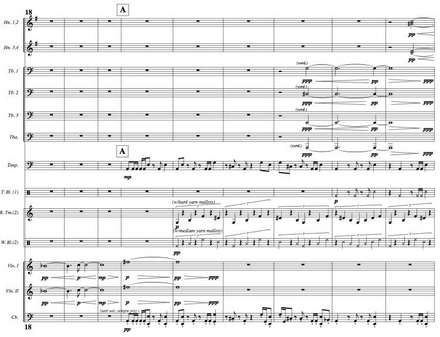
Robert thinks this is the best he’s done at creating a multimovement “symphonic argument” that emerges over the course of the piece. I certainly hear what he means, as I intuit what it means in symphonies by Beethoven, Bruckner, Mahler, Nielsen, and that crowd. I think it’s probably not something I could come up with myself. I haven’t written a symphony, but I secretly consider my Transcendental Sonnets a choral symphony, and my Implausible Sketches for two pianists the symphony I didn’t bother to orchestrate. From those and my clarinet sonata I gather that I feel multimovement form as a group of fairly self-contained movements all related to a center – more than a suite, the order not arbitrary, but not really symphonic, either. The only other friend of mine who writes symphonies, I think, is Gloria Coates (15 so far), and she doesn’t really aim for that sense of cumulative development either. (My friend Peter Garland got so tired of waiting for an orchestra commission that he wrote a long, wonderful symphony for flute, clarinet, and trombone.) My pieces each gradually explore a soundworld that’s felt to be all present from the beginning, which I guess means my music is more about being, and Robert’s is about becoming. Perhaps that sense of becoming, separable into stages, is what’s needed to be a real symphonist. In any case, I’m proud to have such a long-time friend adding original examples to a true symphonic repertoire.
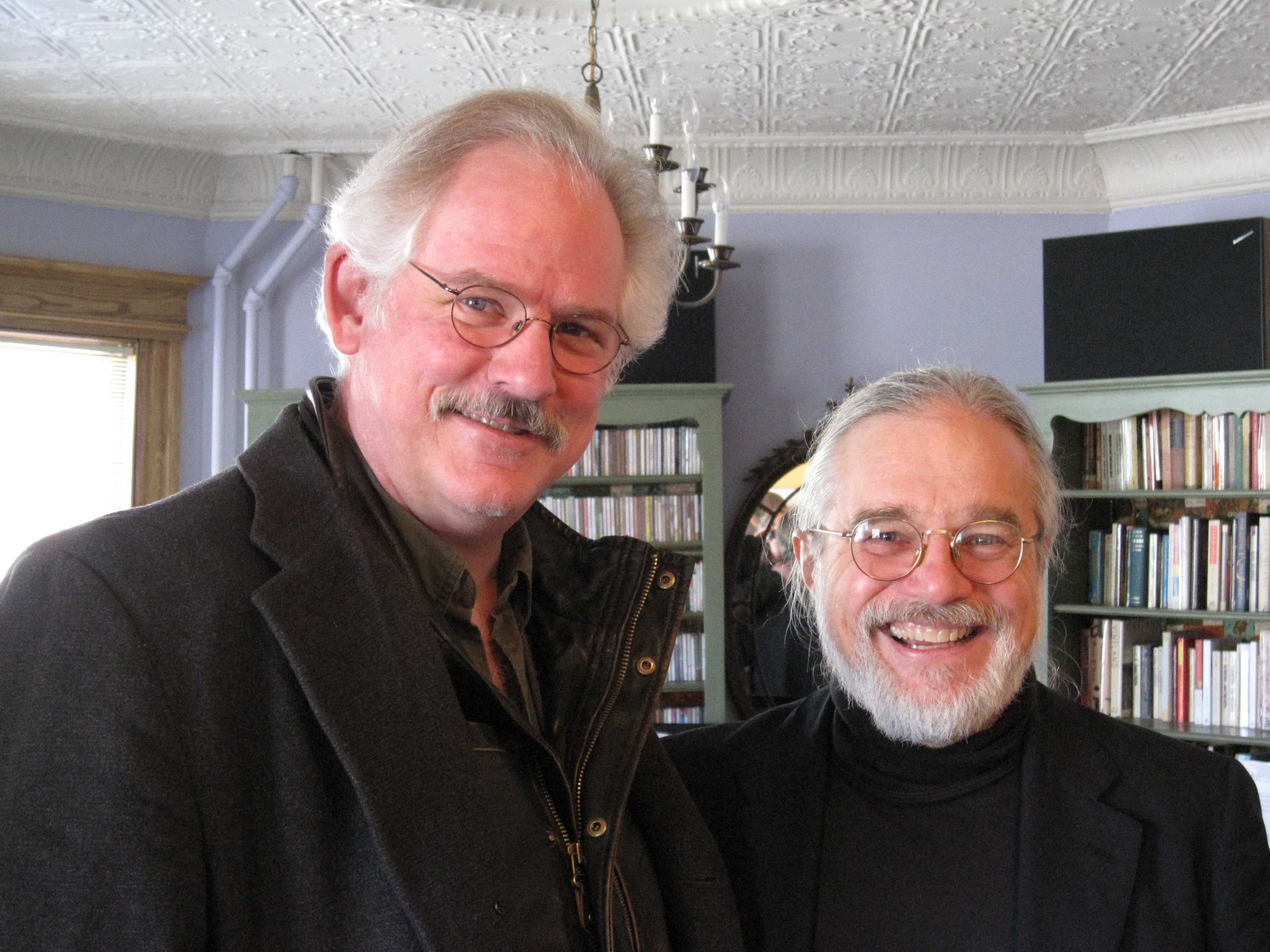
The melancholic, the sanguine: me and Robert Carl (photo by his partner, the sculptor Karen McCoy).
The Poet as Comet

In my first semester at Oberlin in 1973, I set to music a poem called The Knife, by Jean Valentine. By chance, the poet came to campus the following spring to give a reading. I walked up to her after her reading and showed her my piece. Not dreaming how impressed a famous poet might be by a young man’s adolescent homage, I hadn’t made a copy of the score, but she was so visibly touched by my effort that I impulsively gave her my only final copy. I’ve never minded the loss: it was an angularly atonal, poorly thought-out piece for soprano, flute, and piano, written under the influence of Berio’s Circles, and not a good imitation at that (though I must say that my schoolmates thought it an impressively noisy piece for a freshman).
This weekend I noticed that Jean Valentine – now the New York State Poet, it seems (anyone know who our state composer is?) – was giving a reading at Bard. I couldn’t resist going, walked up afterward and reintroduced myself. I managed to quote the last two lines of the poem, which seem typical ones for her:
And every molecule of every object here will swell with life,
And someone will be at the door.
I’m not sure she really remembered me, though she certainly remembered the poem, but she introduced me to her daughter, who teaches part-time at Bard. It turns out that Valentine’s first husband was the late James Chace, Bard’s star political historian for many years. I guess I can get used to her streaking through my life every 35 years.
Top Six Reasons to Wander in the Wilderness
Someone just wrote privately to ask why I use microtonality. Off the top of my head I came up with six things I love about it:Â
1. the strangeness of some of the intervals, which give me the thrill of hearing phenomena that I can’t (as a music theory teacher all too used to analyzing music by ear) automatically process and label;Â
2. the stretching of one’s pitch perception toward harmonics higher than the fifth (since the decision to stop with the fifth harmonic was an arbitrary academic mandate of the Italian 17th century);Â
3. the ability to have lots of pitch variety within a very small space (since I’m a minimalist at heart – I rarely listen to Reich and Glass without wishing I could hear it really in tune);Â
4. the extreme chromaticism available (as a lover of late Romantic music like Max Reger, for whom there never seem to be half-steps small enough);Â
5. the pleasure of writing chord progressions never heard before (countering the deadening feeling in my equal-tempered music that there’s really nothing new I can do in the area of harmony); andÂ
6. the tendency toward hearing the actual sound in its totality, as opposed to the filtering out of acoustic beats we have to subconsciously perform to make equal tempered music make sense.Â
As to why I write in just intonation instead of equal scales of 20 or more steps, I have a whole manifesto available about my idiosyncratic reasons for preferring that.Â
On the other hand, I’m sometimes afraid of talking too much about microtonality, because people stereotype me as a microtonalist, and musicians sometimes shy away from commissioning me for fear I’ll write them something microtonal. I almost never write microtonal music for acoustic instruments (only when seriously begged to by people who want that, and sometimes not even then), and 3/4 of my music is in plain old vanilla equal temperament, which I have never lost my fondness for. Also, like my teacher Ben Johnston, I never, ever encourage student composers toward microtonality. It’s not for the faint of heart.
Don’t Shoot the Electronic Piano Player
Awhile back, pianist Aron Kallay performed all of my microtonal electronic keyboard pieces out in Los Angeles. He recently sent me the mp3s, and I’m struck speechless by their quality. He used a tremendously responsive keyboard (a Yamaha Clavinova), and I’m attributing much of the finesse to that – because the alternative is to admit that I’m a really lousy pianist by comparison. Anyway, he did a beautiful job and made me all impressed with my music all over again, and the recordings are here:
He’ll be playing them again on John Schneider’s KPFK radio show Global Village on March 19th at 11am (pacific time), and again on a Microfest concert at Pomona College on May 10th at 8pm. The purpose of his doctoral recital was to prove that there’s a future for serious keyboard music played on electronic keyboards, and I’m convinced. These are all the microtonal pieces I’ve written for solo keyboard with no background CD, and I wrote New Aunts specifically for his concert. He makes me want to write more.
Also, I just found out that my New Music Box podcast on minimalism is now available online, so you can hear me parse musical examples by Jon Gibson, Eliane Radigue, Janice Giteck, Michael Gordon, Mikel Rouse, John Luther Adams, and others. Matthew Guerrieri has a similar show on serialism, Laura Pellegrinelli on post-jazz, and Tom Lopez on acousmatic music.
A Problem of Identity
Part of the research I’m going to present at next September’s Minimalism Conference is a comparison of the recording and a performance of Harold Budd’s Children on a Hill, a piece for piano electronically modified by a harmonizer. Budd fans will remember the piece from a 1981 recording, The Serpent (in Quicksilver) – a Cantil vinyl disc, rereleased in 1992 on an All Saints CD. I’m comparing this with a tape of the performance Budd gave at New Music America in Chicago in 1982; I’ve transcribed one and am still working on the other. The piece was completely improvised; Harold (with whom I’ve been in contact) says he may have had a cheat sheet for performance at the time, but is “helpless” to give me any information now.Â
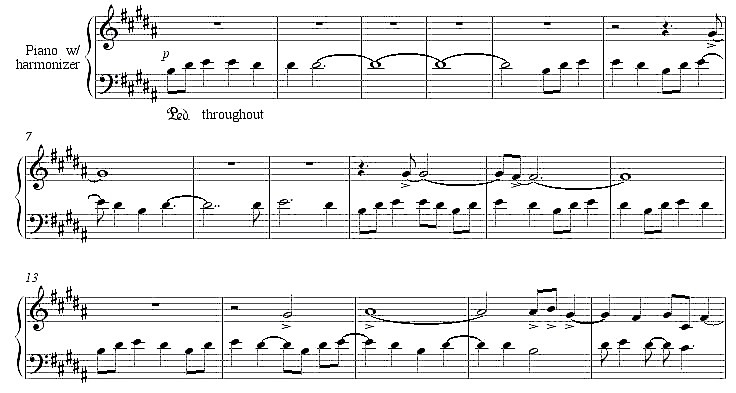
Differences between the two versions are rather spectacular. The Cantil version is five minutes long, the NMA version 23 minutes. The Cantil version begins like this:
The live version begins like this:
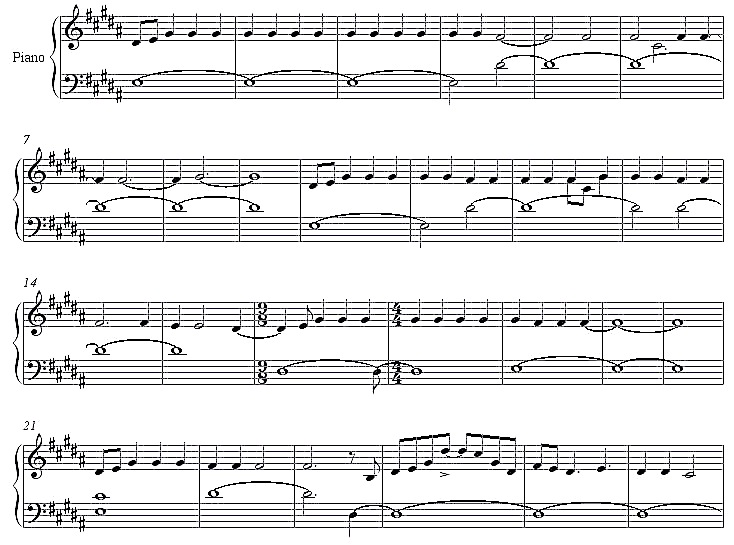
Notice that the germinal motive of the recorded version is B-D#-E; that of the NMA version is D#-E-G#. The second motive is, of course, the inversion of the first. The Cantil version stays entirely within the B major scale, without a single accidental. The live version keeps shifting among major scales on B, D, and C#. In addition, the live version has a 12-minute middle section completely lacking in the recorded version, wildly rhapsodic with lots of arpeggios, and moving among major ninth chords on B, Db, D, Eb, E, F, and Gb, never jumping more than a minor third in root movement. This fast section is the hard part to transcribe, but I’m determined I can do it. The recorded version ends in G# natural minor, the live version in C#. On Cantil the lowest note is G# at the bottom of the bass clef, and the highest goes into the piano’s top octave. The live version descends to the lowest A# on the piano, but doesn’t venture as high.
In two diverse recordings of a jazz composition, we know what the identity of the piece consists of: the chord changes, perhaps a head melody. But in what does the identity of an improvised piece like Children on the Hill consist? The two versions have the following things in common: 1. Each begins and ends using a scale bounded by a B-major key signature. 2. Each revolves around a repeating motive of a major third adjacent to a half-step. 3. Each emphasizes repetitions on the F# and G# above middle C, with tonality directed to G# by an A#-B-G# motive. 4. Each climaxes melodically by leaping up to high D#s and G#s. 5. Each employs a consistent quarter-note and 8th-note momentum, except for the middle section of the live version, which is much freer. 6. Each employs different modes within the major scale by emphasizing certain drone notes: sometimes Aeolian, sometimes Lydian, sometimes Phrygian. And certain melodic motives recur in both renditions. Other than that, the identity of the piece can only be more felt than specified: a mood, a texture, an approach.
The recorded version has approximately the same weight, charm, and texture as Cage’s Dream or In a Landscape, and is worthy of them. The live version has all the gravity and formal ingenuity of a Beethoven sonata. I remember it was the first piece played at Navy Pier at the Chicago festival, and I (working as administrative assistant for the festival) arrived at the concert a couple of minutes late. I walked in, heard Budd playing, and stood in the doorway transfixed, as I’m still transfixed by the piece today. The texture looks a little thin on paper, but the harmonizer sustained all the piano tones and blurred them into a resonant wash. And in the fast arpeggio section, the music increasingly introduces melodies bitonally in the wrong key and resolves them by changing chord, a haunting effect. Budd was a tremendous influence on young West-Coast composers like Peter Garland and Michael Byron, and, through his recordings and from a greater distance, also on me. I hope this paper will demonstrate that the complexity and subtlety of not only his music, but his very conception of music, make him one of those minimalist composers who cannot possibly be shrugged off as simplistic.Â
The First Downtown Inauguration After All
Bob Gilmore alerts me to a video that reveals what Yo-Yo Ma and his gang really played at the inauguration. If memory serves, I think it’s an Elliott Sharp tune. Certainly beats John Williams half-heartedly trying to avoid directly plagiarizing Aaron Copland.
It’s the Only Way to Go
Today I was teaching my 19th-century harmony course, starting with John Field’s Nocturnes, and as I was placing my Schirmer edition on the piano, it fell open to the little capsule biography of the composer. By chance my eye lit on the following words:
…He died in Moscow January 11, 1837.
Field’s execution was distinguished for taste and extreme delicacy, and characterized by an extreme ease and placidity of manner which sometimes amounted to a morbid languor and indifference.
For the next couple of minutes I was unable to continue teaching. I had always rather assumed that Field died a natural death, but the shock was somewhat ameliorated by the assurance that, thank goodness, at least his execution had been extremely delicate. Those Russians really know how to kill a man.
My Ives Keynote Address
I insist that I am at least tied for the place of Number 1 Charles Ives fan on the planet, but I’ve done no scholarly work on his music; I hope to, someday, because I’m not really satisfied with what’s been written on my favorite piece the Concord Sonata. In general it is enough work just keeping up with what research is already out there. Someone mentioned that there are already 70 full-length books on Ives. Like flies to roadkill are the musicologists to Ives. Anyway, the point of a keynote address, as I see it, is not to present new information anyway, but to provide a rough general picture to be filled in with detail and variously repainted by the participants, which happened to this one. (For one instance, I mention below that many of Ives’s early songs could have been musically at home in the 1820s. Wesleyan musicologist Yonatan Malin admitted that this was true harmonically and texturally, but that the rhythms and style of text setting tend to be post-Wagnerian, which is not something that would have occurred to me.) It would be a luxury to be allowed to write one’s keynote speech after one’s understanding had been broadened by the conference, but a few people asked me to make this text available, so here it is: simply one composer’s reaction to the overall meaning of Ives’s songs.
* * * * * * * * * * * * * * * * * * * * * * * *
Must a Song Always be a Song?
I like to think of Charles Ives sitting at home, after work, reading a newspaper. I don’t imagine anyone else we know about has ever read a newspaper the way he did. He’d see a little bit of verse in the New York Herald:
Quaint name,
Ann Street,
Width of same,
Ten feet.
Barnums mob
Ann Street,
Far from
Obsolete.
and ripping arpeggios leading to crashing chords would leap into his head. Or, reading a book by the Reverend James T. Bixby, called Modern Dogmatism and the Unbelief of the Age, he would run across a poem:
There is no unbelief.
For thus by day and night unconsciously,
The heart lives by that faith the lips deny.
God knoweth why!
and stern, puritan triads would swell into his ear, dying away into a wisp of the old Lowell Mason tune Azmon, “O, for a thousand tongues to sing / My great redeemer’s praise / The glories of my god and king, / The triumphs of his grace!” Near the surface of Ives’s consciousness swam a jumbled wealth of tunes and lyrics and symphonies and ragtime and college songs and complex sonorities and fearsome rhythms, any and all of which could be triggered by a well-envisioned image, a piquant phrase, a clever rhyme.
In the brief essay written to accompany the first printing of Ives’s 114 Songs, he tells us explicitly how he saw this process. He presents it as a theory that no one had ever agreed with before (except a man once who was trying to sell him a book called “How to Write Music While Shaving”). The theory runs thus:
[A]n interest in any art activity from poetry to baseball is better, broadly speaking, if held as a part of life, or of a life, than if it sets itself up as a whole – a condition verging, perhaps, toward… a kind of atrophy of the other important values….
[I]f this interest… is a component of the ordinary life, if it is free primarily to play the part of the, or a, reflex, subconscious-expression,… in relation to some fundamental share in the common work of the world,… is it nearer to what nature intended it should be, than if… it sets itself up as a whole – not a dominant value only, but a complete one? If a fiddler or poet does nothing all day long but enjoy the luxury and drudgery of fiddling or dreaming, with or without meals, does he or does he not, for this reason, have anything valuable to express? – or is whatever he thinks he has to express less valuable than he thinks?
This is stated with a humorously self-effacing circuitousness, and I’ve left out a number of intervening clauses that would render it unintelligible off the page, but the gist is Ives’s defense of relegating artistic creativity to the periphery of one’s life, rather than doing it, to put it bluntly, as a job. Ives’s belief as stated here is that music’s most valuable function is as a reflex subconscious expression – that the valuable part of music comes from the subconscious, and that the way to trigger it is to catch it inadvertently, almost by an accident of consciousness. Thus the unexpected inspiration of having musical sounds triggered by something you read in a newspaper is not only tolerated as a creative paradigm, but privileged, over the more self-conscious act of sitting down to write a symphony for which one has received a commission – whose inspiration is likely to be attenuated, contaminated, by, in Ives’s words, “the artist’s over-anxiety about its effect upon others.”
This absolute confidence in inspiration is a young man’s view of creativity. We think of Ives as a cranky old diabetic, easily over-exerted, waving his angry fist at planes flying overhead, and it’s always a shock to realize that when he wrote these words he was 47, the same age that the enviably buff Barack Obama is now – and that his creativity had already been in decline for several years. Within the typology outlined in David Galenson’s book Old Masters and Young Geniuses, Ives was a “Conceptual Innovator” rather than an “Experimental Artist.” That is, he composed quickly, guided by a predetermined sense of what he heard in his head, rather than slowly working his materials and proceeding intuitively, without any preconceived idea for where the music was heading. According to Galenson’s researches, the conceptual innovators tend to peak earlier in life than the experimental artists, in their 20s or 30s rather than their 40s or 50s. Of course Ives wrote Thanksgiving, one of his greatest works, at age 30, completed most of his great works, including the Concord Sonata, by his 41st birthday, and was almost through composing by age 44. The conceptual innovators, Galenson notes, also tend to be fond of quotation, T.S. Eliot’s The Wasteland being one of his prime examples.
However, this merely relativizes rather than answers Ives’s assertion, that the value of music is its ability to reflect back subconscious insights from one’s larger life when caught unawares. We know that Ives’s music was often incited by external stimuli, like a parade on the 4th of July or a Yale-Princeton football game or a crowd’s reaction to the sinking of the Lusitania. But fittingly, since he advances this theory in the “Postface to 114 Songs,” it is in the songs that we see the process spread out in its greatest variety. Only in the early songs written at Yale under Horatio Parker do we get the feeling that Ives sat down to write a song and looked around for a text. More often we get the feeling that he was struck by a text, sometimes just a chance line or two, or even just that an observation occurred to him that seemed to demand musical exegesis. Some of the texts reflected in Ives’s subconscious responses seem particularly trivial, fragmentary, or ephemeral. One of the bits of poetry Ives ran across in the New York Evening Sun was by one Anne Timoney Collins:
My teacher said us boys should write about some great man,
So I thought last night ‘n thought about heroes and men that had done great things.
If we look up Anne Timoney Collins on the internet today, every single reference to her is a reference to this Charles Ives song. Other than that she seems to have disappeared. Some of the more reckless record liner notes go so far as to say that she “flourished” in the 1920s. By “flourished,” they mean, apparently, that she got this poem printed in the New York Evening Sun. Whatever else her flourishing might have consisted of, we can only surmise.
Ives wrote many songs on poems and texts of famous authors: Bulwer-Lytton, Christina Rossetti, the Irish poet Thomas Moore, George Meredith, Alfred, Lord Tennyson, Heine, Shelley, Wordsworth, Shakespeare, Kipling, Longfellow, Goethe, Whittier, Byron, Keats, Robert Louis Stevenson, Robert Underwood Johnson, Vachel Lindsay, Thoreau, Whitman, Milton, Emerson, Browning, Matthew Arnold, Louis Untermeyer, Walter Savage Landor. After these comes a second rank of writers: ministers, hymnists, poetasters, such as Frederick Peterson, the Anglican minister Rev. Henry Francis Lyte who wrote “Abide with me,” the English clergymen Greville Phillimore and Henry Alford, the English statesman John Bowring, the religious poet Elizabeth York Case, the 18th-century bishop and ballad collector Thomas Percy. There are also a number of early songs written to texts found in previous songs of famous composers: Brahms, Dvorak, Schubert, Massenet, Robert Franz.
Ives set a poem by a friend from Yale, Moreau “Ducky” Delano, one by former Yalie Henry Strong Durand, and two by his poet friend Henry Bellaman. We know that the early American novelist James Fennimore Cooper had a grandson of the same name because the latter, who graduated from Yale in 1913, wrote the poem that Ives’s song “Afterglow” is based on. And of course, Ives wrote at least 40 of his songs on texts of his own, another eight we know of on poems by his wife Harmony.
What is remarkable about this miscellany of texts is that, if we divide them according to category – notable poets, clergymen and hymn writers, friends, wife, himself, odd bits of reading he ran across – there is little parallel division among the multifarious types of song. A poem run across in the newspaper, like “The Greatest Man,” might produce a major, fully fleshed out song, while a quotation from one of Ives’s most admired writers, like Emerson, might elicit a quizzical little fragment like “Duty.” If we separate out the songs for which Ives wrote his own texts, there is no apparent distiction between those and the others, they do not seem more personal. Almost every text Ives used was a quotation expressing his own thoughts.
Ives was no great respecter of texts even by famous authors, selecting and omitting lines to turn a poem into a song, or simply taking for his use the fragmentary thought that appealed to him. Similarly, he felt just as free to quote Whitman, Virgil, or a hymn in a text of his own. The effect of this lack of distinction, between famous poets and popular ones, between his own words and those of others is, as the late great Wiley Hitchcock pointed out in his “Charles Ives as Lyricist” article, that the persona we encounter in the songs is almost always Ives’s own. Only in a few of the early songs does one feel that Ives has put himself in the poet’s place, tried to hear the world through the poet’s ears, and altered his own style to fit the poem. Sometimes the text just as much as the music seems like a reflex subconscious expression, as in the song “Resolution”:
Walking stronger under distant skies,
Faith e’en needs to mark the sentimental places;
Who can tell where Truth may appear, to guide the journey!
This little song has no beginning, middle, or end. Its reiterated chords define no territory large enough to define a musical language. It seems a fragment of music, cut off from the total fabric of Ives’s imagination. In eight little measures lasting 25 seconds it leads to a dissonant but diatonic climax chord, then back to the opening thirds just enough to suggest a small circle, a bit of eternity without beginning or end. It is not a song, but less than a song, and therefore more interesting than a song because, not being self-contained, it points to a world beyond itself of which it is merely an evocative moment. Though it is titled “Resolution,” and speaks of resolve, it denies resolution. I’ve never been able to fathom what the text means. “Faith even needs to mark the sentimental places”? It is like an epigram from Nietzsche, or some classical author that speaks volumes only if we know its original context, which sadly is lost to history.
Or this one:
A sound of a distant horn
O’er shadowed lake is borne,
My father’s song.
This isn’t a song either, but a thought set to music. Since we know that Ives’s father was a decisive musical influence on him, and that he died suddenly after Ives went off to college, the text bears an immense emotional weight: but that weight isn’t generated or even alluded to in the song, except in the tiny pathos of the piano repeating the voice melody in canon, like an echo, perhaps Ives thinking of himself echoing his own father in canon. “Remembrance,” as these nine little measures are called, isn’t a song, but a cut-off bit of Ives’s life and mind that points us back to the whole of it.
And how many composers would have taken out manuscript paper to embroider such a trivial musing as “Why doesn’t 1, 2, 3, seem to appeal to a Yankee as much as 1, 2?” When I was in high school, the idea that a song could be this short came as such a revelation that I wrote a setting for chorus and large orchestra of a poem by Ogden Nash which read, in its entirety, “The lord in wisdom made the fly / And then forgot to tell us why.” The piece lasts 13 seconds, and is still waiting for its premiere.
So many of Ives’s songs can hardly be understood on their own, without reference to some larger musical vision of which they are a part. What is the song “Thoreau” except a footnote to the Concord Sonata? How would we understand its music, its chant-like vocal part, without recognizing the original? “The Night of Frost in May” is one of Ives’s loveliest conventionally tonal parlor songs. But what sense does its text make outside of the George Meredith poem from which it is excerpted? Meredith begins by describing sounds he hears in the woods on a frosty night in May:
Then soon was heard, not sooner heard
Than answered, doubled, trebled, more,
Voice of an Eden in the birdÂ
Renewing with his pipe of four
The sob: a troubled Eden, rich
In throb of heart: unnumbered throatsÂ
Flung upward at a fountain’s pitch,
The fervour of the four long notes,
That on the fountain’s pool subside,
Exult and ruffle and upspring:
Endless the crossing multiplied
Of silver and of golden string….Â
And then come the concluding words that Ives imposed on a melody earlier meant for another lyric, which, to be understood, need to be read in the rhythm as punctuated in the poem, rather than the phrasing imposed by the regular phrases of the song:
Then was the lyre of earth beheld,
Then heard by me: it holds me linked;
Across the years to dead-ebb shores
I stand on, my blood-thrill restores.
But would I conjure into me
Those issue notes, I must review
What serious breath the woodland drew;
The low throb of expectancy;
How the white mother-muteness pressed
On leaf and meadow-herb;
Know that background, and then this lovely little parlor song, otherwise rather enigmatic, takes on a mystical and truly Romantic fervor. Ives’s songs are a window backward into his education as an English major at Yale. Most of his poets were born in the 18th or early 19th century – as Wiley points out, he almost never set a poet younger than himself, and, perhaps prejudiced by Henry Cowell, Ives called Gertrude Stein “Victorian without the brains,” and an unfortunately typical example of modernity. Thus despite the modernism Ives created in his harmonies and rhythms, moving up to the very edge of 12-tone music and serialism in his song “On the Antipodes,” the overall picture his songs give us is of an American and English spirituality of the previous two centuries, reflected in a modernist subconscious.
This unsupported disparagement of Gertrude Stein in the Memos has always stuck in my mind, and when I was young it prejudiced me against her for many years. I see it as a possible reaction formation, a defense mechanism, against a seemingly unmanly tendency toward which Ives was irresistibly drawn. The most obvious distinction within Ives’s songs is that between early and late, early Romantic and Modernist. The “early” songs, not all of them that early, are almost neoclassic, Schubertian, pre-Wagnerian, in shape: consistent in texture throughout, with no more than a high note or a slight ritard to mark a final cadence. We might mention “Slow March,” “Canon,” “To Edith,” “My Native Land,” “Allegro,” “A Night Song,” “Kären,” “There Is a Lane,” “Ilmenau,” and quite a few others. Fabulous songs, every one of them inspired, every one impressing you with the initial attractiveness of its musical idea, but mostly rather conservative by contemporary European standards. Several of them would have felt just as much at home in the 1820s as they did 70 years later.
Among the modernist songs there are several archetypes, and several songs that follow no pattern but their own. But there is one archetype that strikes me as more central than the others, embodied as it is in more songs: the quiet texture of ostinatos suggesting eternity or an unchanging state, punctuated at the end, or near the end, with a climactic dissonance or set of dissonances, but returning at the end to the opening texture, somewhat circularly. We hear this most eloquently in “The Housatonic at Stockbridge,” where the dissonant white-note thirds over a C#-major drone create an image of a river flowing steadily, forever, immutable, until the text becomes more subjective at the end with the words “I also of much resting have a fear,” and the music speeds up to a climactic chord on B-flat, A, and D triads all at once – only to give away to some ppp chords suggestive of the beginning again.
We hear it in “From the Incantation,” where the ostinato is in the voice line, the atonality giving away to tonal chords at the climax, then ending quietly with the opening motive. We hear the circular form in “Resolution,” which returns to the beginning after its one climactic polytonal chord. It is suggested in “The Indians,” in which a sad repeating phrase works its way up to a rhythmically complex climax and then ends with the repeating phrase again.
The most obvious examples of this ostinato technique used to suggest eternity are two of Ives’s most popular songs. In “The Cage,” from 1906, a phrase repeated three or four times represents the repetitive pointlessness of a leopard’s life walking back and forth around a cage. The music builds to an unrepetitive climax on the words “A boy who had been there three hours began to wonder” – once again, as in “The Housatonic at Stockbridge,” suggesting that the unchanging ostinato represents nature and the climax some subjective point of human consciousness.
And in one song Ives managed to do without the climax altogether. I mean, of course, “Serenity,” the song which most explicitly embodies Ives’s sense of a song as a timeless piece of eternity. The two chords between which this song rocks back and forth for three minutes could have occupied Arvo Pärt for a full half hour. The poem by Quaker abolitionist poet John Greenleaf Whittier finds Zen in its Christianity:
O Sabbath rest of Galilee!
O calm of hills above,
Where Jesus knelt to share with Thee
The silence of eternity
Interpreted by love.
Drop Thy still dews of quietness
Till all our strivings cease
Take from our souls the strain and stress
And let our ordered lives confess
The beauty of thy peace.
The two flat-five chords that bring the song to an arbitrary close have a purely conventional function of stopping the song. They’ve always disappointed me, because the song could go on forever, like Tibetan or Gregorian chant, and I want it to. We find a similar stillness expressed by the same wandering around over a few notes in “General William Booth Enters into Heaven” when
Jesus came from the courthouse door,
Stretched his hands above the passing poor,
Booth saw not, but led his queer ones,
Round and round and round and round…
On the other hand, an earlier passage in the same song exhibits a nervous wandering within a whole-tone scale similar to that of “The Cage”:
Every slum had sent its half a score
The round world over (Booth had groaned for more).
Clearly for Ives this archetype of repetitive ostinato with a closely circumscribed melodic line demonstrated eternity in two potential aspects: one spiritual and peaceful, the other evocative of boredom and frustration, suitable for the tiger whose strivings haven’t ceased.
Recently I was listening to “Sunrise,” Ives’s last song from 1926, the one with the violin. My mind wandered for a moment, and when it came back I found myself wondering why I was listening to Morton Feldman – because the reiterated figures and sparse, repeating single notes of that piece seem to point to Feldman’s motionless, mobile-like sonority clouds of half a century later. It’s as though Ives foresaw not only the new materials and rugged contours of modernism, but also the allure of the static, spiritual quality of repetition and phase-shifting that would emerge once the main wave of modernism had passed. Only in that one song, “Serenity,” did Ives so yield to the spiritual impulse that he omitted the climax, the element of human consciousness.
Clearly, for Ives repetition, and especially rhythmically dissonant, out-of-phase repetition, meant what it has meant for the minimalists, a kind of meditation on eternity. If indeed Ives had read any Gertrude Stein, instead of merely knowing her reputation through Cowell, I wonder if he recognized in her flat, repetitive, climaxless, minimalist prose a seductive element of stasis and repetition that he was too afraid would take over – as perhaps it finally did, in the long polytempo prelude of the Universe Symphony, whose completion he never acknowledged. Or perhaps he simply didn’t find in Stein the spirituality that he felt justified the stasis. Of course, human music cannot truly represent eternity, and so every musical evocation of eternity becomes a mere fragment, lacking a true beginning or ending and pointing beyond its double barline. “Serenity” is not the only Ives song that sounds like it could continue past its ending.
Another respect in which Ives’s songs point beyond themselves is worth mentioning. There is, as we all know, a secondary language within Ives’s music, a language of hymns and patriotic tunes, that makes it especially potent for those of us who spoke that language from birth. If you know that language, you can register the pun at the end of “Religion” whereby “O for a thousand tongues to sing” turns into “Nearer my god to thee,” so slyly that the unconscious notices before your conscious can work out the resemblance. I know a lot of people who have spent their careers on Ives’s music are from the South like myself, and those of us who grew up in the South may have imbibed that language of hymns more recently and as a living tradition than some of our urbanized Northern neighbors. For instance, there are some songs that Ives quotes that I didn’t grow up with – “Marching Through Georgia,” commemorating Sherman’s march to the sea, never became very popular in Dixie – and I had to learn the associations of those songs, when Ives quotes them, as an adult. Therefore they don’t grab me in the gut the way “There is a fountain filled with blood” and “Just as I am” do.
“Just as I am,” its undistinguished tune notwithstanding, was the most emotion-filled hymn in the Southern Baptist Church, the one the choir sang at the end of every service when Dr. Criswell invited people to come down to the front of the church to be saved. No matter how far I travel culturally from that experience, no matter how indignant I was about Rick Warren praying at the inaugural, when Ives’s song “The Camp-Meeting” turns into “Just as I am” at the end, the reptile part of my brain will transport me, involuntarily, back into that milieu, and I’ll see you again when the song is over.
This second language grants Ives the ability to make the tune say one thing and the words say something else, as when, in “General William Booth,” the words say [to my own astonishment I sang the following examples, something I don’t usually do in public],
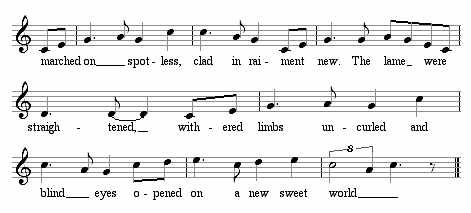
But at the same time the melody says,
There is a fountain filled with blood
Drawn from Emmanuel’s veins
And sinners washed beneath that flood
Lose all their guilty stains.
even though Vachel Lindsay directed that the poem should be sung to the tune of a different hymn, “Are You Washed in the Blood of the Lamb,” which has a completely different syllable scheme. I’m not sure those are the right words to that hymn, but I sang it many times in the first 20 years of my life, and I decided to set it down as Ives would have, from memory, with whatever divergences from the printed page it may have acquired in 30-odd years. It is difficult to overstate the subconscious pull that even only two or three notes tugging on a childhood memory can have in Ives’s music.
And incidentally, I will never cease to marvel at how Ives correctly intuited that “Shall We Gather at the River” was intended, from time immemorial, to cadence through a diminished triad:

– a version that has completely supplanted the original in my memory.
It may appear a criticism of some of Ives’s songs to say that they don’t stand on their own, but it’s actually to their fragmentary character that I attribute some of their psychological power. There is a theme in Shakespeare criticism, brought out most articulately by Stephen Greenblatt, that starting in the year 1600 Shakespeare heightened his sense of drama by omitting rational motivation from his plots. For instance, in the original Danish legend of Hamlet, it is no secret that Claudius has killed Hamlet’s father, and therefore Hamlet has a very practical reason to feign madness – to convince his uncle Claudius that he’s harmless and thus keep himself from getting killed. But Shakespeare makes the murder of Hamlet’s father a secret that Claudius doesn’t realize Hamlet knows, and therefore Hamlet’s simulation of madness has no practical motivation. The irrationality of it draws us more deeply into the play because the plot doesn’t explain why he’s doing it.
In a similar way I think some of Ives’s less self-contained songs ultimately make a more vivid impression because they are not explainable within themselves, and make our imaginations roam elsewhere. We’ve all seen his most complete songs, like “General William Booth,” “The Greatest Man,” “Majority,” or “The Side Show” printed in anthologies as an example of a great 20th-century song, and it always strikes me as a little disappointing, even misleading, because the breadth of Ives’s genius is so panoramic that one little perfect song, even one so ambitious as “General William Booth,” reduces him to a type, as though he were just another Dvorak, or Mussorgsky, or Bartok, that you could distill the essence of his style to one example. But a song like “Afterglow,” or “Walt Whitman,” or “Religion” or “Maple Leaves” or “Disclosure” or “Grantchester,” can’t be anthologized because it would raise more questions than it answers, and can’t be reduced to a type. Each of those songs is too obviously a cut-off piece from some larger whole, and needs the rest for context. These unanswered questions make us continue pondering some of these more ambiguous songs long after we would have quit thinking about “The Side Show.”
But this fragmentation manifests not only in the texts. Even more deeply it stems from radical discontinuities in the music, such as the atonally impressionistic introduction of the song “Old Home Day,” which gives way to an innocent opera house tune in march time – and never returns. Or the few syrupy measures of C major in the middle of “On the Antipodes,” surrounded otherwise by massive 12-tone sonorities in formalist patterns. Or the grandiosely Romantic chords that suddenly end the otherwise straightforward song “In the Alley,” or, in the opposite direction, the suprise V-I cadence in which the atonal song “Duty” crashes to a close. Each of these disjunctions points beyond the boundaries of the song to a world of musical materials, in some cases a foreign syntax, which is not instantiated within the song itself. The material of the song partakes of two or more different worlds, and we have to look outside the song to those worlds to complete the meaning of the song in our minds. This is, after all, classic postmodernism, and the premier theorist of musical postmodernism, the late Jonathan Kramer, took Ives’s music as the earliest locus classicus for the tendency.
When Ives wanted to imitate a pre-existing style, he could do so remarkably well. I’ve always been astonished at how succulently and identifiably French his songs “Qu’il m’irait bien” and “Chanson de Florian” are, yet without being traceable to any specific French composer. Yet this is rare for him, and more than any of the later postmodern composers, like William Bolcom or David Del Tredici or George Rochberg or even John Zorn, Ives had to create the musical worlds he refers to in his fragmentary works, so that in the Concord Sonata, “General William Booth,” Three Places in New England, and other works we find the completion of these other musical languages. In this way, it seems obvious that, more than any other great song composer, Ives’s songs need to be presented in their entirety for their sense to be complete, so that this week’s marathon serves a more urgent purpose than could any marathon of Schubert or Hugo Wolf or Ned Rorem or Cole Porter. Every single song is a piece of a puzzle.
As Ives says more than once in the “Postface to 114 Songs,” the question of whether one’s artistic creativity will gain more depth being in the center of one’s life rather than on the periphery is one that every composer has to answer for him- or herself. Many of us are not given the choice to make. Ives intended his songs as a reflex subconscious expression in response to the things in life that triggered his imagination, and what is most amazing about him for me is the compelling verisimilitude with which he appears to succeed in this. Where every previous composer had channeled his imagination through chords and materials consciously learned and analyzed from previous music, Ives invented not only a language, but languages, in which to express his subconscious – the atonal and massively contrapuntal language of “From Paracelsus,” the language of tone clusters in “Majority,” the dissonant tonal language of “The Housatonic at Stockbridge,” the 12-tone language of “On the Antipodes.”
For me, and I have never qualified this opinion, Ives was the greatest composer who ever lived – precisely because of his preternatural ability to imprint his imagination onto the musical page intact in every detail, without compromise, without a filter, without limitations, without fear, without invoking a syntax where no syntax was needed, without the slightest curtailing of the emotional intent for the sake of a merely aesthetic effect. Of course, this makes him Platonic rather than Aristotelian, because it was Plato who insisted on absolute fidelity to reality, Aristotle who argued for the internal consistency of a work of art. There will always, I suppose, be Aristotelians who find Ives lacking in aspects of completeness and craftsmanship and consistency of language, but I hope I have suggested that in his case these criticisms are inapplicable, and that the deepest power of his music resides exactly in what a conventional viewpoint would consider his flaws. That’s the spin I’d like to have in the air this week as we embark on listening to all 185 of these wonderful, inspired, and unbelievably varied songs.
Pointing to a Better Time than Ours
Blogging the Ives Vocal Marathon, day three:
The conference’s most surprising event was the Ivesian Sunday morning service at South Congregational Church, the Rev. Marybeth Marshall, minister, and with conference organizer Neely Bruce at the organ. The unsuspecting local congregation was joined by a dozen or more musicological academics, some of whom hadn’t been to church in, mm, a long time, but we restrained our ethnomusicological curiosity and struggled to blend in. At appropriate points in the service Neely led the choir and soloists in Ives’s “O Have Mercy, Lord, on Me,”  Psalm 42, “Rock of Ages,” “The Collection,” and “Serenity,” and also worked “Serenity”‘s repeating chords into his organ improv. No mere academic panel could have been as enlightening as hearing Ives’s liturgical music in its natural habitat: one had to imagine the possible world that could have resulted had Ives not freaked out from his positive 1902 reviews for The Celestial Country, kept his organ job, and become a successful church musician instead of veering into the insurance business. After such superb performances all weekend, hearing an amateur choir sing “Serenity” and “The Collection” was one of those “Be careful what you wish for, you may get it” moments, gratifying in its homespun sincerity but an acquired taste nonetheless. It called to mind John Bell, the stone-mason of whose raucous singing Ives’s father remarked, “Don’t pay to much attention to the sounds – for if you do, you may miss the music. You won’t get a wild, heroic ride to heaven on pretty little sounds” [Memos, p. 132]. Interestingly, Bill Brooks made exactly the same comment after I sang a few Ives phrases in my keynote address. And one of the hymns Neely scheduled was “Dear Lord and Father of Mankind,” based on the Whittier poem on which the text of “Serenity” is based:
Drop Thy still dews of quietness,Â
Till all our strivings cease;Â
Take from our souls the strain and stress,Â
And let our ordered lives confessÂ
The beauty of Thy peace.
I didn’t know, or had forgotten, that the poem was already a hymn, certainly not one the Baptists ever sang, damn them for mediocre taste.
I had spent the early morning hours reading Carol Baron’s Musical Quarterly article “Efforts on Behalf of Democracy by Charles Ives and his Family,” which details the strains in Ives’s thought he drew from the Congregationalist denomination, which broke away from the Massachusetts puritans because they were too theocratic and literal. Moss Ives, the composer’s brother, was a Congregationalist deacon and wrote books and articles about the history of religion in Connecticut, highly relevant to Ives’s Essays Before a Sonata. I haven’t finished Carol’s article, need to savor it slowly.Â
The usual examples of Ives’s songs are so often “Majority,” “Paracelsus,” “General William Booth,” and such modernist extravaganzas that we forget what percentage of the bulk of his song output (60%, maybe?) is polite parlor songs. Today, we remembered. “Far from my Heavenly Home” and “A Perfect Day” may be the only Ives pieces I never need to hear again: all the rest are at least perceptibly inspired, if not uniformly interesting. But the climactic final concert made up for any weak moments with a rousing “They Are There” and “Lincoln, the Great Commoner.” It was a truly amazing weekend. I used to write songs, and gave up partly, I suspect, because I never really came up with a song concept distinct from Ives’s – some of Ives’s posthumous songs can be found on my web site. But I’m now tempted to go back and write a few of the songs I’d once envisioned. Many in the audience seemed to consider the marathon a potentially life-changing event.
…of the Things Our Musicologists Loved
Blogging the Ives Vocal Marathon, day two:
1. Bill Brooks, whom I could follow around and write a fascinating blog titled “Blogging Bill Brooks,” gave a presentation on three of Ives’s war songs, “Tom Sails Away,” “He Is There,” and “In Flanders Fields.” However extraordinary Ives was in a lot of ways, Bill contextualized these three songs as a fairly normal attempt to be a good American in war time. Of the 36,000 songs written about World War I (geez, he actually counted – the most musical war America’s ever had, he claimed, and proved it), it was typical to use Tom as the ethnically neutral name for the soldier who went overseas. “In Flanders Fields” was a runaway smash hit poem, that got set to music more than 65 times, including a modernist setting by one Susan Wier Hubbard, socialite, that Bill claimed was as good and forward-looking as Ives’s. Most impressively, it turns out that mixing political tunes collage-style was a popular marching band ploy of the day, and Bill played some sound bites, notably “General Mixup” by the Arthur Pryor Band, to demonstrate that the juxtaposition of the Star-Spangled Banner, “Marching Through Georgia,” “Columbia the Gem of the Ocean,” and so on, in Ives’s “He Is There” wasn’t a startlingly unusual idea. It doesn’t take away anything from Ives’s genius, but does show that in 1917 he was more typically responsive to the music around  him than one tends to assume. Then Judith Tick talked about how “They Are There,” the 1943 update of that song, was one of 16 commissions for political pieces given by the League of Composers. She ended with a YouTube video of the song played by a ’90s punk duo.
2. Ken Steen, electronic composer at Hartt School of Music, took scans of Ives’s sketches, and wrote out, as best he could using computer-altered visuals to make the dim notes clear, all the bits of songs that Ives worked on and never finished. Bill Brooks then sang the song fragments, with Neely Bruce at the piano. Some were fairly complete as to vocal line, with only sketchy piano parts; some proceeded fully for a few measures before trailing off; some were college songs, some late experimental sketches, and some just dissonant arpeggios with a vague vocal line. It was strange listening to sparse fragments of songs, but along with the 185 songs being performed on concert, we certainly feel like we’ve heard every song impulse Ives ever got so far as to commit to paper. As a composer, I recoil from the idea that anyone might ever perform publicly the sketches I abandoned, which were usually abandoned for good reason. As a voyeuristic Ives buff, though, I couldn’t help relishing these little song skeletons whose outlines I could only reconstruct in my imagination.Â
3. I’ve heard a half dozen or more Ives songs I’d never heard before, most of them early, but the largest and latest by far was the seldom-recorded “Aeschylus and Sophocles,” for singer and two pianos with optional string quartet (both versions performed tonight). Strange, amazing piece in Ives’s dissonantly introspective, classical-text vein (see also “August,” “September,” “December”), decrescendoing to spare octaves for the line “But where kings honour better men than they, / Let kings be honoured too.” Elizabeth Saunders sang, and all the singers – David Barron, Johana Arnold, Gary Harger – have greatly internalized these songs, and are doing a dynamite job. Tomorrow morning, if I can wake up in time, we have an Ivesian church service at the local Congregationalist church.