The Psychology of Script

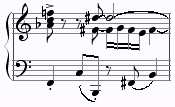
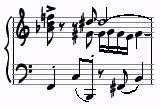
This was inevitable, but it hadn't happened to me before. We now have a student composing both string quartets and jazz tunes using Sibelius notation software. I found it amusing that he prints the string quartets in Sibelius's "normal" notation and the jazz pieces in its "inkpen" script:


I asked him why and he shrugged and didn't know. But it does subtly look like in the notation on the left the notes are fixed and must be played correctly, while the ones on the right are sort of just the "suggested" notes, and if you can think of something better you're free to substitute something. 


Years ago I used to write pieces that did have optional notes, placed in brackets or parentheses. Maybe I should notate them this way.


December 12, 2008 2:58 PM | | Comments (9) |

Categories:

9 Comments

I do that same thing ... I just think the inkpen notation is cool. I have a set of saxophone duets, in which the first 4 movements are in normal font, and the last is inkpen because it is a jazz influenced work. I think for a saxophone player (or any musician used to alternating between jazz and classical style) it can make a big in the mindset of the player, telling them to swing the eighth notes and add jazz inflections.

It may also come from when I used to use Finale. Their inkpen notation is called Jazz font.

I use Finale. It also has a "Jazz" font and a "Classical" font. When you start a new document, if you pick a "Leadsheet" template you get "Jazz" font by default, but you get a "Classical" font by default if you start an orchestral score. You can change these defaults, but learning how to do so takes time. I suspect you student is just sticking with the defaults of Sibelius.

Odd how the dots came out on the wrong end of the stems in the "Jazz" sample above.

I've seen experienced jazz players stumble over some parts written in fonts like the one on the left. I think it's just what the player is more comfortable with, what they're used to. A classical player would probably have to do a double take on the notation on the right.

Absolutely, notation and the psychology thereof is a fascinating subject, no doubt about it. As one who has lately spent a lot of time in the role of performer, I've developed some pretty strongly-held ideas about notation. Basically, the sole credible, plausible function of notation (as I see it) is that of enabling a composer to communicate his/her ideas as clearly as possible to performers. A qualification to that might be: as clearly as possible, where clarity is the desideratum - which in my experience is (or ought be) almost always the case. There may be certain cases where some degree of notational ambiguity is fine because the composer has deliberately opened a window looking toward a multiplicity of distinct interpretative possibilities; but genuine cases of this are quite rare. The whole idea that notation is more than that, is somehow a thing in itself that needs to be revered, admired, taken as Holy Writ, something that should be seen as a clear manifestation of the genius of the composer, I can't take seriously. And I'll add one more thought: in my experience all the best composers are willing to reconsider details of their notation in the light of working with good performers - not that they'll totally capitulate to any damn fool suggestion a performer comes up with, but rather that they'll exercise judgment and discernment to see how their notation can better relate to intelligent expressions of the realities of musical performance.

I think Dave MacD is right -- there's certainly some psychology there, but jazz musicians are much more likely to have read from the Real Book or other hand-notated sources. It's just easier, and more appropriate.

I do like how the font suggests style though -- but there are all kinds of other visual ways of representing music (20th Century-style) that do the same thing. Nifty.

Dave MacD's observation reinforces the general finding in (text) typography: people read best what they read most. The sans serif fonts we're all comfortable with were originally considered relatively difficult, the blackletter (Fraktur) fonts that were once common are now very difficult.

I'm pretty sure that anyone who had played from manuscript parts has also had the experience of presentation influencing expression, often unintentionally.

And I never know what to make of the 'conventional' scores of Bussotti, whose compositional and notational details are chosen to make interesting pictures on the page. I don't mean the partly-graphic scores (like this) but the 'normal' ones (can't find any examples on the web, alas). The result is the purest example of Augenmusik I can think of.

I'm still waiting for the George Crumb font: it will make everyone think my pieces are really difficult to play and involve theatrics and ritualistic behavior. Mwah ha ha ha haaaaah!

I prefer the "jazz font" for jazz charts, and although I've never thought about it before, it does seem like it would be easier for me to swing naturally when reading the jazz font. At the same time I would really want to swing a classical chart if it was written in jazz font. It's what I'm used to.

I remember a friend in school who used to write study notes in different coloured pens for each class. She said it helped her to get in the mindset for that subject.

Maybe this is a similar thing; if we usually read jazz in one font and classical in another, we'll have a tough time doing the opposite. I still use my calligraphy pens to handwrite charts, and I don't change the way I write for each style of music. Thanks to Sibelius, the days of copyists and hand written music are pretty much history.

There is a John Cage font available:

http://www.p22.com/products/cage.html

Leave a comment

Sites To See

Postclassic Radio! - Kyle Gann's internet radio station that accompanies the blog; see the playlist at kylegann.com

American Mavericks - the Minnesota Public radio program about American music (scripted by Kyle Gann with Tom Voegeli)

Kalvos & Damian's New Music Bazaar - a cornucopia of music, interviews, information by, with, and on hundreds of intriguing composers who are not the Usual Suspects

Iridian Radio - an intelligently mellow new-music station

New Music Box - the premiere site for keeping up with what American composers are doing and thinking

The Rest Is Noise - The fine blog of critic Alex Ross

William Duckworth's Cathedral - the first interactive web composition and home page of a great postminimalist composer

Mikel Rouse's Home Page - the greatest opera composer of my generation

Eve Beglarian's Home Page - great Downtown composer

Just Intonation Network - a meeting place for people interested in alternative tunings

Erling Wold's Web Site - a fine San Francisco composer of deceptively simple-seeming music, and a model web site

The Dane Rudhyar Archive - the complete site for the music, poetry, painting, and ideas of a greatly underrated composer who became America's greatest astrologer

Utopian Turtletop, John Shaw's thoughtful blog about new music and other issues

About this Entry

This page contains a single entry by PostClassic published on December 12, 2008 2:58 PM.

Occasionally the Truth Is Spoken was the previous entry in this blog.

Compliment Sighting is the next entry in this blog.

Find recent content on the main index or look in the archives to find all content.

AJ Ads

Introducing
AJ Arts Blog Ads

Now you can reach the most discerning arts blog readers on the internet. Target individual blogs or topics in the ArtsJournal ad network.

Advertise Here

AJ Blogs

AJBlogCentral | rss

culture
About Last Night
Terry Teachout on the arts in New York City
Artful Manager
Andrew Taylor on the business of arts & culture
blog riley
rock culture approximately
critical difference
Laura Collins-Hughes on arts, culture and coverage
Dewey21C
Richard Kessler on arts education
diacritical
Douglas McLennan's blog
Dog Days
Dalouge Smith advocates for the Arts
Flyover
Art from the American Outback
Life's a Pitch
For immediate release: the arts are marketable
Mind the Gap
No genre is the new genre
Performance Monkey
David Jays on theatre and dance
Plain English
Paul Levy measures the Angles
Real Clear Arts
Judith H. Dobrzynski on Culture
Rockwell Matters
John Rockwell on the arts
Straight Up |
Jan Herman - arts, media & culture with 'tude

dance
Foot in Mouth
Apollinaire Scherr talks about dance
Seeing Things
Tobi Tobias on dance et al...

jazz
Jazz Beyond Jazz
Howard Mandel's freelance Urban Improvisation
ListenGood
Focus on New Orleans. Jazz and Other Sounds
Rifftides
Doug Ramsey on Jazz and other matters...

media
Out There
Jeff Weinstein's Cultural Mixology
Serious Popcorn
Martha Bayles on Film...

classical music
The Future of Classical Music?
Greg Sandow performs a book-in-progress
On the Record
Exploring Orchestras w/ Henry Fogel
Overflow
Harvey Sachs on music, and various digressions
PianoMorphosis
Bruce Brubaker on all things Piano
PostClassic
Kyle Gann on music after the fact
Sandow
Greg Sandow on the future of Classical Music
Slipped Disc
Norman Lebrecht on Shifting Sound Worlds

publishing
book/daddy
Jerome Weeks on Books
Quick Study
Scott McLemee on books, ideas & trash-culture ephemera

theatre
Drama Queen
Wendy Rosenfield: covering drama, onstage and off
lies like truth
Chloe Veltman on how culture will save the world

visual
Aesthetic Grounds
Public Art, Public Space
Another Bouncing Ball
Regina Hackett takes her Art To Go
Artopia
John Perreault's art diary
CultureGrrl
Lee Rosenbaum's Cultural Commentary
Modern Art Notes
Tyler Green's modern & contemporary art blog
Creative Commons License
This weblog is licensed under a Creative Commons License.