
I refuse to do those “playlist” things that tell you what I’m listening to lately, because 1. I go for long periods without listening to anything, and I’m entitled because I’ve already spent way too much of my life involved with other people’s music; 2. half of what I do listen to is for teaching reasons; 3. I often listen to pieces because I’m planning to steal ideas from them, so admitting it would sometimes be too revealing. But lately I’m listening over and over to a mammoth work that’s long fascinated me, Grand Hotel (1989)Â by Cornelis de Bondt. I found a score of it last year in Amsterdam at Donemus, and in fact, I envy the Dutch that they have such a helpful, friendly, professional institution as Donemus as a one-stop-shopping center for Dutch music. I hiked over to their spacious office (way off in an inconvenient corner of eastern Amsterdam) several times, and was welcome to listen to recordings and peruse scores for hours before buying anything. Imagine if the U.S. had a central place you could go to and look through scores by John Luther Adams, David Lang, Elodie Lauten, and almost any other American composer you could name – that’s what the Netherlands has. Although some of the younger Dutch composers have refrained from selling their scores through Donemus because, they told me, the place has gotten a reputation for representing the stodgier side of Dutch music. Given that they handle music by people as hip as Jacob ter Veldhuis, I couldn’t quite see the criticism myself, but I report what I was told. One easily imagines that if there were such a place in the U.S. it would get swamped by the officially approved orchestral New Romantic crowd of whom our elites are so dubiously proud, but Donemus struck me as admirably democratic in its absence of stylistic bias.
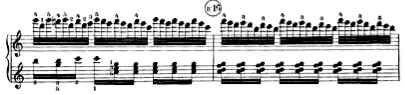
It’s a huge, sprawling, 37-minute essay, one of those complex pianistic virtuoso marathons mostly notated on three if not four staves, played in a frantic fury by Gerard Bouwhuis, and based on Beethoven’s Op. 111 Sonata. The opening diminished-seventh chords of that piece burst forth frequently, and many of the streams of falling 32nd-notes come from the concluding scale passages of Beethoven’s first movement. The longer (naturally) second movement is dotted with less obvious references to Beethoven’s tranquil Arioso theme, often simply sudden secondary dominant chords that hang quietly in the air. Key signatures – three flats, six sharps, five flats – run through the piece, although it more often sounds atonal than diatonic. The title, according to the liner notes, is a reference to the crumbling edifice of tonality, which certainly stands nobly, but in ruins, here. I’m told by one of his students that Cornelis de Bondt (b. 1953) teaches theory at the Hague Conservatory. I’ll upload an mp3 here for you, as is my wont, but only temporarily, for it’s a big file and I can’t spare the space forever.
Grand Hotel is a interesting contrast to Clarence Barlow’s Variazioni e un pianoforte meccanico, which is a theme and variations for live pianist and Disklavier based on the theme of Op. 111’s second movement. Barlow’s achievement is a stunning logical and technological feat, the computer grabbing data from Beethoven’s theme and composing its own cheery, sometimes almost humorous variations. Grand Hotel is far darker and more introspective, a kind of existential, manic-depressive drama featuring Op. 111’s elements in dozens of flashbacks, playing with sudden recognitions and buried shards of memory.Â
As documented here, though 95% of my musical influences are American, I’ve got my own long history of associations with Op. 111, a piece which haunts me almost as much as the Hammerklavier haunted Brahms. (Other European pieces deep in my compositional bloodstream include Mahler’s Sixth – which turned up in Custer and Sitting Bull – the adagio of Bruckner’s Eighth, Busoni’s Fantasia Contrappuntistica, Boulez’s Rituel, and everything Erik Satie wrote.) I’ve never directly quoted Op. 111 except in my Disklavier piece Petty Larceny, which consists entirely of quotations from the Beethoven sonatas, but my I’itoi Variations of 1985 was a kind of spiritual homage to it, and my two-movement piano concerto Sunken City mimicked Op. 111’s proportions and movement contrasts. In grad school, for Peter Gena’s class on the late Beethoven sonatas, I wrote a paper titled “Zen and Op. 111,” in which I analyzed the piece as a contrast between samsara and satori, between the earthly veil of illusions and the tranquility of Zen consciousness. My idea was that the first movement’s angry diminished sevenths chords represented a relentless drive to the final, sad resolution, while the arioso variations gradually defuse the polarity between tonic and dominant, creating an image of timelessness in which resolution becomes unnecessary:
(Years later, in a review of Pauline Oliveros, I described this same C-D-F-G sonority as a musical equivalent of the Yin-Yang symbol, a union of tonic and dominant with no thirds to specify major or minor.)
Obsessively quoting every historical thinker from Basho to Nietzsche and beyond, “Zen and Op. 111” was too embarrassingly immature to make public now, but at the time I was moved to write it by a book that I recently had the tremendous pleasure of rereading: R.H. Blyth’s Zen in English Literature. This is one of the books Cage read in the ’40s, and one I had discovered through his writings. Blyth was a British Japanese scholar who sat out World War II in Japan, and whose books on haiku elevated that genre to heightened visibility in the West. Zen in English Literature is an absolutely charming tome, a virtuoso display of astonishing erudition (which I tried ineffectively to imitate) in which he traces examples of Zen consciousness through Wordsworth, Dickens, Shakespeare, Keats, Blake, Pope, Donne, Milton, Chaucer, Cervantes (not English, but included anyway), and many others. Hamlet’s “There is nothing either good or bad but thinking makes it so” is the book’s continually recurring mantra, and he finds Zen in every perfectly self-forgetful artwork: “Art is frozen Zen.” No isolated example will do the book’s flavor justice, but for instance Blyth compares George Herbert’s