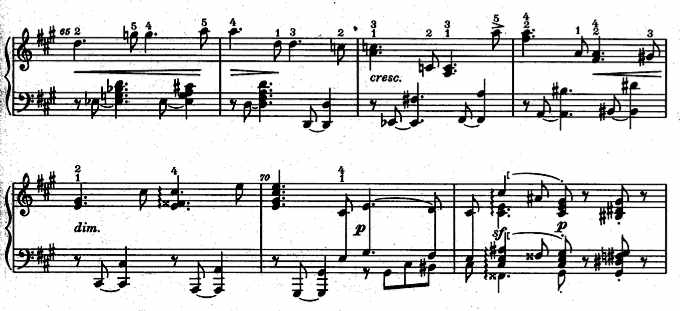
[UPDATE: Anwer below] Don’t you wish your doctoral music exams could have gone on forever? I know I do. And here, just to relive a little of the thrill, is a small test reminiscent of same. If you can guess the composer’s name, you and I have a lot to talk about, but failing that, guess 1. the date of composition, and 2. the date of the composer’s birth. Here’s an mp3 of the passage so you don’t have to drag your computer to the piano.
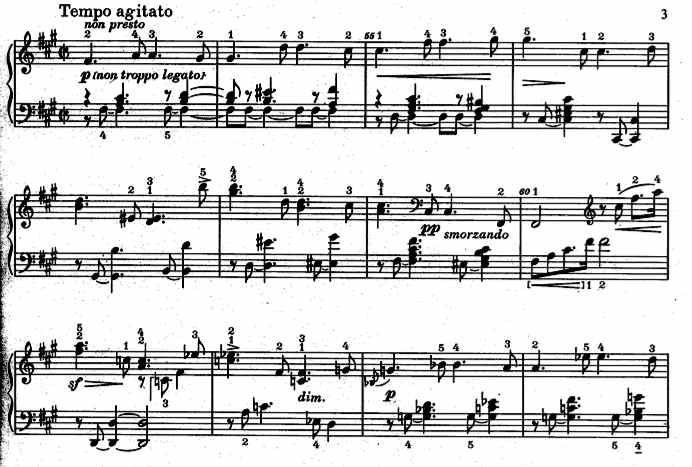
The tempo of that music sample wasn’t very agitato…
I bet it’s a trick question, but I guess I’ll go with composed 1860, born 1830.
Pure Guess:
Composition: 1845
Born: 1810
C.P.E. Bach ?? (In a Hitler-era edition?)
Dussek, right? Figures: us unrepentant Bohemians always have a lot to talk about. (No, I’m not a Dussek expert. But my rule is, if it looks like early Schumann but it’s not, Dussek is the best place to start looking.)
Sounds like Brahms or Schumann.
A quick search on Google and IMSLP easily finds the piece, whose author lived from 1760 to 1812 and was previously known to me only for a couple of small pieces I played when learning piano as a child.
Ok – I was cheating, without any help I would never have located the piece before 1860.
Composed in 1885, born in 1850.
Just throwing it out there.
It’s by Jan Ladislav Dussek, b. 1760. His piano sonata in f# minor, op. 61, written around 1806.
Hmmm…. I’m not sure whether that went through the first time. If it did, apologies for the double post:
It’s by Jan Ladislav Dussek, b. 1760. His piano sonata in f# minor, op. 61, written around 1806.
That might be Dussek…but then I have no doctorate, sir.
Dussek – Sonata in F sharp minor, Elegie harmonique, Op. 61
First decade of 19th cent.
Just got lucky, really.
That was the relative date of composition in the last post. D.O.B is February 12, 1760. Had to look that up. Does that count?
Darn, I was going to guess Dussek, too. His harmonies seem to anticipate Schubert’s abrupt harmonic changes. What also strikes me is that it looks as though it could be played on guitar (except for a few of the lowest notes.
You gave the answer away before I was through reading. My guess before that, though, was a composer a generation before Schumann. The piano texture gives it away – this is not anything written by the generation born at the beginning of the 19th century, i.e. Schumann, Chopin, Liszt – it’s way too thin. The range of the piano doesn’t go below G# or above B, so it’s conservative even for its day, compared to, for example, Beethoven’s Appassionata. That said, I’m completely ignorant of Dussek’s music. Another composer to look at from that era is Beethoven’s friend Reicha, whose odd meters and strange fugues freaked out Beethoven (one fugue has the answer at the tritone! Mozart meets Bartok! http://en.wikipedia.org/wiki/36_Fugues_(Reicha))
KG replies: Well, the entire sonata uses a six-octave range, and a lot of Dussek’s piano writing is fairly thick – no point in generalizing all that from this one opening passage. And I do mention Reicha’s fugues and meters now and then:
http://www.artsjournal.com/postclassic/2008/10/a_clementi_afterthought.html
Well, I guessed Chopin.
But from your update note, is it fair to say that there is nothing in the .mp3 fragment style-wise that would indicate its actual date of composition? Ken Fasano gives a list of technical issues pointing to the early date – are any of them conclusive?
I suppose the bigger issue is not limiting composers to some arbitrary pigeon-hole, but it seems to me if you were not familiar with Dussek’s work, assigning an accurate date would be difficult from the hearing or seeing the score.
KG replies: Well, I rather thought that if you weren’t familiar with Dussek, then you’d be likely to guess a much later date – which everyone unfamiliar with Dussek did. The point was not really to test people’s historical acuity, but to show how ahead-of-his-time Dussek was – which means it was a trick question, I guess. Actually, I think what would give it away would be the overall form, which is more like Clementi than like Schumann.