
What Part of "Eno" Didn't You Understand?

Byrne.jpg
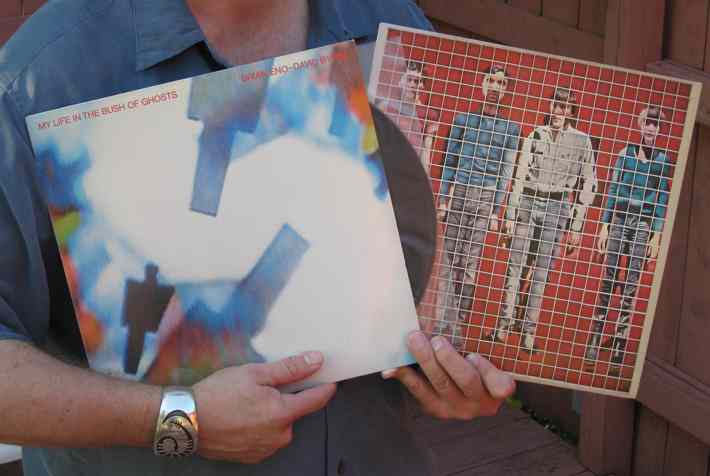
The items you see me holding above are my old vinyl copies of My Life in the Bush of Ghosts by David Byrne and Brian Eno (1981) and Talking Heads's More Songs About Buildings and Food (1978), both bought when they were brand new. There is a riff going around the internet that I don't know who David Byrne is, or didn't have any idea that he ever had any connections to experimental music. In fact, in addition to knowing the above albums I saw David Byrne play at the Walker Art Center in Minneapolis at New Music America in 1980 - where his three-minute set drew a loud cry of "too short!" from an angry audience member. (Consensus at the time was that he hadn't taken our underfunded little experimental festival very seriously, and had blown it off with a lackluster piece.) And, back when people bought cassettes, I had a cassette of The Catherine Wheel, the dance he wrote for Twyla Tharp, and even read some of the book it was based on because I was trying to get into it. It's new to me, this thing about not being allowed to disagree with a document until you know all about the author; and that if the author is a famous and well-loved figure, you're not allowed to disagree at all. But I've known for 30 years who Byrne is and where his career has connected with avant-garde music. 


It is sometimes suggested, as lately, that I have a classical elitist's antipathy toward pop songs. In fact, I have often mentioned that my early music was heavily influenced by Brian Eno, but perhaps I've never said it entirely in caps. FROM 1978 TO 1984 I WAS RATHER OBSESSED WITH BRIAN ENO, BUYING EVERY RECORD HE PUT OUT - WHICH I STILL DO (JUST A COUPLE OF WEEKS AGO I ACQUIRED BEYOND EVEN, HIS LATEST COLLABORATION WITH FRIPP, RELEASED LAST FALL) - NOT ONLY HIS AMBIENT ALBUMS BUT HIS POP ALBUMS, AND I ALSO CHECKED OUT EVERYONE HE COLLABORATED WITH, PARTICULARLY FRIPP, CLUSTER, AND BYRNE. Short of tattooing "Blank Frank is the messenger of your doom and your destruction" or "More for me, bless my soul" on my forearm, I don't quite know what else to do. If being able to sing from memory all the lyrics to Taking Tiger Mountain by Strategy, Here Come the Warm Jets, and Before and After Science isn't enough to kill this elitist reputation, then you just want to think ill of me, so go ahead.


I shook hands with Eno once, at the 1988 Composer-to-Composer Festival at Telluride. There was a beautiful woman standing just behind me, so Eno and I didn't actually make eye contact. He had showed up at the festival a couple of days late, and in the meantime, Lou Harrison and Terry Riley had enjoyed some wonderful public discussions about microtonality - different kinds of scales, the problems of retuning a piano, gamelan tunings, and so on. Eno arrived, and was on a panel with the other composers. Someone mentioned microtonality, and Eno instantly blurted out, "Ohhh, microtonality, that just produces a lot of good theory and a lot of bad music." Every composer's eye in the house shot toward Lou and Terry, who exchanged commisserating glances. 


This is relevant to the reactions (not only mine) to the recent Byrne article. I yield to few in my enthusiasm for Eno - but I can't help but be aware that, personally, he is too high up in the musico-social stratosphere to deign to notice that he was on stage with two of America's greatest composers who just happened to be microtonalists, and that he insulted their entire outputs with an offhand comment. I'm not mad at him, I still listen to and imitate his music (I just finished a month's repeated listening to his The Plateaux of Mirror with Harold Budd - an album I prefer, by the way, to Bush of Ghosts, sorry). But for all his experimental-music street cred, which I find vastly impressive, Eno is a pop elephant trampling on us poor classical ants without noticing it. 


Likewise, I think of Byrne as one of the good guys, his blog often full of populist common sense - I quoted it approvingly during the internet radio crisis of 2007 - and I maintain that I treated him respectfully. But you see how casually he dissed and dismissed two entire genres of composers, and the fact that he does have experimentalist bona fides doesn't ameliorate his minor sin, but makes it the more insulting. I was not moved to think, as some apparently did, "Well, Byrne sure made all us classical composers look like self-deluding losers, but since he's such a creative experimentalist himself, I guess that's just fine!" He ought to know better, just as Eno should have in 1988. But these guys - wonderful, creative human beings though they may be in general - are not focused on us postclassical musicians. We are way too far down in the dirt beneath them for it to even occur to them what effect they might have on us, good or bad. Thank goodness we at least have the right to disagree with them - though some in the blogosphere are telling me that's not true either.


August 2, 2008 12:25 AM | | Comments (8)

Categories:

8 Comments

Well, at least Eno and other famous non-classical musicians have no critical standing with respect to contemporary classical music. Nor, as a result, do they have any kind of professional obligations to assure that their critical judgments are objective, well-informed and backed by relevant experience. So I (for one) would not get too upset about anything they say.
Don't you think it is far more upsetting that such categorical, misinformed and poorly considered judgments also have been voiced in print by professional critics of classical music? Harold Schonberg's longtime and wholesale vendetta against serialism on the pages of NY Times is probably the best example. But I still encounter this kind of critical attitude toward contemporary classical music today.

Don't tattoo any lyrics on your body without first fact-checking them.

KG replies: Especially with Eno. Is it, "King's Lead Hat was a poker to the fire, / It will come, come, surely it come"? Who knows?

I always wondered where that Eno quote about microtonal music came from...thanks.

I hate speaking for other people, but I'm under the impression that Eno--and by some extension Byrne--work with such high-profile pop acts these days for such exorbitant amounts of money that they perhaps lose sight of various areas of classical/avant-garde music. When Eno was producing the new Coldplay album, I'm sure it was difficult for him to hear microtonal music over the "Kaching!" of cash registers.

And, as an aside, I took a class with Kyle just a shade under four years ago in which he played us Eno's "1/1" from Music for Airports on piano--and expressed to us how meaningful that was to him (I'm paraphrasing slightly on the last part).

Oh, and, hi Kyle!

KG replies: Hi Tal, thanks for weighing in. I think you tried to get in touch with me a couple of years ago while I was traveling, and I'm sorry I failed to get back to you. Let me know when you're in town again.

I just thought that adding this rather remarkable example of mean, vitriolic and scornfully dismissive criticism of a well-known and much respected contemporary classical composer would be relevant to your discussion.
The link is to Richard Taruskin's infamous New York Times attack on Donald Martino. I'm sure you know this article well, and I think it makes Eno and Byrne sound rather gentle and innocent in their negative remarks about contemporary classical music.

http://query.nytimes.com/gst/fullpage.html?res=9E00E5D61F39F933A25750C0A960958260&sec=&spon=&pagewanted=all

KG replies: I've always loved that article, thought it was brilliant. Thanks for the link. But the difference is, Taruskin's comments are extremely nuanced and entirely focused on a specified number of works. Eno's and Byrne's comments are directed in a scattershot way at a wide range of composers, referring by implication to hundreds of works that the commenters had never listened to.

I've noticed that recently Eno & Byrne have both made comments like "Who would listen to that?" or "Why would anyone do that?" when discussing or writing about certain musical procedures. Given Eno's documented notion that one of art's functions is to increase one's empathy towards situations, people and things that are unfamiliar, I find their comments amusing.

These two quotes from John Cage seem apt: "If something is boring after two minutes, try it for four. If still boring, then eight. Then sixteen. Then thirty-two. Eventually one discovers that it is not boring at all." and: "The first question I ask myself when something doesn't seem to be beautiful is why do I think it's not beautiful. And very shortly you discover that there is no reason."

Something strange happens to people who only dress in black Armani and know nothing about culture beyond BAM. Shame on them and their high-priced ghetto. They really should know better.

Kyle, just tell them this:

Some of them are old
But it would help if you could smile,
To earn a crooked sixpence you'll walk many a crooked mile,
And when you do, remember me, remember me.

Those who get it, will. Those who don't, oh well.

Leave a comment

Sites To See

Postclassic Radio! - Kyle Gann's internet radio station that accompanies the blog; see the playlist at kylegann.com

American Mavericks - the Minnesota Public radio program about American music (scripted by Kyle Gann with Tom Voegeli)

Kalvos & Damian's New Music Bazaar - a cornucopia of music, interviews, information by, with, and on hundreds of intriguing composers who are not the Usual Suspects

Iridian Radio - an intelligently mellow new-music station

New Music Box - the premiere site for keeping up with what American composers are doing and thinking

The Rest Is Noise - The fine blog of critic Alex Ross

William Duckworth's Cathedral - the first interactive web composition and home page of a great postminimalist composer

Mikel Rouse's Home Page - the greatest opera composer of my generation

Eve Beglarian's Home Page - great Downtown composer

Just Intonation Network - a meeting place for people interested in alternative tunings

Erling Wold's Web Site - a fine San Francisco composer of deceptively simple-seeming music, and a model web site

The Dane Rudhyar Archive - the complete site for the music, poetry, painting, and ideas of a greatly underrated composer who became America's greatest astrologer

Utopian Turtletop, John Shaw's thoughtful blog about new music and other issues

About this Entry

This page contains a single entry by PostClassic published on August 2, 2008 12:25 AM.

All Indians Walk Single File was the previous entry in this blog.

Those Who Don't Like, Do Well is the next entry in this blog.

Find recent content on the main index or look in the archives to find all content.

AJ Ads

Introducing
AJ Arts Blog Ads

Now you can reach the most discerning arts blog readers on the internet. Target individual blogs or topics in the ArtsJournal ad network.

Advertise Here

AJ Blogs

AJBlogCentral | rss

culture
About Last Night
Terry Teachout on the arts in New York City
Artful Manager
Andrew Taylor on the business of arts & culture
blog riley
rock culture approximately
CultureGulf
Rebuilding Gulf Culture after Katrina
Dewey21C
Richard Kessler on arts education
diacritical
Douglas McLennan's blog
Flyover
Art from the American Outback
Life's a Pitch
For immediate release: the arts are marketable
Mind the Gap
No genre is the new genre
Rockwell Matters
John Rockwell on the arts
Straight Up |
Jan Herman - arts, media & culture with 'tude

dance
Foot in Mouth
Apollinaire Scherr talks about dance
Seeing Things
Tobi Tobias on dance et al...

jazz
Jazz Beyond Jazz
Howard Mandel's freelance Urban Improvisation
ListenGood
Focus on New Orleans. Jazz and Other Sounds
Rifftides
Doug Ramsey on Jazz and other matters...

media
Out There
Jeff Weinstein's Cultural Mixology
Serious Popcorn
Martha Bayles on Film...

classical music
The Future of Classical Music?
Greg Sandow performs a book-in-progress
On the Record
Exploring Orchestras w/ Henry Fogel
Overflow
Harvey Sachs on music, and various digressions
PostClassic
Kyle Gann on music after the fact
Sandow
Greg Sandow on the future of Classical Music
Slipped Disc
Norman Lebrecht on Shifting Sound Worlds

publishing
book/daddy
Jerome Weeks on Books
Quick Study
Scott McLemee on books, ideas & trash-culture ephemera

theatre
Drama Queen
Wendy Rosenfield: covering drama, onstage and off
lies like truth
Chloe Veltman on how culture will save the world
Stage Write
Elizabeth Zimmer on time-based art forms

visual
Aesthetic Grounds
Public Art, Public Space
Artopia
John Perreault's art diary
CultureGrrl
Lee Rosenbaum's Cultural Commentary
Modern Art Notes
Tyler Green's modern & contemporary art blog
Creative Commons License
This weblog is licensed under a Creative Commons License.