Robot Shit

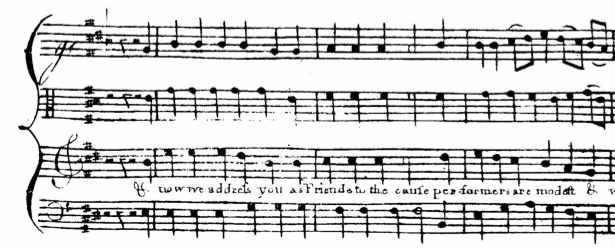
I love this score layout from William Billings's hymn "Modern Musick" from The Psalm-Singer's Amusement, originally published in 1781, a reprint of which I picked up at a used book store this week. Notice how the sharps in the key signature are written as much as possible straight up in a line, F-C-D-G:
BillingsMM.jpg

Notice too how the note-stems are all on the right, and the treble clef in the soprano is indicated by a "g" on the second line. For awhile in college I wrote my treble clefs that way myself, on the reasoning that a treble clef is just an ornate Baroque Italian G written around the second line, and there was no reason for us to go on writing a "g" in that ridiculously festooned manner 300 years later when even the Italians don't write them that way anymore. I had to choose my battles, I was destined to become engaged in so many, and I rather quickly gave that one up. But I love the insouciance with which the sacred order of sharps in a key signature is ignored, and how little difference it makes in reading the music.

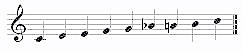
So many conventions of notating music we take as sacred, ancient, and unalterable are actually of relatively recent vintage, and used to be quite malleable. In Bach's day the customary way of indicating a minor key indicated what we now think of as Dorian mode; for a violin suite in E minor he would notate two sharps, F and C. Nowadays, of course, we "correct" him, for old Bach clearly hadn't taken first-year theory class. In the 1890s, theory textbooks (Rimsky-Korsakov's, for example) taught the "harmonic major" scale:

harmonicmajor.jpg

based on the idea that the minor iv chord had become so common in major as to necessitate a special scale. Fashions come and go, theoretical premises change, but we teach notational conventions as though they are somehow ontologically necessary, and browbeat young musicians into a terrified conformity to which Billings was happily oblivious. Why? For efficiency's sake, so that none of our orchestral musicians will ever have to encounter a piece of music that doesn't look pretty much like every one they've ever seen, which otherwise might force them to actually pause and think a moment.

I had a friend many years ago, who died at a tragically young age. Bill Hogeland will know who I'm talking about. Right out of Oberlin she got a job as bassoonist for the Dallas Symphony. I saw her one morning, and she was tired because, she said, the orchestra had performed the night before.

"Oh, what did you play?," I asked.

"Ummmm... Mahler, I think."

She was a sweet young conservatory product, but her conception of her job was to prepare her reeds, sit down in her chair onstage, and expertly and automatically play the notes on the page some functionary had placed on her music stand, without ever thinking about who the composer was or what the notes meant. And to make sure that such nice people never have to think, never have to pause a moment and figure out anything they haven't seen a million times before, our young composers have to have notational conformity beat into them on pain of excommuncation from all decent musical society. Yesterday a student brought me an orchestra piece with the following rhythm:

7-8.jpg

It's a perfectly nice rhythm of a kind I might have well used myself. But not in an orchestra piece you don't! I knew enough to put the kibosh on that. Because efficiency, sight-reading, automaticness, and thoughtlessness are at the heart of turning out classical music, that hallowed repertoire that Miles Davis so aptly termed "robot shit" - because it was played by robot musicians who couldn't be bothered to deviate from or even think about what they saw on the page.

Don't bother writing in to tell me how communist and retarded my opinions are, 'cause I already know what the robots think of me. I'm an evolutionist, who thinks music has evolved and has a right to keep evolving, whereas most classical musicians are creationists who think Beethoven created it 200 years ago and it has to stay that way eternally. As Mark Twain said, "I don't give a damn for a man who can only spell a word one way."

February 20, 2008 6:05 AM | | Comments (22)

Categories:

22 Comments

YES! Finally someone speaks the truth, the whole truth and nothing but the truth. But why is it so rare in the online *classical* music world to see this acknowledged?

Fascinating post. Personally, I've always taken the view that it's fine to stray from or stay within the confines of "conventional" notation, as long as you know why you're doing it. It always worries me how many people I come across who don't seem to have thought about it. To paraphrase Miles Davis, the thing to judge is, does the man project and does he have ideas.

Kinda reminds me of my violin teacher, who was associate concertmistress of a major orchestra in the NJ/NYC area. I noticed her orchestra was scheduled to perform a work by a 19th-century composer I was fond of and asked what she thought of his music. Her reply: he wrote thorny string parts. That's when I realized that orchestras are myopic, that they only see what is in front of them within their own small part of the musical universe. My teacher related to the composer's music only insofar as how the composer wrote and notated for the violin. Reminds me of that story about those three blind dudes and the elephant...

Why'd you put the kibosh on that? Those rhythms were pretty easy to read--they fit the meter without an irrational subdivision and the beaming corresponds to the underlying beat/conducting pattern. Take five seconds to point out those two bars at the outset, and I don't think even my all-amateur choir would have much trouble. How else will players get used to reading rhythms like that?

Seriously, it strikes me that notation has evolved, even in the last fifty years, and in a good way--from an ad hoc, varied lingua franca to, in essence, a mother tongue, a framework that allows for near-universal communication. (Billings' notation, for example, is quite clunky and vague when it comes to metrical changes and metric modulations--something that's been clear as a bell for us since around the 1950s.) I'd have to really work to come up with a musical idea that couldn't be expressed using some ready combination of standard notation. At the same time, I'd have no problem coming up with music that would be absolutely notationally bland and still defy sight-reading and limited rehearsal time.

The problem is not notation, but musical training (though that's getting better all the time) and the limitations of the business (getting worse). Orchestral music tends towards boring predictability because of the current logistics of orchestral rehearsal and performance, not because standard notation can't express novel, complex ideas. (And, in defense, those logistics aren't always the players' fault.)

KG replies: I agree with virtually everything you've said. Your penultimate sentence practically sums up my entire meaning. But as for the 7/8 rhythm, I have found that a lot of brilliant classical players cannot, simply cannot adjust to playing a dotted 8th beat that runs against a quarter-note or 8th-note meter, even though my composer friends and I do it all the time. You can write it for new-music groups, but not for the orchestra.

You may not want to post this, Kyle, but I don't have any quarrel with your communistic, retarded side. I think of the creationist/evolutionist analogy a bit differently, though. To me, inventing a new way to indicate that G is on the second staff line is creationist, as opposed to an evolutionist's approach of using the clef that has demonstrated its fitness to survive.

KG replies: If it's fit to survive, why can't students draw one well? Even *my* treble clefs look like crap. And you should try to read my quarter rests! No wonder Feldman replaced them with a straight line.

Actually I thought it was kind of a pissy post, but I've been starting to feel too damn respectable lately.

I think we're seeing a shift in the orchestral repertoire--composers who can write complex, yet comprehensible rhythms are creeping into the canon. If that's not standard rhythmic practice yet, and frankly I'm surprised to hear it isn't, it certainly will be, very soon.

Here I thought hand-drawn clefs were extinct.

KG replies: What, you don't have a chalkboard in your theory classroom? Oh, I see, those big-endowment schools must all have *smart* classrooms by now.

Just pullin' yer leg.

Classical notation has always seemed peculiar to me. My engineering background pleads to try to find some better, more rational and unambiguous way to notate. And orchestral scores seem so simple compared to piano scores, which follow no rules I can determine (but, then I never learned piano .. just them single staff instruments).


But even if there was a better notational system, who would use it? Like the quirky QWERTY (Roman) keyboard, there are many better arrangements of the keys, but none have a chance of being adopted only because everyone is used to QWERTY. And like classical notation, which was based on assumptions and conventions that no longer hold, the QWERTY arrangement was intended to minimize clashes between typewriter hammers when typing fast. Now, who remembers typewriters?


But some composers (e.g. Feldman) have a lot of fun with notational ambiguities, like painters with their optical illusions.

KG replies: Well, we're stuck with QWERTY, and I think we're stuck with the seven white/five black piano-keyboard concept. But the computer keyboard has evolved, and has extra buttons and functions that it didn't have on typewriters. And the example of jazz notation, which is so much looser than classical, often not repeating things like clefs and key signatures, suggests that within that scale framework we could have a lot of wiggle room for more varied styles of notation, and still allow performers to use their ingrained chops.

Miles Davis was
guilty of reverse
snobbism against classical music,and
judging it by the
standards of Jazz.
I doubt that he had any
real understanding of
it. Orchestral musicians
are not necessarily
robots.Many are highly
intelligent,knowledg-
able people with
advanced degrees who
are highly dedicated
professionals.When it
was new,the Rite of Spring was fiendishly
difficult for orchestras.Now it is
no big deal.
I'm afraid you merely
set up a straw man here,with all due respect.

KG replies: I've never met an orchestral musician myself, but I read Miles Davis's autobiography, and based my opinion of them on what he said. This is evidently the conclusion you've drawn. Actually, my gripe is not with orchestral musicians per se, but with the extreme conformity that the composing world imposes on musical artists in the guise of prostrating ourselves in hopes of becoming worthy to be accepted into the exalted world of orchestral performance. This is something I've dealt with week in and week out my entire professional life, and you're not going to sweep aside decades of experiences with a comment about straw men. Actually, the episode in which Miles Davis made that comment - trying to get brass players to play with feeling and a little swing in Sketches of Spain - is very revealing and worth reading.

Kyle, do you feel there is any qualitative difference or advantage between composers writing by hand vs. using software? I ask this question in reference to an earlier entry where you mentioned a famous composer ditching his publisher and going it alone. I assume that composer uses software at some point in the creative process in order to self-publish. Someone writing from hand could perhaps still benefit from the copyists, proofreaders, and editors employed by a publisher.

I mean, using software doesn't allow as much flexibility as writing from hand, does it? Although there are a lot of symbols you could insert in lieu of clefs and regular noteheads, or to represent existing or invented extended techniques, etc., aren't you still essentially limited to whatever the software allows?

But on the other hand, the use of software then allows for the survival of archaic notation because no-one using it needs to know how to actually draw a treble clef anymore.

KG replies: Hey, Nathan. I particularly like your last observation. And let me herewith admit my guilt that working in Sibelius has, sadly, caused me to shy away from some of the more radical things I used to do in my music, like incomplete tuplets and meters like 17/24 and 7/5. I really need to get back to pencil, the gods will never forgive me if I don't. And though I hate to say it because it makes me sound like an old curmudgeon, I really think that working in pencil is crucially important for a young composer, as developing a better sense of continuity. There'll always be some genius who survives without it, just as Stravinsky became a great orchestrator despite always composing at the piano, but I fear for a generation that never has the pencil-on-paper experience.

However, the composer I mentioned (whom you know) always works in pencil himself, and pays a guy to enter his music into software. So he doesn't have that problem.

And on a totally unrelated note, I owe you $200.

I'm wondering how you told your student to notate that rhythm. It is a nice rhythm, of course; the problem is just getting people to play it without spending a lot of extra-time figuring it out, or just playing it wrong all the time. It seems to me that it would be fine as notated, maybe, in, say, a piano piece, or a solo fiddle piece (although it still offers the same problems about getting accuracy easily and quickly), but for an ensemble piece, especially a large ensemble piece, it just asks for a lot of unnecessary time, even though a notation that makes it easier to see how it's counted in 7/8 is immediately more cumbersome.

KG replies: Well, I'd be interested in your opinion. I had him divide certain dotted 8ths into a 16th tied to an 8th, and to arrange such tie-overs into a pattern consistent in adjacent measures: i.e. 3+2+2 in every 7/8 measure, or 2+2+3. And I'm still considering trying to renotate the whole passage back into 4/4 with accents. Often the question, I think, is, not so much whether the musicians can handle it as, can the conductor?

Hey Kyle,

Composers who do it old school (which I also agree is a big plus) can certainly still avoid using a big publisher by paying someone to enter the notes into software (I've paid several electric bills by being the lackey for such a composer).

However, composer beware! I once did a piece by Stephen Paulus--Age of American Passions--and when I first got the score, I confess I did exactly what you rant against...judged it because the finale score looked so "childish." Turns out after meeting Paulus, I learned someone does it for him. I guess this is where having that special Boosey font comes in handy (since, unfortunately, I don't think I'm the only conductor who judges scores at least on some level this way...)

KG comments to everyone else: The author here is a promising young conductor, and when conductors speak, composers are all ears. We don't always hear what we want to hear, but we're all ears.

Notation is a funny thing! We do still use a strange notation for 8th notes. For example: 6/8, 9/8, 12/8, are based on the idea of 12 eighths in a measure of triplet 4/4. The truth is, this makes the notes "12th notes." Our notation should logically be: 6/12, 9/12, 12/12.

And we should have 15th-notes too! (for the quintuples)

Just a thought...

KG replies: Hey, Henry Cowell had the same thought, and it's one of my favorite thoughts.

Charles wrote: Notation is a funny thing! We do still use a strange notation for 8th notes. For example:{...]


It's a problem I've always had with traditional notation; unless you spend far too much time fighting it, the simple fractional divisions lock it all into a very narrow range of relationships. Part of what the interpretation of the performer does is to loosen that feeling, but it's often all too apparent. Anyone who works a good while with midi "piano roll" notation will know how weak and stifling our whole "proportion of 2, 4, 8, 16, 24, etc. (or 3, 5, 7, 9, 11..., together or in combination)" staff notation thing is.

Even without 15th notes, there are wonderful meters, all of which are sight-readable.

For example: 2/4 can be nicely divided as 5/16 + 3/16. Add another 3/16, and you have a lovely 11/16 time signature.

(p.s. I am truly enjoying your blog.)

A trumpet-player friend of mine in a major Symphony Orchestra also once expressed a very myopic (my-auric?) comment to me about not remembering which work had been performed the night before. When I expressed amazement at this, my friend pointed out that sitting on stage in the orchestra is perhaps the worst place to actually HEAR the music, since the acoustics of most halls are designed to project sound away from the orchestra towards the audience. The situation is usually worse for the brass, since they are typically placed at the back behind everyone else, with all the sound going away from them. So, perhaps it is unfair of us to criticize orchestral musicians for not always having a good sense of the overall sound of what they are playing.

In all fairness, Finale can handle pretty much anything I throw at it in terms of notation. But "pretty much anything" isn't "everything," and I also have moderated my notational preferences due to either an inability to do something in Finale (large time signatures that span several staves) or the hassle factor involved in doing something (cutout scores). Still, I'd hate to go back to the days of pencil or worse, transparencies, fountain pen nibs and electric erasers. I still can't believe I spent so many hours dealing with that stuff.

17/24 is perfectly possible at Sibelius, isn't it? It just won't play it right, unless you change the metronomic mark when producing the midi file.

KG replies: Well, I've done it, but it's certainly not convenient, and the hardest part is indicating the incomplete tuplets. Got any good tricks, pass it along.

I agree the notation itself is what's truly confusing here, since the dotted notes obscure the beat pattern. The notation should reflect whatever the conductor will beating -- assuming this is the dominant rhythm, I'd be inclined towards 3+2+2 myself.

Players need to be able to see at a glance what's on the beat and what's off the beat.

KG replies: Indubitably - according to convention. But there's an increasing practice of running different-duration pulses against the grain of the meter, common in Michael Gordon's music, and John Luther Adams's, and Mikel Rouse's, and mine, and a lot of other people's, that classical musicians are going to have to internalize someday, and the way we notate it is actually simpler, once you know how to do it, than the conventional note divisions.

KG replies: Indubitably - according to convention. But there's an increasing practice of running different-duration pulses against the grain of the meter, common in Michael Gordon's music, and John Luther Adams's, and Mikel Rouse's, and mine, and a lot of other people'

And mine.

But still, the players in my band find these rhythms much easier to read and perform (and honestly, I find them much easier to conduct) when they notated with ties rather than with dots over the beat. Ties make it possible to see the underlying grid at a glance, which is crucial for sight-reading purposes.

I don't dispute that the dotted notation is more elegant. You may be right that we all ought to learn to read rhythms notated that way, and that eventually we all will.

For now, though, I have no intention to abandon the more practical (tied) notation, which sounds exactly the same but is, for most people, in most situations, much easier to read.

There was a similar discussion about beaming the pattern vs. beaming the meter over on NMBx a while back.

Oh, right, you need the tuplet. Somehow I thought that "24" would alone tell that each sixteenth-note is now working like one sixth of a quarter-note (I hope I'm not messing the English names).

In fact it does, but that seems a bit too complex just to let it 17/24 and no other marking. Do you have in your blog (or elsewhere) an example of how you'd like it written? I like to [try to] solve things at Sibelius.

KG replies: Here's the excerpt from "Mars" (if I can put an image in a comment):

Oops, guess I can't. But it's on page 4 at http://www.kylegann.com/Mars.pdf

If you need numbers of tuplets that "officially" do not exist for Sibelius, you could try to write them as "plain text", choosing for that "Opus Text" as font, size 10 will be okay.

The problem is, if you want to write other texts, you'll need to use "Small text" and other text options. One of them will be exclusive for the Opus Text font, which has those numbers used for tuplets.

Create > Text > Other Staff Text > Plain Text

To choose Opus Text for plain text writing:

House style > Edit text styles > Plain Text > Edit - choose Opus Text

Then you'll be able to write whichever tuplet numbers on anything. I hope I could've brought something new...

Leave a comment

Sites To See

Postclassic Radio! - Kyle Gann's internet radio station that accompanies the blog; see the playlist at kylegann.com

American Mavericks - the Minnesota Public radio program about American music (scripted by Kyle Gann with Tom Voegeli)

Kalvos & Damian's New Music Bazaar - a cornucopia of music, interviews, information by, with, and on hundreds of intriguing composers who are not the Usual Suspects

Iridian Radio - an intelligently mellow new-music station

New Music Box - the premiere site for keeping up with what American composers are doing and thinking

The Rest Is Noise - The fine blog of critic Alex Ross

William Duckworth's Cathedral - the first interactive web composition and home page of a great postminimalist composer

Mikel Rouse's Home Page - the greatest opera composer of my generation

Eve Beglarian's Home Page - great Downtown composer

Just Intonation Network - a meeting place for people interested in alternative tunings

Erling Wold's Web Site - a fine San Francisco composer of deceptively simple-seeming music, and a model web site

The Dane Rudhyar Archive - the complete site for the music, poetry, painting, and ideas of a greatly underrated composer who became America's greatest astrologer

Utopian Turtletop, John Shaw's thoughtful blog about new music and other issues

About this Entry

This page contains a single entry by PostClassic published on February 20, 2008 6:05 AM.

Charles Ives's Alma Mater was the previous entry in this blog.

Read It - and Feel It is the next entry in this blog.

Find recent content on the main index or look in the archives to find all content.

AJ Ads

Introducing
AJ Arts Blog Ads

Now you can reach the most discerning arts blog readers on the internet. Target individual blogs or topics in the ArtsJournal ad network.

Advertise Here

AJ Blogs

AJBlogCentral | rss

culture
About Last Night
Terry Teachout on the arts in New York City
Artful Manager
Andrew Taylor on the business of arts & culture
blog riley
rock culture approximately
CultureGulf
Rebuilding Gulf Culture after Katrina
Dewey21C
Richard Kessler on arts education
diacritical
Douglas McLennan's blog
Flyover
Art from the American Outback
Life's a Pitch
For immediate release: the arts are marketable
Mind the Gap
No genre is the new genre
Rockwell Matters
John Rockwell on the arts
Straight Up |
Jan Herman - arts, media & culture with 'tude

dance
Foot in Mouth
Apollinaire Scherr talks about dance
Seeing Things
Tobi Tobias on dance et al...

jazz
Jazz Beyond Jazz
Howard Mandel's freelance Urban Improvisation
ListenGood
Focus on New Orleans. Jazz and Other Sounds
Rifftides
Doug Ramsey on Jazz and other matters...

media
Out There
Jeff Weinstein's Cultural Mixology
Serious Popcorn
Martha Bayles on Film...

classical music
The Future of Classical Music?
Greg Sandow performs a book-in-progress
On the Record
Exploring Orchestras w/ Henry Fogel
Overflow
Harvey Sachs on music, and various digressions
PostClassic
Kyle Gann on music after the fact
Sandow
Greg Sandow on the future of Classical Music
Slipped Disc
Norman Lebrecht on Shifting Sound Worlds

publishing
book/daddy
Jerome Weeks on Books
Quick Study
Scott McLemee on books, ideas & trash-culture ephemera

theatre
Drama Queen
Wendy Rosenfield: covering drama, onstage and off
lies like truth
Chloe Veltman on how culture will save the world
Stage Write
Elizabeth Zimmer on time-based art forms

visual
Aesthetic Grounds
Public Art, Public Space
Artopia
John Perreault's art diary
CultureGrrl
Lee Rosenbaum's Cultural Commentary
Modern Art Notes
Tyler Green's modern & contemporary art blog
Creative Commons License
This weblog is licensed under a Creative Commons License.