No obituary I've seen for the record producer Teo Macero (1925-2008) has mentioned that he was also a composer, though the Times notes that he studied with Henry Brant. I offer the only piece I've heard of Macero's, recordings of Macero's music. I always feel bad making a big deal out of a composer just after he dies. That's why I've devoted the bulk of my musicology work to living composers while they're around to appreciate it. … [Read more...]
Marketing Postminimalism
market aleatory music and totalism, too. … [Read more...]
Read It – and Feel It
As an introvert who grew up as a classical musician in Texas, I tend to apologetically assume that everyone in the world knows more about pop music and jazz than I do. For instance, I didn't read Miles Davis's incredible autobiography until I was in my 40s, while I assume any hip musician would have read it in his 20s if not earlier. (The fact that I was 34 when it was published does not allay my suspicion.) But it appears that not everyone knows the context in which Miles referred to classical music as "robot shit," and the story - heavily … [Read more...]
Robot Shit
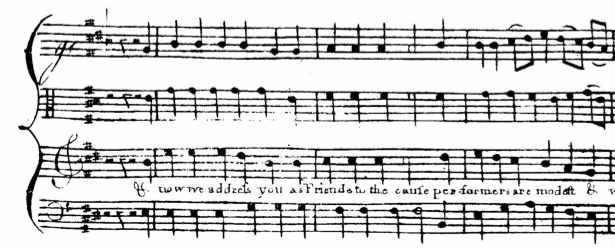
I love this score layout from William Billings's hymn "Modern Musick" from The Psalm-Singer's Amusement, originally published in 1781, a reprint of which I picked up at a used book store this week. Notice how the sharps in the key signature are written as much as possible straight up in a line, F-C-D-G: Notice too how the note-stems are all on the right, and the treble clef in the soprano is indicated by a "g" on the second line. For awhile in college I wrote my treble clefs that way myself, on the reasoning that a treble clef is just an … [Read more...]
Charles Ives’s Alma Mater
This Thursday at 2:30 I'm delivering the Poynter Fellowship lecture at Yale University. I'll be illustrating the problems of my career by mixing up musicology, microtonal theory, and composition in one big indecipherable melange, with some rare scores and manuscripts by Nancarrow, La Monte Young, and myself and my contemporaries. It's at William L. Harkness Hall, Room 207, 100 Wall Street, reception to follow. See ya there. … [Read more...]
Exercise in Futility
To serendipitously follow up on my post about publishing and the unavailability of scores, I had dinner with a friend tonight who's a tremendously successful composer, scads of orchestral performances, awards out the wazoo, you name it. And he's telling me how he abandoned his big-name publisher, bought a fancy Xerox/scan/printing machine, and is publishing his own scores, with the same kind of binding and exactly the same quality he got from his publisher. He's sick and tired of people not being able to get his music, or having to pay … [Read more...]
History – Last Refuge of Scoundrels
I note with pleasure that my old friend Bill Hogeland, my only college pal I'm still regularly in touch with, got to write the … [Read more...]
Knowing the Score
A non-composing new-music enthusiast writes in with an urgent question: It is often nearly impossible for an ordinary person to obtain contemporary scores. I've written to composers that you mention without success (or often, without even a response). Why do we need to be Kyle Gann or eighth blackbird to get contemporary scores, even (or especially) when recordings are available? Amen, amen. How can we keep up a civilized discourse about new music today, even when we can get the recordings, when we can't find the scores on which the … [Read more...]
My Longyear Musicology Lecture
The opportunity to speak in an endowed musicological lecture series inspired me to talk about musicology itself for the first time in my life. I felt like I was going out on a limb a little, but these are thoughts I'd been having about what we need from musicology lately, and I hoped that some young musicologist or two might see this as an opportunity to return to the cause of new composed music, and do some much-needed good. In that spirit I post it here for a wider audience. The topics are pluralism, minimalism as a new historical era, and … [Read more...]
Mallet Heaven
LEXINGTON - Wow: never have I gotten a welcome like the one the University of Kentucky music department gave me. I was brought here on two pretexts, to give the Rey M. Longyear Musicology Lecture (which I'll post shortly), and to have my new vibraphone piece premiered by Andy Bliss. And it turns out that UK is one of the country's leading, if not the leading, percussion schools, due to the presence of percussion guru James Campbell. Who knew? They've got 30 percussion majors here, 24 undergrad and 6 grad, and four of the sophomores (Michael … [Read more...]
Answering All Questions
LEXINGTON - Yesterday I spoke at a graduate musicology seminar at the University of Kentucky. The professor, Lance Brunner, bade me not prepare, and used a method for directing class discussion that I recommend to others. The group had been reading my book American Music in the 20th Century, and he had each person prepare a question, the questions all asked in turn without being immediately answered; after which discussion could proceed with all the questions in mind. One question was, did I think complex music like that of the New Complexity … [Read more...]
The Dark Gang
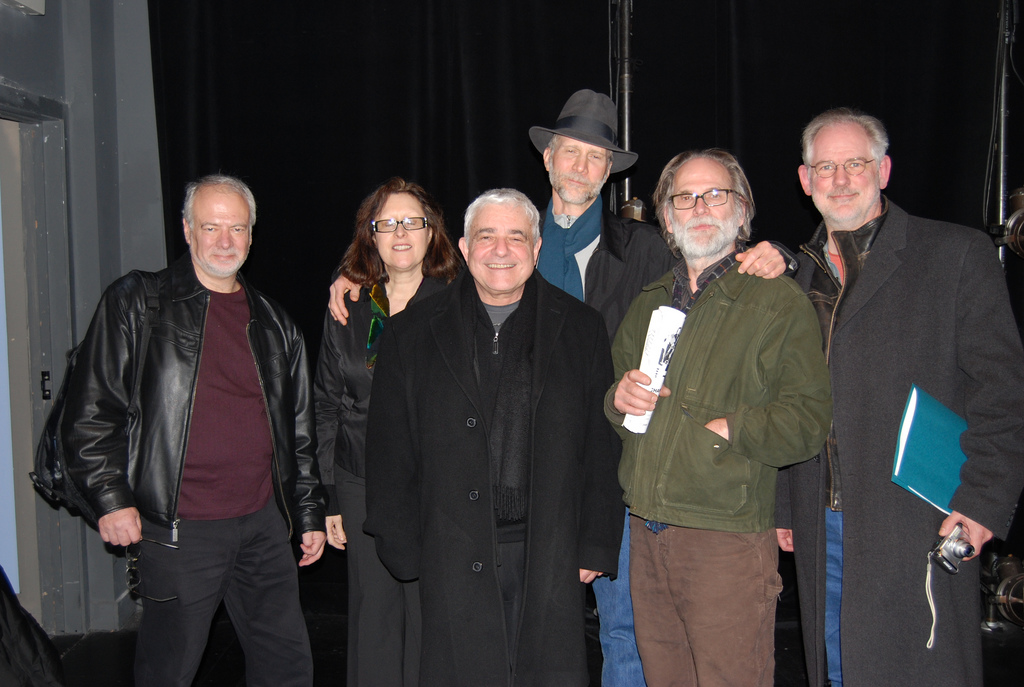
Arthur Sabatini, Elodie Lauten, Bill Duckworth, John Luther Adams, Trimpin, me, just prior to jumping on our motorcycles and roaring off into the Seattle night for a feverish orgy of debauchery and destruction from which the city would never recover. Photo by Tamara Weikel (DJ Tamara). … [Read more...]
The Art of the Nonsequitur
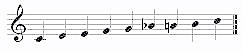
I would like to write something about my new piece Kierkegaard, Walking: not to draw attention to it, but because of a technical aspect of the work that I think draws together a number of late-20th-century influences and says something about the extent to which musical ideas can be style-independent. On a personal level, this is to fill in gaps in the lengthy drinking discussion John Luther Adams had the other night about our respective premieres, and also to clarify for anyone curious that my new piece does indeed intend to do what it seems to … [Read more...]

Recent Comments
mclaren on Ives, Caught Between Two Caricatures
Once again we get a high-octane musician slamming a composer for producing "naïve" work. And what, I ask you, is...Bob Gilmore on Ives, Caught Between Two Caricatures
Agreed. I love Ives 1, terrific piece. But I'd have to say my favourite of all the symphonies is the...M. on Ives, Caught Between Two Caricatures
Mr. Plush has already written, in his first sentence, what I would have liked to. Consider it seconded.Bill B on Ives, Caught Between Two Caricatures
You can hear it without going to it. The concert is streamed live over WQXR, as are all of...Vincent Plush on Ives, Caught Between Two Caricatures
Kyle, you have just reminded us (as if we needed reminding) why we regard you as one of the most...Steven Ledbetter on Minimalism Invented in England, It Turns Out
Sullivan did, indeed, brilliantly solve the problem set him by Gilbert's lyric, but he didn't find it easy. In fact...Paul Schleuse on Minimalism Invented in England, It Turns Out
The additive process is clearly there, but the harmony isn't really static. The alternation between D and D maj7/sus4 is...Gene on Minimalism Invented in England, It Turns Out
"Das Rheingold" opens with six minutes of tonic, not dominant. KG replies: But after six minutes of E-flat the curtain opens...Juhani Nuorvala on Minimalism Invented in England, It Turns Out
The minimalist I'm most reminded of by that Gilbert and Sullivan piece is Tom Johnson. - For additive process, there's...Ian Stewart on Minimalism Invented in England, It Turns Out
For additive precedents there is also the the folk song "Green Grow the Rushes, O". I also believe that the big...