
Tempo Canon Roll Call

Conventbit.jpg

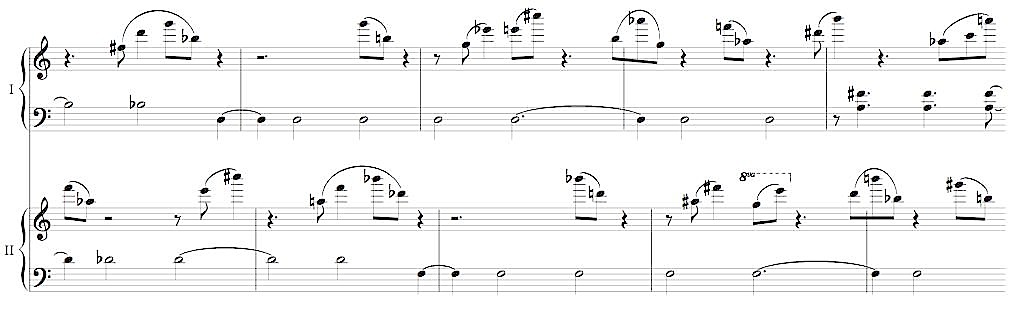
I recently had cause to mention my tempo canon for two pianos (or piano and tape), The Convent at Tepoztlan, and it occurred to me that the poor piece hadn't seen the light of day in 17 years. So I took a few spare hours and put it into Sibelius notation, which was a pain in the neck, because the two parts (performed with clicktrack) are out of kilter by a tempo ratio of 23:24. I had to input one part in an invisible 23:24 tuplet, and since Sibelius won't copy partial tuplets or paste into tuplets, there was no efficiency involved in its being a canon. (Of course, I'm still using Sibelius 2; if Sibelius 5 is improved in that respect, I'd appreciate hearing about it. I'm resisting upgrading because I don't like how long the sounds seem to take to upload in newer versions.) And since the meter is 5/4, and 5 doesn't divide into either 23 or 24, I couldn't justify measures and staves in either part. Does anyone know if true multitempo (or multi-meter) music is getting any easier in notation software?

In any case, a score to The Convent at Tepoztlan is now available. I think I might not post an mp3, since the sole recording used a tape part made with 1989 MIDI technology, and I would only get comments on its hokiness. It's an odd piece for me because the structure of the canon (pianos starting together, diverging, switching tempos, and coming back, at the canonic interval of a minor third) imposed a more audible, somewhat Bartoky architecture than I'm accustomed to use. It wasn't my first tempo canon - I wrote a slow, soft, Feldmanish one in college, at a time I'm not sure I'd even heard any Nancarrow - but I've never written one since. I'm curious as to whether my readers know of other tempo canons besides:

- the two dozen Nancarrow wrote,
- the couple I've written,
- Lou Harrison's 1941 Fugue (though per its title this may be more tempo fugue than strict canon, I can't remember and don't have the score handy),
- Jim Tenney's Spectral Canon,
- Larry Polansky's Four-Voice Canons,
- the augmentation canons in The Musical Offering,
- and the remarkable Agnus Dei from Josquin's Missa L'homme armé super voces musicales reprinted in HAM.

I remember years ago Ron Kuivila had an electronically generated piece based on the idea called Loose Canons, a title I much envied, and I also recall once a live performance by "Blue" Gene Tyranny in which material he played was echoed by a sped-up recording in real time. We should make another list! (I'm not going to count Ockeghem's Missa Prolationem, because a prolation canon and tempo canon aren't really the same thing; once Ockeghem moves into faster note values, the voices all end up at the same tempo.)

UPDATE: OK, in response to overwhelming demand from David Toub and Marc Geelhoed - come on, guys, slow down the e-mail barrage already! - I've put up an mp3. The tape part was sequenced in 1989 on old Voyetra Sequencer Plus software - anyone remember that? - with a Yamaha DX7, onto a four-track cassette recorder. Sounds like I was living in the 19th century (but at least I wasn't using Italian expression markings). The pianist is the superb Judith Gordon of Essential Music, but the recording is hardly better than the MIDI realization. Let it serve as a cautionary example, a reminder of primitive times.

January 22, 2008 10:37 AM | | Comments (20) |

Categories:

20 Comments

Kyle, please post a MP3. It can't be any more hokey than some of my MIDI-generated scores.

In Finale, which is what I use, one can do multiple meters. But as far as I have been able to tell, that might not translate into playback the way you intend it to. I can research it some more on the Finale Forum if you'd like.

That list is pretty comprehensive. I love the Spectral Canon---great work by Tenney.

Placed in your research published in "Contemporary Music Review," Volume 10, Part 1 (pp. 46-47), you indicate Larry Polansky's famous "Four Voice Canon #5 " - part of a magisterial series of short works of his - and the prolific and ubiquitous Ben Neill's "Antiphony" both to be representative examples of recent tempo canons to be considered.

James Tenney definitely made a nice point with his piece.

KG replies: Thanks, had forgotten the Neill.

Perhaps Arvo Pärt's Arbos, and the Cantus in Memory of Benjamin Britten...

KG replies: Really? *Tempo* canons? I had no idea. Need to brush up on my Pärt.

It will be a dark day when composers begin exercising self-censorship on the grounds of keeping potential hokieness from making its way to the public. Throw it all out there and let your readers decide, I say. Hokieness didn't deter Beethoven.

Larry Polansky!

KG replies: Got him. He may have others besides the Four-Voice Canons, though.

In the Cantus five voices are playing the same melody (just a descending natural minor scale that unwinds a note at a time -- A AG AGF AGFE etc.) in duration proportions of 1:2:4:8:16. Would you call that a "tempo canon" or do you make a distinction between that and other kinds of mensuration canons (I've heard the Pärt called an "augmentation canon")?

KG replies: I suppose that one could make a distinction based on the fact that half-notes moving against whole notes don't necessarily articulate a different tempo, but in the spirit of theoretical ecumenicism I am willing to include all augmentation canons under the tempo canon umbrella. I'll have to get a score to that.

Very much of my own work is at least close to tempo canon, but only few pieces get to be anything like strict tempo canons. In particular, one of my very few unperformed pieces is News from the Sun, which is something of an afterthought to Toccata III for 2 Glockenspiele (a fragment of which is on my site).

In News from the Sun, I just have three pages of music all based on harmonic variations with one melodic shape. The performers play in the tempo relationship 3 to 5, with the faster part playing his part 5 times and the slower part three times; so they do begin and end together and there are three points of convergence.

I think it's a big challenge, if only not to go crazy while playing, it's already quite dizzying to play only one part. If any percussionists reading this would like to give it a shot, I'm happy to send the score out.

What about Ockeghem's Mass?

Thanks for the MP3. If you want, Kyle, feel free to send me the MIDI file and I'll see what I can do with it using some piano samples. It's the least I can do.

What Tom describes in Arvo Pärt's music - "Cantus.." was the mensuration canon, a medieval-era technique whereby the melody was given proportionate rhythmic values of equal distribution, values of voices being twice as long as others, and on, and on.

But I found a very interesting article regards a Super Collider2 application, a microtonal tempo canon generator (with a limit to eight voices) just now. David Jaffe contributes. The article, written by the Englishman Nick Collins, seems thorough enough, and I would include the link here, and am submitting a URL under my name (see above). This link is a PDF file.

To wit, the Europeans Ockeghem, de Demarto, and Dufay composed the way Kyle did, as did Nancarrow, although many did not, I suppose. Still, in particular, the Missa Prolationem, by the ancient Johannes Ockeghem, was definitely the greatest example of canonic virtuosity within the canon. But I'm also reminded of the medieval European techniques of use of the "talea" and "color" - asserting something different and still not quite American by way of Tom Johnson in his Rational Melodies, for example. I hadn't tried the technique yet.

I remember Voyetra! My first sequencer program in 1993 or so was Voyetra, and I think it was an old version then because it came free with a MIDI interface, was DOS based, and only had a the piano-roll view. I upgraded to Cakewalk as soon as we got sweet, sweet Windows 3.1

Is there a reason not to include the Reich phase pieces in this list? I could see excluding the ones, like "Piano Phase", where one person speeds up and slows down in order to effect the phasing and then lock in at the new tempo, but it seems like "It's Gonna Rain" would be a pretty strict tempo canon.

And then there's this piece of mine: www.galenbrown.com/audio/GalenHBrown--Chorale.mp3
It's from 2004, and it's called "Chorale." It's for "two" sampled pianos or two Disclaviers. The tempo ratio is 136:143 The two pianos play the same material at slightly different tempi, starting 8 bars apart, and converging on the downbeat of measure 144. The last 20 bars or so are a non-canonic coda.

KG replies: I should have known you had something, Galen, and I think you must deserve credit for being the first composer anywhere to use the ratio 136:143 for *anything*. (Although I think Elliott Carter uses 175:216 in Night Fantasies.) And (sigh) I suppose we'd better include the Reich pieces for theoretical completeness, though it seems like cheating somehow.

Really nice piece, by the way. I'll put it up on Postclassic Radio when I get back to that.

Lord, I'm dense; please, remind me not to comment whilst cramming a giant Cuban sammich in my face. Of course I was thinking of the Four-Voice Canons. My eye skipped right over them in your list.

By way of atonement, I've done a quick google search and come up with another pair of names: Louis Andriessen (in Trilogy of the Last Day) and Roger Reynolds (in that Pulitzer piece). I just happened to download a recording of the Reynolds--I'll have to give it a closer listen.

Anyhow, as long as I'm here, what does distinguish a tempo canon from a prolation canon? What I don't know could fill a warehouse.

KG replies: Ah, you and me both, Dan, on all counts. I should have known about the Reynolds piece, I wrote the liner notes for the CD lo these many years ago. In a prolation canon (without wanting to go back and look up exact details), a long note is divided into three in one prolation (like 3/2), but only two in another (2/2), so that the same line will be interpreted as dotted whole notes in 3/2 but regular whole notes in 2/2. And that 3:2 works on two different levels. But when you get down to the level of faster notes (quarters or halves, depending on your transcription ratio), the notes are all the same regardless of prolation. Ockeghem gets out of his tempo canons by moving to shorter notes toward the end of every movement.

Hi Kyle,

To answer your question concerning Sibelius: I upgraded to Sibelius 5 about four months ago, and it is just as much of a pain in the ass to do true multi-meter and tempo canons as it was in sibelius 4 (I never used any versions before those two, as I was still doing everything by hand). I just spent roughly a month wrestling (read: hiding tuplets, rests, and barlines) with said program to get five parts into assymetrical loops of three different time signatures (at the same time) alternating with free time, and it still does not look right (but I am fairly certain it looks as good as it possibly can for the time being).

I don't know about anyone else, but I'm considering buying adobe illustrator for overall organization, and using sibelius for mere note entry and spacing within parts.

rumor has it that lilypond can do accurate scores with different times in each part because you are merely telling it where to put graphics, so it doesn't have to do the calculations the other notation programs do. i'm still hoping to get some time to learn this program and see if it's true. then, kyle, i can give you a score to that string octet instead of eight parts. =)

doesn't bach have some tempo canons in a musical offering? then there's that Fritz Jöde book "Der Kanon" -- that's got to have some examples. I'll check when I get home.

KG replies: Shit!, I meant the Musical Offering instead of the Art of Fugue, of course, and no one caught me on it. (I've changed it.) Whither musical literacy? Art Jarvinen's always touting a notation software called Score that is entirely graphics, no sequencing, so the score can look any way you want. But I'm so addicted to sequencing because I do so much MIDI stuff...

Wow, I was disappointed that I missed the Bach. I wasn't quite feeling right about the Art of the Fugue, and knew about the canonic variations of the Musical Offering from reading/scanning the popular layman's book from the 70's (or 80's?) Gödel, Escher, Bach" or two ago. Musical literacy, indeed!

On a different note, I like how this conversation has mentioned much about the different type of notation software other than Finale and Sibelius. I think it's cool, and I'd like to research them.

Actually when it comes to notating multiple meters or tempos I found that the best solution is to use a design program in addition to a music notation program such as Finale or Sibelius. I make tiff images of the music and then paste them into the design document. This can be done even using a word processing program such as Word. Just paste the different music staves as tiffs.
Elodie

Hey Kyle, I wrote a four voice tempo canon for movement 8 of my piece Tools. Each voice comes in at 4:3 of the voice before it.

By the way, I've been reading Music Downtown a lot the last couple of months - it's very inspiring.

Cheers, Ned

KG replies: Hi Ned, glad to know it. I'll take another listen. I've got some of your music up on Postclassic Radio.

James Tenney also wrote the Chromatic Canon (for Steve Reich), which features a tone row built up in repeating patterns of steady eighths; two pianos phasing against one another as pitches/eighths are added sooner in one part than the other. The parts share a constant single pulse and note values, but it's as succinct as the Spectral Canon, if not nearly as complex.

KG replies: Well, maybe we'll need to make a list of postclassical non-tempo canons as well.

Hey, I'm glad you posted that. It's not 'hoki' at all, just a little bit distorted from being on an old tape. Similar quality to FM radio, no problem at all with that. And I liked the piece, very listenable.

hi kyle

have you been able to discover a music notation program that can notate and play back multi-tempo compositions?

please let me know what is possible

best
sean

KKG replies: Not as such, and I keep sending out general queries. But of course I do my electonic/Disklavier pieces in Sibelius using complex tuplets, the empty brackets of which are easy to repeat from measure to measure, and you can even make the brackets invisible if you want. My 23:24 tempo canon is notated and plays back in Sibelius, but it was a pain in the tuckus and doesn't play back terribly well:

http://www.kylegann.com/TheConventatTepoztlan.pdf

Hi Kyle,

Glad to see you're interested in this subject!

Someone mentioned my name above so I thought I'd write a bit about my work in this area...

I've explored tempo canons in works such as Silicon Valley Breakdown (1982) and American Miniatures (1992) and in an interactive context in pieces such as The Seven Wonders of the Ancient World (1995).

One of the more interesting (to me) techniques used in the 1982 piece involved starting several voices at the same time, but applying an acceleration to some and a ritard to others, then reversing the process so that the formerly slowed parts speed up and the formerly sped up parts slow down. This was all done continuously and in such a way that they all ended up at the end of the phrase at precisely the same moment. This was done by using a "time map" which essentially takes the integral of the tempo.

Then, in "The Hanging Gardens of Babylon" (from The Seven Wonders of the Ancient World), I had a live percussionist (playing the "radio-drum") controlling the tempo deviation interactively so that he could control how far apart the parts deviate or bring them instantly in synch.

I've written up my approach in articles such as "Ensemble Timing in Computer Music." D. Jaffe. 1985. Computer Music Journal, MIT Press, 9(4):38-48.

Best regards and here's hoping for better support for multi-meter/multi-tempo meter in Sibelius!

David A. Jaffe
www.jaffe.com

Leave a comment

Sites To See

Postclassic Radio! - Kyle Gann's internet radio station that accompanies the blog; see the playlist at kylegann.com

American Mavericks - the Minnesota Public radio program about American music (scripted by Kyle Gann with Tom Voegeli)

Kalvos & Damian's New Music Bazaar - a cornucopia of music, interviews, information by, with, and on hundreds of intriguing composers who are not the Usual Suspects

Iridian Radio - an intelligently mellow new-music station

New Music Box - the premiere site for keeping up with what American composers are doing and thinking

The Rest Is Noise - The fine blog of critic Alex Ross

William Duckworth's Cathedral - the first interactive web composition and home page of a great postminimalist composer

Mikel Rouse's Home Page - the greatest opera composer of my generation

Eve Beglarian's Home Page - great Downtown composer

Just Intonation Network - a meeting place for people interested in alternative tunings

Erling Wold's Web Site - a fine San Francisco composer of deceptively simple-seeming music, and a model web site

The Dane Rudhyar Archive - the complete site for the music, poetry, painting, and ideas of a greatly underrated composer who became America's greatest astrologer

Utopian Turtletop, John Shaw's thoughtful blog about new music and other issues

About this Entry

This page contains a single entry by PostClassic published on January 22, 2008 10:37 AM.

Seattle, City of Dreams was the previous entry in this blog.

Ainsi on dit is the next entry in this blog.

Find recent content on the main index or look in the archives to find all content.

AJ Ads

Introducing
AJ Arts Blog Ads

Now you can reach the most discerning arts blog readers on the internet. Target individual blogs or topics in the ArtsJournal ad network.

Advertise Here

AJ Blogs

AJBlogCentral | rss

culture
About Last Night
Terry Teachout on the arts in New York City
Artful Manager
Andrew Taylor on the business of arts & culture
blog riley
rock culture approximately
critical difference
Laura Collins-Hughes on arts, culture and coverage
Dewey21C
Richard Kessler on arts education
diacritical
Douglas McLennan's blog
Dog Days
Dalouge Smith advocates for the Arts
Flyover
Art from the American Outback
Life's a Pitch
For immediate release: the arts are marketable
Mind the Gap
No genre is the new genre
Performance Monkey
David Jays on theatre and dance
Plain English
Paul Levy measures the Angles
Real Clear Arts
Judith H. Dobrzynski on Culture
Rockwell Matters
John Rockwell on the arts
Straight Up |
Jan Herman - arts, media & culture with 'tude

dance
Foot in Mouth
Apollinaire Scherr talks about dance
Seeing Things
Tobi Tobias on dance et al...

jazz
Jazz Beyond Jazz
Howard Mandel's freelance Urban Improvisation
ListenGood
Focus on New Orleans. Jazz and Other Sounds
Rifftides
Doug Ramsey on Jazz and other matters...

media
Out There
Jeff Weinstein's Cultural Mixology
Serious Popcorn
Martha Bayles on Film...

classical music
Creative Destruction
Fresh ideas on building arts communities
The Future of Classical Music?
Greg Sandow performs a book-in-progress
On the Record
Exploring Orchestras w/ Henry Fogel
Overflow
Harvey Sachs on music, and various digressions
PianoMorphosis
Bruce Brubaker on all things Piano
PostClassic
Kyle Gann on music after the fact
Sandow
Greg Sandow on the future of Classical Music
Slipped Disc
Norman Lebrecht on Shifting Sound Worlds

publishing
book/daddy
Jerome Weeks on Books
Quick Study
Scott McLemee on books, ideas & trash-culture ephemera

theatre
Drama Queen
Wendy Rosenfield: covering drama, onstage and off
lies like truth
Chloe Veltman on how culture will save the world

visual
Aesthetic Grounds
Public Art, Public Space
Another Bouncing Ball
Regina Hackett takes her Art To Go
Artopia
John Perreault's art diary
CultureGrrl
Lee Rosenbaum's Cultural Commentary
Modern Art Notes
Tyler Green's modern & contemporary art blog
Creative Commons License
This weblog is licensed under a Creative Commons License.