
AMSTERDAM – The painter Philip Guston was Morton Feldman’s best friend. In 1970, Guston abandoned the abstract expressionist style he had been closely associated with, and began painting cartoonish figures that often included shoes, disembodied eyeballs, and hooded figures. To say Feldman was shocked would be an understatement. As someone recently told me the story (heard from someone else who was there), Feldman came to the initial exhibition and Guston came up to ask him what he thought. For several minutes, Feldman simply couldn’t speak, and Guston slowly and sadly got the point. Finally Feldman just turned away and left, and the two parted ways for years. And Feldman wasn’t the only one. “It was as though I had left the church,” Guston later recalled; “I was excommunicated for awhile.” The dependably venomous Hilton Kramer titled his review of the show, “A Mandarin Pretending to be a Stumblebum.”
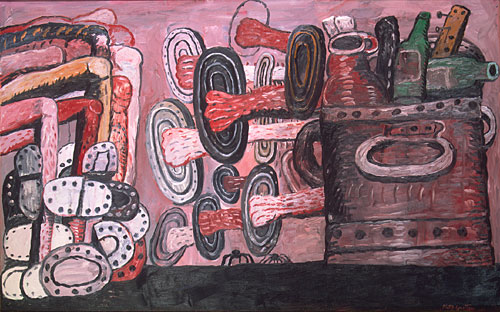
Guston: The Street
I have a couple of upcoming performances in Amsterdam, and I got here early to see John Luther Adams and to hear his beautiful sound installations Vespers and Veils. John and I have fantastic conversations. Something about the interaction of his profundity and vagueness and my superficiality and sharpness gives off sparks that seem to intermittently illuminate all of existence. Perhaps the most mind-blowing musical conversation I’ve had in my life was one John and I had about a year and a half ago, walking through the snow and cold outside Fairbanks. I keep meaning to blog about it someday, but I’m still trying to process it. I’ll tell you about it when I can do it justice.
John, as everyone knows, is a composer whose paradigm is nature. Vespers and Veils, based on prime-numbered harmonics of the overtone series, are softly roaring continua. All of John’s works, by his own frequent admission, have to do with the incredible Alaskan landscape he lives within. His pieces are walls of sound: not impenetrable, but gorgeous, relentless, ebbing and flowing, swelling and dispersing, piling up in waves that stretch beyond one’s concert-hall attention span. Veils engulfs you and makes you just want to sit down and be quiet. His orchestra piece For Lou Harrison, just released this month on New World, is a series of avalanches, each one quite like the last but different in detail, before whose massive beauty one can only submit. His music is big, beyond human in its scope, and as impersonal as it is translucent.
Back in the ’80s, I tried to be the kind of composer John is. It was in the air. Cage had unleashed the force of nature into music, and everyone was obsessed with sonority and process, trying to get their own personality out of the music and let nature speak for itself. The objectivity of 12-tone music had given way to a perhaps even greater objectivity of process-oriented logic. But over years of experimentation, I found that nature didn’t speak through me. The natural processes I came up with were more tedious than compelling. I loved Cage’s music, and La Monte Young’s, and Steve Reich’s, and John’s, but it was not mine to write. Whatever joy I took in composing had to do with the personal and subjective: the quirky melodic decoration, the unexpected key change, the rhythmic figure that seems bizarre at first, but finally becomes familiar through repetition. I greatly admired the composers of nature, and wrote about them enthusiastically, but I was not one of them. My muse led in a different direction.
I’d been thinking about this difference between me and John lately, and in discussing it, we wandered into Feldman and Guston. Both of us largely base our music in a Feldmanesque paradigm, an ongoing continuum of only subtle dynamic change. For me, Feldman was not a composer of nature, though he is ambiguous in this respect, and the question is one about which reasonable people could disagree. “Those 88 notes are my Walden,” he said, referring to the piano keyboard, and I interpret that to mean he saw himself not as a channel for nature, but as the Thoreau-like individual reacting to nature. I hear the anxious melodic figures in Rothko Chapel as psychological, not natural, conscious of their alienation and attempting to find release or resolution or integration. Take the incredible passage near the end of Feldman’s For Philip Guston where the music strips down to just four chromatic pitches for a full 25 minutes, and then suddenly opens up into a pure C-major scale across the entire piano: that’s no natural process, the result of no inevitable logic, but an incredible psychic release after almost unendurable repression. Of course, I’m cherry-picking my examples to make the point.
What was revealing was the differing reactions John and I had to Guston’s heretical pictorial style. When he first encountered it years ago, John, he said, had the same reaction as Feldman: he couldn’t believe that a great abstract expressionist had turned away from the wonders of pure color and shape to paint naive-looking figures with strangely personal, idiosyncratic associations. It took him awhile to decide that Guston’s late works were no less masterful than the early ones. I first knew Guston from his earlier work as well, but the shoes and giant eyeballs and hooded figures flooded me with an instantaneous sense of relief. It was liberating. I had been a Jackson Pollock fanatic, or thought I was, but Guston made me realize that I was hungry for art to reintegrate the human element, the personal element, the whimsical and idiosyncratic. Nature is a paradigm that an artist can hardly help worshipping, but ultimately I felt that we also need an art that is about being human, with all the attendant neuroses, embarrassments, longings, and humor. I love(d) abstract expressionism, but I wanted to know how, once we had made our way through it, we were going to come back to dealing with the uncomfortableness and absurdity of human consciousness.
It helped that Guston’s paintings were cartoon-like. I love cartoons myself, and in the ’90s found myself drawn to what I think of as my cartoon music, the stylized appropriations of musical clichés. I especially let myself go in my Disklavier pieces: the rhythmically dislocated ragtime of Texarkana, the deadpan tango rhythm of Tango da Chiesa. I flatter myself that, like Haydn, Ives, and Satie, I am one of the rare composers capable of purely musical humor, independent of extramusical references. My entirely representational Custer and Sitting Bull, with its trumpet calls, Indian flutes and drums, and “Garry Owen” quotations, taps into obvious prototypes. There are deliberate caricatures in my music, skewed pictures and appropriations of familiar musical phenomena.
I fear that, to the sophisticated new-music fans who’ve learned to love the sublime blankness of John’s self-evident canvases, those caricatures must seem like a naive back-pedaling. I often use secondary dominants, and even in these days of returned diatonic tonality, such familiar chords are not “signifiers” of originality. Composers (though never John) sometimes react to my music with the same disappointment that Feldman showed Guston’s late work, denigrating it as merely pastiche or satire, and I’ve learned very well how it feels to seem like a mandarin pretending to be a stumblebum. On the other hand, I think my music may be more comfortable for fans of 19th-century classical music than John’s, in whose wide canvases they might miss a certain expected level of surface detail. In 1989 John Rockwell, kinder than Kramer, called my music “naively pictorial,” and it was a phrase from heaven. I’ve carried the banner of “naive pictorialism” ever since.
I wrote a piano concerto about hurricane Katrina – only it skips over the hurricane. The first movement, “Before,” is an expression of happy thoughtlessness; the second movement, “After,” is about anger, mourning, betrayal, recovery, and includes a stylized image of a New Orleans funeral. If John had written a Katrina piece, it would be about the hurricane. It would be a hurricane.
The “natural” path was not easy to abandon. “New music,” as we called it back then, was almost definable as music that “let nature take its course.” Back in the day I even gave a New Music America lecture titled “The De-Spiritualization of Sound,” about how new music was now about sound waves and not personality, but I gave it with an uneasy conscience. Distinctions like natural versus psychological, literal versus metaphorical, are not trivial: they are the axes in reference to which we position ourselves to stake out aesthetic territory and explore what music means and what it can accomplish, because, thankfully, we’ll never know everything music can achieve. But just as it was fundamentally stupid to think, as so many did in the ’50s, “OK, the age of tonal music is over, from now on music can only be atonal and anyone who lapses back into tonality is not with the times,” it would be equally stupid to think that “history now demands” that music now be always literal in its depiction, or that psychological metaphor must be abandoned as old-fashioned. George Rochberg was right: the problem with 12-tone music was not what it added to our vocabulary but what it tried to subtract, that it attempted to outlaw anything associated with the past. The history of creative music never goes backward, but neither does it ever decide that one side of a creative duality is now useless, and only the opposite side can be gainfully explored.
What’s most fascinating for me, though, is that, if you made an aesthetic map of the new-music world, John would be nearly my closest neighbor. It is immodest of me to link myself with him, I know, because he is far better known as a composer than I am. But as he and I discuss it, we both share a backyard boundary with Peter Garland, with Jim Fox and Mikel Rouse next door, Michael Gordon down the road one way, Larry Polansky the other way, and like that. You couldn’t find two composers more in the same “camp” than me and John. We have the same influences, similar histories, the same heros, the same dreams. But our brains are wired differently, and all those new-music impulses that hit his brain and turn into vast celebrations of nature hit mine and turn into quirky celebrations of personality. He once called me a “force of nature,” but that was a generous projection: he’s the force of nature, I’m a force of culture. (Quite parallel, John still models himself after Thoreau, while I long ago realized I actually prefer Emerson.) It’s astonishing how diametrically opposite people with so much affinity for each other can be when you look at them close enough.