
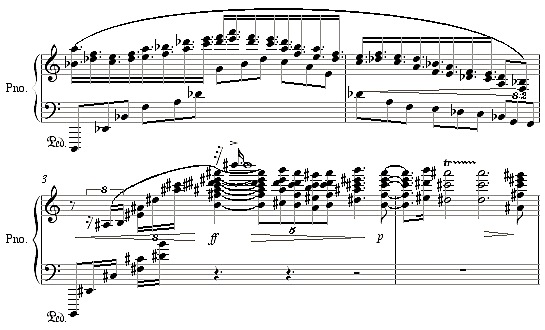
A playable draft of the 18-minute second movement of Sunken City, my piano concerto in homage to New Orleans, is completed. Now I have to go back and tackle the first movement’s complex coda. The problem with composing, for me, is that once I start it pretty much ruins me for any more practical work. It’s really not unlike drinking too much: once my head is absorbed in trying to figure out where the piece goes next, all quotidian matters, like e-mails I need to write, bills I need to pay, errands I need to run, fly out of my head and it’s difficult to remember that I was supposed to do anything else. Even forgetting to eat is quite common; I realized an hour ago that I didn’t have lunch today. So when I go into a composing period my life becomes very disorganized. If practical duties demand my attention, I basically have to take an entire day off from composing to do them, in which case I suddenly get a tremendous amount done. I’m just not the kind of artist, I don’t believe, like Anthony Trollope or Philip Glass, who can get up every day, compose from 8 to 11 or whenever, and then cut it off and go about the rest of my life.
I do, however, have a natural cutoff point. At some moment between 2 and 4 PM, my composing mind turns off as abruptly as a spigot. I’ll be working on a phrase and suddenly realize that I wrote four inelegant notes that make no sense and I don’t know why, or I write three variants of something and have no idea how to choose among them, and I know I’m just done. My mind steps out of that fog in which I know how to make artistic judgments. Sometimes I can start composing again around 7 or 8 in the evening, if family or social life haven’t intruded. In between my mind seems too sharply focussed. Peripheral vision perceives objects with a different kind of acuity than centrally focused vision, and I’m absolutely convinced something similar happens with the brain. But that still doesn’t mean I can get much done between 4 and 7, because my mind is still racing around trying to solve whatever problem the day’s work leaves me with. It’s a wonderful feeling, and I love it, but it’s extremely inconvenient.
Certain artists fall into creative patterns, but I believe there’s a wide range of artistic working types, and that nothing can possibly work for everyone. I’ve read enough about left- and right-brain activity to attribute the difference to physiological variations. Men (generally speaking) have less fluid communication between their brain hemispheres than women do, for example, and I’ve long had a distinct impression that my left and right brain barely stay in touch at all. Alternating between talking (left brain) and playing the piano (right brain), for instance, is extremely difficult for me; I have to take that in account in my lecture style. If I play well and then immediately try to talk, I stumble trying to form sentences, and if I talk first it’s difficult to lose myself in the music. And I gather that when I get into composing, I go into some kind of deep right-brain state, and making the transition back involves a painful effort.
Every artist has to figure out these patterns about himself, and it’s more difficult because they change over the course of your life. When I was young, I wrote almost all my music between 11 PM and 4 AM, something I could never do now. It’s very mysterious.