Willing One Thing

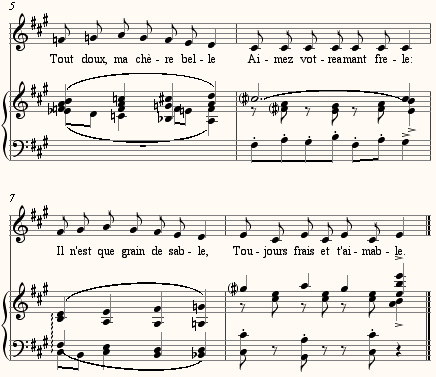
Ninety-two years ago this week, between Nov. 20 and Dec. 2, 1914, Erik Satie penned Trois Poèmes d'Amour, a trio of brief love songs to poems of his own. At the risk of taxing my reader's browser, I offer the first here in its entirety:
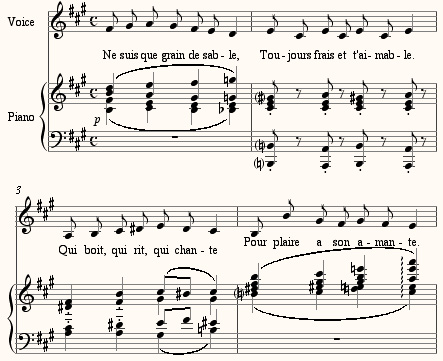
SatieTrois1a.jpg

SatieTrois1b.jpg

One notices right away that the voice sings the same rhythm in all eight measures: six 8th-notes and a quarter-note. This is also true of the other two songs: not only that they use the same rhythm in all eight measures, but that they all use this particular rhythm, six 8th-notes and a quarter-note. Thus not only did Satie write three songs each devoid of rhythmic variety, he wrote three songs with no rhythmic variety among them (save for some peculiar chromatic grace notes in the piano in the third, which the sketches indicate were added as an afterthought just before publication). You can listen to the whole set, which lasts barely two minutes, here, on an old Angel vinyl record with baritone Gabriel Bacquier and pianist Aldo Ciccolini. Rather than a collection of three songs, it is really one song - written three times. And yet, no one of the songs is superior to the others, no one sounds like the authentic model from which the other two were derived. Each has its own slightly distinct atmosphere. Each song is memorable on its own; each could stand on its own. Were you to insert a measure from one song into another, those of us familiar with the songs would find the intrusion jarring.

Since my teenage years I have been mesmerized by the studied blankness of mind that could produce these songs. To write a song, and then, as though you had never written it, to write another with the same rhythm and chordal characteristics, just as fresh, just as authentic, requires a mind that can wipe out the immediate past and return to center. And then, within that song, to write each measure so unmindful of its predecessor that you feel no need for contrast, yet that you can also repeat with no fear of exact repetition, seems like the kind of acute moment-to-moment awareness that Zen masters describe. In the poems, Satie was mimicking the flat rhyme-scheme of 12th-century trouveres. But, lest you conclude that only the texts made this feat possible, remember Satie's similar achievements in formal identity in the far more ambitious contexts of instrumental works: not only the famous Gymnopedies and Sarabandes, but the even more astonishing Pièces Froides and Nocturnes, and to a lesser extent the Gnossiennes. He is capable of writing a third movement virtually identical to the first, or one that quotes the first as though it is not a quotation, but a new creative odyssey leading back into identical material. Like Borges' hero who writes (not rewrites) Cervantes' Don Quixote, Satie was capable of writing the same music twice: not in absent-minded forgetfulness, but in acute awareness of every moment as new.

Having discovered Satie at 15 and instantly recognized him as an old friend, I am more and more trying to achieve the blankness of mind - and also the craft, because contrary to public impression, Satie was a painstaking reviser - that makes pieces like Trois Poèmes d'Amour possible. "What should I do in this section?" is a question I try to prevent from ever arising. By the end of the first measure, everything should be decided, and the only task is to continue. By continue I mean simply to sustain the idea, to keep it alive without having to resort to anything else. Although, it's hardly simple, it's damned difficult: so much easier to move to a contrasting section, to bring in a second idea, to swerve and create a facile "unity" by returning to the original material later. This is what La Monte Young meant, I surmise, when I asked him circa 1991 why the five movements of his early string quartet were so similar, and he replied, after a moment's thought, "Contrast is for people who can't write music" - an unnecessarily dismissive formulation, perhaps, but one I found inspiring. And possibly what Kierkegaard meant when he titled one of his books, "Purity of Heart Is to Will One Thing."

The classical music world - which values educatedness in a composer over discipline of will, and speciously takes variety of techniques as evidence of education - does not much respect this goal, nor Satie. But that's the goal that continues to inspire me. (One piece that achieves it heartbreakingly well is Evensongs by Ingram Marshall, which I have just added to Postclassical Radio.)

November 21, 2006 5:23 PM | | Comments (6) |

Categories:

6 Comments

I desperately need to find a complete list of Satie's works and on what record I can find them..I've thought I had 'everything' several times now but more just keeps coming! (I prefer it that way, actually.) But I don't think my heart could take buying a CD full of the Gymnopedies and Gnossiennes for that one obscure piece again.

KG replies: Well, those songs and some others are on an old Angel recording called "The Irreverent Inspirations of Erik Satie" (Angel S-36713). Some of the other songs are on Arabesque 8053-L, a record put out by Caedmon under EMI in 1974. There are so many Satie web sites, I'm sure one of them must have a complete listing. I have the complete piano music and ballets on CD, but not the songs.

The rhythm of "Happy Birthday" is a bit more complex, but I hope you enjoyed a few renditions in the last 24 hours.

KG replies: Thanks, Lawrence. Actually didn't hear any at all. But I appreciated Jerry's toast the evening before.

"Cultivating blankness of mind" of course leads us to Zen -- which points to the unrecognized fact that minimalism actually taps into the vast non-Western tradition of music.

The idea that music be goal-oriented, a "tone poem" which "sets out on a journey from beginning to end" certianly has its antique charms. But that conception of music remains a minority viewpoint in the world music community of the 21st century, and that's arguably one of the most important reasons to teach and discuss minimalism.

Thanks for posting these gorgeous songs.

My absolute favorite recording of Satie's songs is the old Philips LP (9500 934) with soprano Marjanne Kweksilber and Reinbert De Leeuw on piano. (includes Trois Mélodies de 1886, Trois Autres Mélodies, Hymne, Trois Poemes de Amour, Quatre Petite Melodies, Trois Melodies, and Ludions)

Kweksilber brings an early music sensibility to her performance, without trying to make it sound too "classical." And unlike Ciccolini, who I think is always trying too hard to make Satie more "exciting" or "fun," De Leeuw is not afraid to play him slowly. He gets Satie's spaciousness, and is not worried about boring anyone.

Hopefully someday Philips will reissue this out of print gem, as they have De Leeuw's solo Satie recordings.

Having read this after reading your entry about mixing pop, rock, jazz and classical styles, I was immediately struck by the opening measure in the voice; identical to "sex and drugs and rock and roll (all my mind and body need)." Obviously just a coincidence, but one hears what one's experience leads one to hear.

Leave a comment

Sites To See

Postclassic Radio! - Kyle Gann's internet radio station that accompanies the blog; see the playlist at kylegann.com

American Mavericks - the Minnesota Public radio program about American music (scripted by Kyle Gann with Tom Voegeli)

Kalvos & Damian's New Music Bazaar - a cornucopia of music, interviews, information by, with, and on hundreds of intriguing composers who are not the Usual Suspects

Iridian Radio - an intelligently mellow new-music station

New Music Box - the premiere site for keeping up with what American composers are doing and thinking

The Rest Is Noise - The fine blog of critic Alex Ross

William Duckworth's Cathedral - the first interactive web composition and home page of a great postminimalist composer

Mikel Rouse's Home Page - the greatest opera composer of my generation

Eve Beglarian's Home Page - great Downtown composer

Just Intonation Network - a meeting place for people interested in alternative tunings

Erling Wold's Web Site - a fine San Francisco composer of deceptively simple-seeming music, and a model web site

The Dane Rudhyar Archive - the complete site for the music, poetry, painting, and ideas of a greatly underrated composer who became America's greatest astrologer

Utopian Turtletop, John Shaw's thoughtful blog about new music and other issues

About this Entry

This page contains a single entry by PostClassic published on November 21, 2006 5:23 PM.

E-persons Become Flesh was the previous entry in this blog.

Music Downtown in TLS is the next entry in this blog.

Find recent content on the main index or look in the archives to find all content.

AJ Ads

Introducing
AJ Arts Blog Ads

Now you can reach the most discerning arts blog readers on the internet. Target individual blogs or topics in the ArtsJournal ad network.

Advertise Here

AJ Blogs

AJBlogCentral | rss

culture
About Last Night
Terry Teachout on the arts in New York City
Artful Manager
Andrew Taylor on the business of arts & culture
blog riley
rock culture approximately
critical difference
Laura Collins-Hughes on arts, culture and coverage
Dewey21C
Richard Kessler on arts education
diacritical
Douglas McLennan's blog
Dog Days
Dalouge Smith advocates for the Arts
Flyover
Art from the American Outback
Life's a Pitch
For immediate release: the arts are marketable
Mind the Gap
No genre is the new genre
Performance Monkey
David Jays on theatre and dance
Plain English
Paul Levy measures the Angles
Real Clear Arts
Judith H. Dobrzynski on Culture
Rockwell Matters
John Rockwell on the arts
Straight Up |
Jan Herman - arts, media & culture with 'tude

dance
Foot in Mouth
Apollinaire Scherr talks about dance
Seeing Things
Tobi Tobias on dance et al...

jazz
Jazz Beyond Jazz
Howard Mandel's freelance Urban Improvisation
ListenGood
Focus on New Orleans. Jazz and Other Sounds
Rifftides
Doug Ramsey on Jazz and other matters...

media
Out There
Jeff Weinstein's Cultural Mixology
Serious Popcorn
Martha Bayles on Film...

classical music
The Future of Classical Music?
Greg Sandow performs a book-in-progress
On the Record
Exploring Orchestras w/ Henry Fogel
Overflow
Harvey Sachs on music, and various digressions
PianoMorphosis
Bruce Brubaker on all things Piano
PostClassic
Kyle Gann on music after the fact
Sandow
Greg Sandow on the future of Classical Music
Slipped Disc
Norman Lebrecht on Shifting Sound Worlds

publishing
book/daddy
Jerome Weeks on Books
Quick Study
Scott McLemee on books, ideas & trash-culture ephemera

theatre
Drama Queen
Wendy Rosenfield: covering drama, onstage and off
lies like truth
Chloe Veltman on how culture will save the world

visual
Aesthetic Grounds
Public Art, Public Space
Another Bouncing Ball
Regina Hackett takes her Art To Go
Artopia
John Perreault's art diary
CultureGrrl
Lee Rosenbaum's Cultural Commentary
Modern Art Notes
Tyler Green's modern & contemporary art blog
Creative Commons License
This weblog is licensed under a Creative Commons License.