
New Dutch Developments

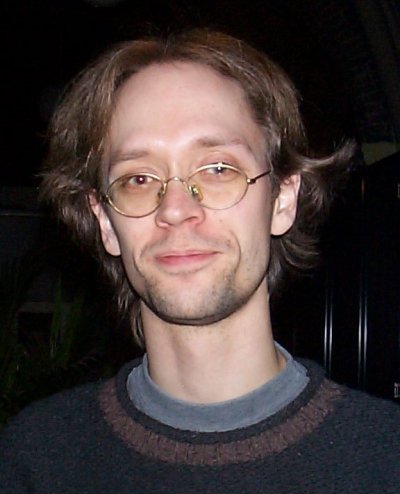
Vriezen.jpgDutch composer Samuel Vriezen was just here at Bard, supervising a rehearsal of his piece The Weather Riots, which my Open Instrumentation Ensemble is playing soon, and giving a wonderfully lively lecture about his compositional process. (He's in New York for the riotous-looking Sequenza 21 concert happening this Monday at CUNY Graduate Center, where Weather Riots will also be performed, and which you can find out more about here.) Samuel usually writes pieces in which all the performers are playing similar material at the same time, unsynchronized. As we learned in rehearsal, it takes more virtuosity than you'd think from looking at the scores. His music has an interesting relationship to serialism (in the types of angular gestures he uses), to minimalism (since those gestures, all in 8th-notes, tend to get repeated and echo from instrument to instrument), and to the kind of experimental performance tradition of Cage, Earle Brown, and Christian Wolff.

In the '70s versions of such music, no one was much interested in controlling the results, and the pieces tended not to have a recognizable identity. Samuel, however, with his incisive mathematical mind, has figured out ways to base all his gestures on a finite number of formulas (a postminimal practice) in such a way that certain echoings among players are pretty much guaranteed to happen. That's what's so fun about rehearsing Weather Riots - you're playing without regard to the rest of the ensemble, you're even choosing your own route through the material, yet you invariably hear echoes of your own notes popping around elsewhere. He can even write multi-movement works like Panoramic Variations (scroll down) in which the movements, though based on identical techniques, are quite distinct from each other. My favorite piece of his so far is an epic two-piano work called 20 Worlds - a "world,' in his terminology, being defined by a particular combination of gesture types. I gave up this kind of incompletely notated performance practice twenty years ago because the results seemed so hit-or-miss. He's completely solved the problem: pieces whose details are different in every performance, but whose overall aura is remarkably consistent, recognizable, and quite lovely and lively. Brace yourself for a Vriezen onslaught on Postclassic Radio soon.

Samuel and I had a lot of great discussions too, and I learned some things. He says that, just as Schoenberg became an overwhelming influence in American musical academia in the '60s and '70s, the influence that flooded Dutch practice, and thus the composer whose exalted status young Dutch composers have most learned to resent, was Stravinsky. He also told a story about Cage I hadn't heard. Cage's 74, one of his late "number" pieces, is a ten-minute piece for 74-piece orchestra in which the bass instruments all read from one part, and the treble instruments from another. It seems that Cage received a fax one morning commissioning the work, wrote it in two hours, and faxed it back that afternoon. That's the kind of compositional technique I'm looking for.

November 17, 2006 11:49 AM | | Comments (1)

Categories:

1 Comments

Well, wonderful! Thanks for the compliments, Kyle!

I feel obliged to add some bits about this Stravinsky issue. It is not a universal thing of course that younger composers in holland resent the influence of Stravinsky, and there remains a lot of good music to be written that is influenced by Stravinsky (to paraphrase Schoenberg...) but to me and quite a few friends, the ubiquity of Stravinsky as a model in the nineties was sort of all too standard.

And it wasn't only in the sound itself that you could hear it (as in how american neoclassicism was influenced by S) but in the mentality and the irony. Irony is a great force with a fantastic philosophical pedigree but if you bandy it about too much it loses force. And in fact 'irony' was often a bad excuse for farce.

You had composers hiding behind "irony", for example, people who would actually want to write very beautiful or sentimental music would do so but put in "ironic" gestures that (1) secured the required level of artsiness and (2) destroyed the whole atmosphere.

Or you had people just borrow from styles under the banner of irony, say, quoting this or that form of religious or traditional or popular music, but you could just hear they didn't have the kind of deep relationship to the tradition they were meddling with that would make the irony urgent and expressive.

All that went under the Stravinsky banner and it was basically a degenerated version of the Stravinsky that Louis Andriessen and Elmer Schoenberger picture in their brilliant Apollonian Clockwork book.

The sound of Stravinsky was also a bit fetishized, particularly his sense of "not quite"-ness, let's say - the way he made things always just a bit "wrong". That was and to some extent remains sort of holy in Holland.

Leave a comment

Sites To See

Postclassic Radio! - Kyle Gann's internet radio station that accompanies the blog; see the playlist at kylegann.com

American Mavericks - the Minnesota Public radio program about American music (scripted by Kyle Gann with Tom Voegeli)

Kalvos & Damian's New Music Bazaar - a cornucopia of music, interviews, information by, with, and on hundreds of intriguing composers who are not the Usual Suspects

Iridian Radio - an intelligently mellow new-music station

New Music Box - the premiere site for keeping up with what American composers are doing and thinking

The Rest Is Noise - The fine blog of critic Alex Ross

William Duckworth's Cathedral - the first interactive web composition and home page of a great postminimalist composer

Mikel Rouse's Home Page - the greatest opera composer of my generation

Eve Beglarian's Home Page - great Downtown composer

Just Intonation Network - a meeting place for people interested in alternative tunings

Erling Wold's Web Site - a fine San Francisco composer of deceptively simple-seeming music, and a model web site

The Dane Rudhyar Archive - the complete site for the music, poetry, painting, and ideas of a greatly underrated composer who became America's greatest astrologer

Utopian Turtletop, John Shaw's thoughtful blog about new music and other issues

About this Entry

This page contains a single entry by PostClassic published on November 17, 2006 11:49 AM.

Quip of the Day was the previous entry in this blog.

Taking on the Postmoderns is the next entry in this blog.

Find recent content on the main index or look in the archives to find all content.

AJ Ads

Introducing
AJ Arts Blog Ads

Now you can reach the most discerning arts blog readers on the internet. Target individual blogs or topics in the ArtsJournal ad network.

Advertise Here

AJ Blogs

AJBlogCentral | rss

culture
About Last Night
Terry Teachout on the arts in New York City
Artful Manager
Andrew Taylor on the business of arts & culture
blog riley
rock culture approximately
CultureGulf
Rebuilding Gulf Culture after Katrina
Dewey21C
Richard Kessler on arts education
diacritical
Douglas McLennan's blog
Flyover
Art from the American Outback
Life's a Pitch
For immediate release: the arts are marketable
Mind the Gap
No genre is the new genre
Rockwell Matters
John Rockwell on the arts
Straight Up |
Jan Herman - arts, media & culture with 'tude

dance
Foot in Mouth
Apollinaire Scherr talks about dance
Seeing Things
Tobi Tobias on dance et al...

jazz
Jazz Beyond Jazz
Howard Mandel's freelance Urban Improvisation
ListenGood
Focus on New Orleans. Jazz and Other Sounds
Rifftides
Doug Ramsey on Jazz and other matters...

media
Out There
Jeff Weinstein's Cultural Mixology
Serious Popcorn
Martha Bayles on Film...

classical music
The Future of Classical Music?
Greg Sandow performs a book-in-progress
On the Record
Exploring Orchestras w/ Henry Fogel
Overflow
Harvey Sachs on music, and various digressions
PostClassic
Kyle Gann on music after the fact
Sandow
Greg Sandow on the future of Classical Music
Slipped Disc
Norman Lebrecht on Shifting Sound Worlds

publishing
book/daddy
Jerome Weeks on Books
Quick Study
Scott McLemee on books, ideas & trash-culture ephemera

theatre
Drama Queen
Wendy Rosenfield: covering drama, onstage and off
lies like truth
Chloe Veltman on how culture will save the world
Stage Write
Elizabeth Zimmer on time-based art forms

visual
Aesthetic Grounds
Public Art, Public Space
Artopia
John Perreault's art diary
CultureGrrl
Lee Rosenbaum's Cultural Commentary
Modern Art Notes
Tyler Green's modern & contemporary art blog
Creative Commons License
This weblog is licensed under a Creative Commons License.