
Mikel Rouse’s music for Merce Cunningham’s dance eyeSpace, which I witnessed at the Joyce Theater in New York last night and is playing again tonight, was brilliantly post-Cagean. Cunningham and John Cage, as you know, made a decades-long joint career by making music and dance whose interaction was unplanned. Cage would make 20 minutes of music, Cunningham the same length dance, then just combine them, so that random coincidences could happen beyond the control of the creators. Mikel took the idea a step further – the dancers don’t even hear the music, because it’s on iPods. So the entire audience sat there listening with headphones to Mikel’s music, and because each iPod was on shuffle mode, each audience member was hearing different tracks and experiencing a different accompaniment to Merce’s dance.
And to make it even more interesting, Mikel and Merce’s sound designer Stephan Moore were playing tracks of environmental sounds into the hall – car horns, people talking, subway noise – at greatly varying volumes. Sometimes the environmental sounds would intrude into the iPod music, either because the noises got very loud or Mikel’s music very soft. So it was a partly communal experience, and more unpredictable than just listening to a series of Mikel’s gently ambient songs, because the noises and songs interacted randomly, and you weren’t always sure which sounds came from where. The whole concept realized Cage’s kind of unpredictable liveliness on a new level, one that allowed for Mikel’s pop-flavored beat. And one of the advantages to Mikel’s and my kind of multitempo music, as we semi-joked afterward, was that no matter what kind of rhythm the dancers were making, there was probably some background tempo being articulated by the music that went right along with it.
Mikel’s wife Lisa Boudreau (pictured) is one of Cunningham’s dancers, and this was the first time she’d ever had the chance to dance to Mikel’s music. 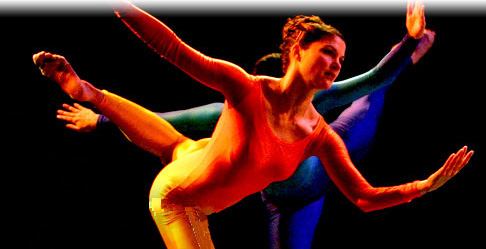 The dancers were forming and reforming in pairs, and wore elastic bands that they would tie each other together with intermittently. Forgive me for not describing more: dance is the most difficult art form for me to grasp, and I’ve never had any vocabulary for it. It looked like the picture.
As if that weren’t enough excitement for one evening, the concert also featured the original choreography (as recalled by Carolyn Brown and others) of Merce’s dance, titled Crises, for Conlon Nancarrow’s first seven Player Piano Studies, done back in 1960. The Cunningham Dance Group kept that in their repertoire until 1964, and there’s apparently a primitive video that they were able to use in the reconstruction. (This Cunningham Dance tour eventually led to the short-lived 1969 Columbia recording of the early Studies.) The dance was kind of robotic and hiply modernist, in skin-tight yellow, red, and salmon tights. In Cage-Cunningham fashion, switches from one Study to the next were not synchronized with sections in the dance. I was paying especially close attention because next May in Boston, Mark Morris is choreographing some of my Disklavier Studies, and I was curious for something to comare with.
The strange thing, that several of us had a big powwow about afterwards, was that one of Conlon’s Player Piano Studies was one no one recognized. Trimpin had supplied MIDI files of the early studies so they could dance to a Disklavier (Cunningham always uses “live” music), but they found that the current MIDI files (which I also have) didn’t match the early tape. So they had to use the old tape, in the middle of which was there was a three- or four-minute Nancarrow study that I’d never heard before. Its melodic quirks sounded exactly like Nancarrow’s style, except that the tune was a little more repetitive and sing-songy, more influenced, perhaps, by the jazz that Conlon had played on trumpet in his jazz gigs of the 1930s. Various theories were advanced, including the possibility that David Tudor had improvised something, but given Conlon’s tendency to become dissatisfied with works and disown them, I strongly suspect that this was an early study that he threw away, probably because the jazz influence was too undigested. I’m going to get a recording and see if I can analyze the tempo relationships. Had they asked me a couple of months ago, I’m sure I could have supplied them with a MIDI version.