
Standing Up for Subjectivity

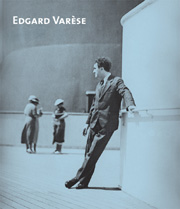
Varesebook.JPGSome months back Felix Meyer and Heidy Zimmermann asked me to write an article on Edgard Varèse's impact on American music for a book that the Paul Sacher Foundation would publish. Well, the book - Edgard Varèse: Composer, Sound Sculptor, Visionary - is out, and rather than being the modest monograph I had envisioned, it is mammoth: a 500-plus-page coffee table compendium loaded with photos, diagrams, and manuscript facsimiles. Thirty-two authors are represented, and the articles cover Varèse's student days, politics, patrons, personality, opinions of jazz, friends, influences, and other facets of this hard-edged figure.

Dipping into it at random (and I'm too immersed in composing to do more at the moment), I find some stunning quotes in Ulrich Mosch's article about Varèse's influence on Wolfgang Rihm: "Varèse [this is Rihm speaking] might have become much more of a key figure if he had only stood up more forcefully for his subjectivism and offset his image of the composer as objective architect with a different image: the artist as 'manic-compulsive.' As it is, we have to dig a long time before we reach him." According to Mosch, Rihm feels that Varèse took on a self-protective cover of rationalism that was good politics for his milieu, but counter to his most basic compositional instincts. And he quotes something Varèse finally argued to Alan Rich in 1965: "Composition according to system is the admission of impotence."

Whew! Well, the 20th century certainly needed a champion of subjectivity from the progressive side, someone to counter the then-spreading prejudice that subjectivity was the fetish of philistines. For my own article (and I hadn't previously given Varèse much thought in 20 years), I found that that subjectivism made him forever suspect among the academics, who otherwise were delighted by his counterintuitive structures and extreme detail of notation. Meanwhile, the Downtowners loved him for his embrace of noise and that very subjectivism, though they resented his role in the imposition of a fanatical approach to notational exactitude. Exciting and original but thorny and personally off-putting, Varèse was a difficult figure to integrate into our musical landscape. This book looks like the most heroic attempt ever.

June 5, 2006 3:36 PM | | Comments (6)

Categories:

6 Comments

I came into contact with Varese the same way millions others did-his connection with Frank Zappa. I bought Zappa's 'Yellow Shark' (My first classical CD) decided that everything on that CD was absolutley amazing (I still think it is) and decided to check out the roots of the music in Varese.

I got a recording of Boulez conducting, and right off LOVED the 'smaller' pieces. Ionisation, Octandre, Integrales, Offrandes..they were all spectacular. It took me longer to appreciate Arcana, just because I had to sit down and listen for 18 minutes.

I bought Deserts just a few months ago, and it reminded me of how cool Varese actually is, and why I like him so much compared to, say Schoenberg or Webern. You could ALWAYS tell that Varese was having it the way he wanted, even if it didn't fit with what other people were doing at the time. My friend's have written him off the same way they write Schoenberg off (Though they honestly write most music over 3 minutes off), but I don't think they are the same at all. I think Varese has a lot of captivating melodies. Am I insane or what?

(Yeah, I actually still like Zappa's classical music more than Varese.)

Wonderful, this looks like an interesting book to get.

Not having read it yet, I confess to having doubts about the term 'subjective' here. I mean, apart from "composing according to system" and subjective writing as in making decisions according to personal preference, perhaps there are more options? If you "let the sounds be themselves" - which may be the direction Varèse was going - it's no subjugation to system, but is it subjective?

Seems to me that "subjectivism" is kind of standing in for "independence" here. Kyle, when you write "Well, the 20th century certainly needed a champion of subjectivity from the progressive side", I think Ives or Cowell fall in there, and certainly Cage (yeah, I know, there's all of that "remove the composer from the composition" thing, but the starting point for each process and element is about as subjective as it gets).

And Samuel, I've got to think that "letting the sounds be themselves" was just about the last thing Varese was heading to; he definitely wants them to do his bidding.

Not sure about that, Steve - I recall that Varese compared his way of crafting forms to traditional masonry, where you just look for which stone fits where.

Letting the sounds be themselves can be a surprisingly broad attitude. Tom Johnson was over at a forum we organised last month in Amsterdam, and he was also quoting Feldman on this, saying that this was how he (Johnson) composed. But it's super-rational at the same time, isn't it? But there really is no contradiction: Johnson listens to what the processes he works with want, Varese looks for where the sounds he develops fit. Neither strike me as either "subjective" or "according to system".

Varese may have said it, but it's not what's there on the page. The best example of a "just look for which stone fits where" composer might be Feldman, don't you think? (though stone might be far too substantial a material to describe his walls...) Or, to head away from traditional instruments, maybe Henry Gwiazda.

tom johnson is a great touchstone. the extreme rationality of his music is precisely what makes it intensely personable.

Leave a comment

Sites To See

Postclassic Radio! - Kyle Gann's internet radio station that accompanies the blog; see the playlist at kylegann.com

American Mavericks - the Minnesota Public radio program about American music (scripted by Kyle Gann with Tom Voegeli)

Kalvos & Damian's New Music Bazaar - a cornucopia of music, interviews, information by, with, and on hundreds of intriguing composers who are not the Usual Suspects

Iridian Radio - an intelligently mellow new-music station

New Music Box - the premiere site for keeping up with what American composers are doing and thinking

The Rest Is Noise - The fine blog of critic Alex Ross

William Duckworth's Cathedral - the first interactive web composition and home page of a great postminimalist composer

Mikel Rouse's Home Page - the greatest opera composer of my generation

Eve Beglarian's Home Page - great Downtown composer

Just Intonation Network - a meeting place for people interested in alternative tunings

Erling Wold's Web Site - a fine San Francisco composer of deceptively simple-seeming music, and a model web site

The Dane Rudhyar Archive - the complete site for the music, poetry, painting, and ideas of a greatly underrated composer who became America's greatest astrologer

Utopian Turtletop, John Shaw's thoughtful blog about new music and other issues

About this Entry

This page contains a single entry by PostClassic published on June 5, 2006 3:36 PM.

A Theory Prof by Any Other Name was the previous entry in this blog.

Some Have Versatility Thrust Upon Them is the next entry in this blog.

Find recent content on the main index or look in the archives to find all content.

AJ Ads

Introducing
AJ Arts Blog Ads

Now you can reach the most discerning arts blog readers on the internet. Target individual blogs or topics in the ArtsJournal ad network.

Advertise Here

AJ Blogs

AJBlogCentral | rss

culture
About Last Night
Terry Teachout on the arts in New York City
Artful Manager
Andrew Taylor on the business of arts & culture
blog riley
rock culture approximately
CultureGulf
Rebuilding Gulf Culture after Katrina
Dewey21C
Richard Kessler on arts education
diacritical
Douglas McLennan's blog
Flyover
Art from the American Outback
Life's a Pitch
For immediate release: the arts are marketable
Mind the Gap
No genre is the new genre
Rockwell Matters
John Rockwell on the arts
Straight Up |
Jan Herman - arts, media & culture with 'tude

dance
Foot in Mouth
Apollinaire Scherr talks about dance
Seeing Things
Tobi Tobias on dance et al...

jazz
Jazz Beyond Jazz
Howard Mandel's freelance Urban Improvisation
ListenGood
Focus on New Orleans. Jazz and Other Sounds
Rifftides
Doug Ramsey on Jazz and other matters...

media
Out There
Jeff Weinstein's Cultural Mixology
Serious Popcorn
Martha Bayles on Film...

classical music
The Future of Classical Music?
Greg Sandow performs a book-in-progress
On the Record
Exploring Orchestras w/ Henry Fogel
Overflow
Harvey Sachs on music, and various digressions
PostClassic
Kyle Gann on music after the fact
Sandow
Greg Sandow on the future of Classical Music
Slipped Disc
Norman Lebrecht on Shifting Sound Worlds

publishing
book/daddy
Jerome Weeks on Books
Quick Study
Scott McLemee on books, ideas & trash-culture ephemera

theatre
Drama Queen
Wendy Rosenfield: covering drama, onstage and off
lies like truth
Chloe Veltman on how culture will save the world
Stage Write
Elizabeth Zimmer on time-based art forms

visual
Aesthetic Grounds
Public Art, Public Space
Artopia
John Perreault's art diary
CultureGrrl
Lee Rosenbaum's Cultural Commentary
Modern Art Notes
Tyler Green's modern & contemporary art blog
Creative Commons License
This weblog is licensed under a Creative Commons License.