
Making the World Safe for Seduction

I'm writing a piece for piano four hands. The first four movements are already 25 minutes, and I'm adding at least one more. They're sort of sketches for pieces I've been wanting to try, and because they're not particularly related, I'm using the generic title A Book of Music. It's for a couple of students who have a piano duo, but it's also a project I've wanted to work on for more than a decade. I've always had a soft spot for two-piano, or four-hand, works, and it's rather remarkable the number of such works that are either my favorite, or near-favorite, work by that composer:

Ligeti's Monument - Selbst-Portrait - Bewegung
B.A. Zimmermann's Monologe
Stockhausen's Mantra (my favorite pieces by all three composers)
Busoni's Fantasia Contrappuntistica
Satie's Trois morceau en forme de poire
Wallingford Riegger's Variations Opus 54
Kevin Volans's Cicada
Tenney's Chromatic Canon
Bach's The Art of Fugue

Years ago I wrote a two-piano piece, I'itoi Variations, which was a huge, ambitious, take-no-prisoners monument of tremendous ensemble difficulty, not the sort of thing that two pianists can sit down and breeze through in an odd moment. Since then I've always wanted to write something more approachable, closer in spirit to Trois morceau en forme de poire. It's a great medium. It shares with solo piano music that you can set tone color aside for the moment, yet it also frees one from the limitations of ten fingers, and opens up the entire range of the instrument for simultaneous use. No wonder it's the chosen medium to substitute for the orchestra in a thousand transcriptions.
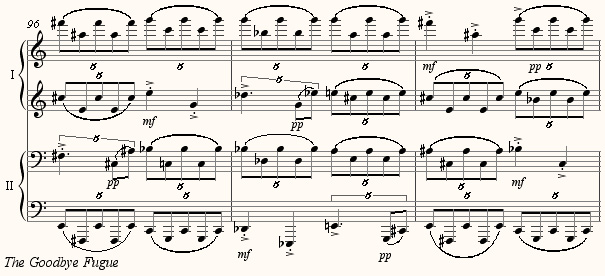
Book.jpg

My students will premiere A Book of Music this fall, and then I'll make it generally available. It's refreshing to write a little gebrauchsmusik, thinking at least as much about the enjoyment of the performers as that of the audience. I love playing four-hand music myself, and one of the best things about it is that it offers such opportunities for seduction. What better association for musicians to have with my melodies than that they were prelude to an evening of unexpected passion?

UPDATE: That working title was too dull to impose on a piece I've come to like as much as this one. The new title is Implausible Premises.

June 16, 2006 11:57 PM | | Comments (7)

Categories:

7 Comments

In No. 13 of Brahms' Neue Liebeslieder, "Nein, Geliebter, setze dich," the right hand of the lower pianist plays above the left hand of the upper pianist, resulting in a rather explict intertwining.

Pleasant surprise to see Mantra on your list of favs. It's mine too. I never could get into this piece (as a listener) until I found the score. There's actually quite a lot of humor in it, which isn't quite so apparent until you look at the score, which, in many ways, is impressive on its own.

Unfortunately, without the score in front of you to follow, it can seem to be a long, boring piece of music.

Looking for it. pretty much curious.

What, no Schubert? My fave for four hands is his two-piano Fantasy in F Minor. Guess I've got conventional taste.

I share your fascination with music for two pianos/pianists.

Stravinsky's Concerto for two solo pianos and the Sonata for two pianos rate highly and of course Bartoks's music for two pianos and percussion (that can count can't it?)

Also anything by Sorabji whilst of course written for one piano almost always sounds (and looks) like it is for four hands!

Nice to see someone else is a fan of the great "non-Pulitzer prize winning" composer Wallingford Riegger!

KG replies: Hey, Riegger's Study in Sonority out-Schoenberged Schoenberg, his Canon and Fugue in D is a neoclassic gem, and his Concerto for Piano and Wind Quintet is one of the most lovable 12-tone works around. I also seem to be the second leading authority (after Don Gillespie) on the fifth American-Fiver, John Becker. I knew Becker's widow in Chicago, and she talked about her embarrassment when Riegger would write Becker letters beginning, "Dear Comrade." "We weren't communists," she'd say, "we were good Catholics!"

Your right on with regard to Riegger, I've long felt a kinship with him, as I also have published my share of "potboilers". I love his very American empirical approach to 12 tone technique (I remember hearing one anal-retentive type complain that Reigger was a "primitive"who didn't follow the "rules") I wish somebody would champion his 3rd symphony, which, aguably, is the "Great American Symphony".

Leave a comment

Sites To See

Postclassic Radio! - Kyle Gann's internet radio station that accompanies the blog; see the playlist at kylegann.com

American Mavericks - the Minnesota Public radio program about American music (scripted by Kyle Gann with Tom Voegeli)

Kalvos & Damian's New Music Bazaar - a cornucopia of music, interviews, information by, with, and on hundreds of intriguing composers who are not the Usual Suspects

Iridian Radio - an intelligently mellow new-music station

New Music Box - the premiere site for keeping up with what American composers are doing and thinking

The Rest Is Noise - The fine blog of critic Alex Ross

William Duckworth's Cathedral - the first interactive web composition and home page of a great postminimalist composer

Mikel Rouse's Home Page - the greatest opera composer of my generation

Eve Beglarian's Home Page - great Downtown composer

Just Intonation Network - a meeting place for people interested in alternative tunings

Erling Wold's Web Site - a fine San Francisco composer of deceptively simple-seeming music, and a model web site

The Dane Rudhyar Archive - the complete site for the music, poetry, painting, and ideas of a greatly underrated composer who became America's greatest astrologer

Utopian Turtletop, John Shaw's thoughtful blog about new music and other issues

About this Entry

This page contains a single entry by PostClassic published on June 16, 2006 11:57 PM.

Will the Real Scelsi Please Say "Cheese"? was the previous entry in this blog.

Four and a Half Cough-Free Minutes is the next entry in this blog.

Find recent content on the main index or look in the archives to find all content.

AJ Ads

Introducing
AJ Arts Blog Ads

Now you can reach the most discerning arts blog readers on the internet. Target individual blogs or topics in the ArtsJournal ad network.

Advertise Here

AJ Blogs

AJBlogCentral | rss

culture
About Last Night
Terry Teachout on the arts in New York City
Artful Manager
Andrew Taylor on the business of arts & culture
blog riley
rock culture approximately
CultureGulf
Rebuilding Gulf Culture after Katrina
Dewey21C
Richard Kessler on arts education
diacritical
Douglas McLennan's blog
Flyover
Art from the American Outback
Life's a Pitch
For immediate release: the arts are marketable
Mind the Gap
No genre is the new genre
Rockwell Matters
John Rockwell on the arts
Straight Up |
Jan Herman - arts, media & culture with 'tude

dance
Foot in Mouth
Apollinaire Scherr talks about dance
Seeing Things
Tobi Tobias on dance et al...

jazz
Jazz Beyond Jazz
Howard Mandel's freelance Urban Improvisation
ListenGood
Focus on New Orleans. Jazz and Other Sounds
Rifftides
Doug Ramsey on Jazz and other matters...

media
Out There
Jeff Weinstein's Cultural Mixology
Serious Popcorn
Martha Bayles on Film...

classical music
The Future of Classical Music?
Greg Sandow performs a book-in-progress
On the Record
Exploring Orchestras w/ Henry Fogel
Overflow
Harvey Sachs on music, and various digressions
PostClassic
Kyle Gann on music after the fact
Sandow
Greg Sandow on the future of Classical Music
Slipped Disc
Norman Lebrecht on Shifting Sound Worlds

publishing
book/daddy
Jerome Weeks on Books
Quick Study
Scott McLemee on books, ideas & trash-culture ephemera

theatre
Drama Queen
Wendy Rosenfield: covering drama, onstage and off
lies like truth
Chloe Veltman on how culture will save the world
Stage Write
Elizabeth Zimmer on time-based art forms

visual
Aesthetic Grounds
Public Art, Public Space
Artopia
John Perreault's art diary
CultureGrrl
Lee Rosenbaum's Cultural Commentary
Modern Art Notes
Tyler Green's modern & contemporary art blog
Creative Commons License
This weblog is licensed under a Creative Commons License.