
Every year I end up talking at some point about soggetto cavato, the practice of making themes from the letters of people’s names, the way Schumann used “S – C – H – A,” better known as “E-flat – C – B – A,” to stand for himself in Carnaval (S being German for E-flat, and H for B natural). I commented on the limited possibilities of my own name in this regard, but my student Ezekiel Virant came up with a possibility I hadn’t considered: a G and A followed by two Neapolitan chords, the Roman numeral analysis symbol for the Neapolitan being an N:
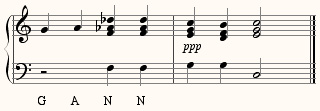
By this logic, I guess the first letter of Virant’s last name could be expressed by a V chord, or the submediant could cover the first two letters by itself.
While we’re talking about student takes on my name, for years I’ve been teaching the movements of the mass:
Kyrie
Gloria
Credo
Sanctus
Agnus dei
according to a mnemonic that a student named Jason came up with back when I was at Bucknell:
Kyle
Gann
Can’t
Sing
Anything
It’s also helpful in that I can use the movements of the mass to help me remember what it is that I can’t do.

Kyle -
Great! For years, I’ve used A-F-(blank)-E for LaFave: solfegge “La” (A) “Fa”( F), and then nothing for the V (what could THAT be?) and the final E. Now I can confidently stick a V chord in where the blank used to be. Only…a V chord in what key? The A and F imply F major, so should that be a C major triad? And then there’s the real problem: the result is BORING!
FYI, I’ve at last started a blog at composerlafave@typepad.com, if you want to check it out.
- Ken LaFave
As “Spiegelberg” means “mirror mountain,” mine should be Berg’s code preceded by its retrograde.
Kyle, do you happen to know who originated the chromatic version of this? i.e, A (letter)=A (pitch), B=Bb, C=B, D=C, E=C#, F=D, G=D#, etc.
I know John Hollenbeck’s used it in a number of his pieces, but it’s such an obvious solution to the problem of translating words to pitch collections that it seems like the sort of thing someone would have hit on long ago.
KG replies: I’ve never heard of John Hollenbeck, but I have known of friends using a similar system. Anyone with a historical citation, please fill us in.
In answer to Tim’s post, I understand your point and we are careful to avoid too many stories.
http://spartan.cis.temple.edu/synergy/_knobas/0000031e.htm