
Mysteries of Barbershop

Barbershop quartet music, like ragtime, is a great source of common-tone diminished seventh chords, when it’s time to teach those. It’s also full of parallel tritones in chromatic descent implying root motion around the circle of fifths. It actually has a lot in common with postminimalism: a use of voice-leading so consistently circumscribed that it tends to generate the same consonant (but not always functionally-related) sonorities over and over again. But the style contains one common chord I haven’t seen in any other context: a dominant seventh built on the leading tone, nominally a V7/iii but never resolved as such - rather, a chromatic neighbor-note chord to the tonic triad, given here at the two X’s:
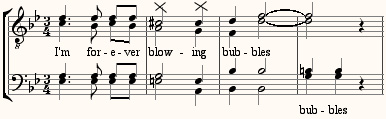
BQchord.jpg

Does anyone have a name for this chord? It often appears between two tonic triads, and the use of the seventh (G, here) helps avoid parallel octaves that might otherwise occur between two B-flats and two A’s. It’s almost identical to a common-tone diminished seventh and serves the same function, only the common tone is done away with, which drops down to the leading tone. The entire assemblage also occurs a perfect fourth higher - i.e., as a D dominant 7th making a neighboring chord to E-flat. Anyone have a name or term for these dominant sevenths used as chromatic neighbors? Anyone ever see them in any other context besides barbershop quartet music?

UPDATE: Allow me to emphasize, since it keeps coming up in the comments, that the entire song is in B-flat major, with no other key ever noticeably implied, and that the chord in question occurs in several varied contexts: quick, drawn-out, passing, neighbor, and so on.

March 7, 2006 9:52 PM | | Comments (16) |

Categories:

16 Comments

As the dominant 7th first appears - in 2nd inversion following IV - it could very well be a passing chord to I6, which could also be heard as VI6/iii. Couldn't the actual progression via the root position dominant 7th to I be extrapolated from that?

KG replies: Yes, in this context it's a passing chord, but not always. It is intriguing how the first three chords spell a N - V7 - VI in D minor, with a deceptive cadence, though there's no other hint of D minor in the song. The dominants on 3 and 7 are often passing chords or neighbor chords, but it's always clear - as with the difficult-to-sing E-natural to A in the bass here, which kind of messes up the passing-tone thesis - that the arranger simply considers them part of his available harmonic vocabulary. "I'm Forever Blowing Bubbles" dates, by the way, from 1919, though that's not to prove that these chords do.

Imagine what it would be like if Kyle and Paul used their analytical skills for financial arbitrage ! I for one would open an account with them.

Boy, maybe I have a weird ear, but I do hear this as a deceptive cadence. V7 of iii to VI of iii, though iii dosen't occur, the next chord implies that it does, as it is V7 of ii. So if there had not been the deceptive cadence-V7 of iii to VI of iii, the progression could have been V7 of iii to iii to V7 of ii

What’s interesting is that it’s exactly the way Neapolitan and Augmented 6ths went from being voice leading chords to being “part of the available harmonic vocabulary” and in the process begat their root position versions.

Hmmm. I'm trying to figure out what it means to consistenly circumscribe a use of voice leading. I suppose it's actually the voice-leading that is "circumscribed" (i.e. there's a limited variety of voice-leading?), but a little clarification/elaboration would be helpful, especially for those of us curious about but unschooled in the hallmark harmonic motions of post-minimalism.

KG replies: No, that's exactly right. A lot of postminimalist music is written within systems that allow only a very limited variety of voice-leading possibilities, or a limited number of sonorities, or a limited range for each voice, and so on. I'll be beginning a series on postminimalism soon to accompany my series on metametrics.

Even after a series of non-functional harmonies, a dominant seventh chord followed by a major or minor chord with a root a fifth below will be perceived as V-I. It takes only two chords to create a simple functional relationship. Try this with root position Major triads (space them C-G-C-E and transpose them up with that spacing): C major -- E major -- G major-- B flat major- D major- F major - A flat major- B7 (B-F#-A-D#) - E (E-E-G#-E). That's perceived (by musicians and non-musicians) as a series of non-functional major chords ("false" relations or "cross" relations), followed by a V7- I cadence in E.

The point is that A7 followed by B flat Major is perceived as a deceptive something or other. It's not a cadence, but a progression, and it's "deceptive." It's V7/VI as a function of an omitted and nearly irrelevant iii chord.

So, in other words, none of you guys know what that chord is called?

In jazz harmony, that's just another flavor of deceptive cadence (when it's coming from a semitone below). When it's coming from a semitone above, it's a tritone sub.

My favorite use of this type of chord movement is at the end of the bridge to "The Song Is You." The tune is in C major but the bridge is in E major. The bridge ends in a B7 (V7) that modulates back to C by resolving chromatically upward to the original tonic (CMA7), with the B melody note used as a common tone between the two chords.

KG replies: Now we're talking. I'd wondered if it was some kind of tritone sub for the subdominant, a sort of Neapolitan in reverse.

Hey, I go with "secondary dominant 7th" (maybe I'm wimping out"), but if you like. let's call it the "Voorhaar" 7th. Has anyone noticed that the relationship between the IV and the V7 of iii is a "Neapolitan" one? If the IV was in 1st invesion you'd have a garden variety N6-V7 ending in a deceptive cadence.What might be as interesting, might be the use of IV as a secondary Neopolitan in Root position.

Actually, let's call it a Triple Leading Tone cadence!

Though you didn't show an example, you mentioned the progession VII7-I. You hear this sort of movement in slide guitar with open tuning (I think that's the guitar term). If the VII-I progession is in parallel motion, it reminds me of the double leading-tone cadence of the Ars Nova. This leads me to think that the chord could be called a triple leading-tone 7th.

KG replies: Is A-C#-E-G to Bb-D-F (chords 2 + 3 in the example) not the progression you mean?

Sorry, Kyle, your right, my brain wasn't working! This progression reminds me of "Richard Strauss" cadence of an augmented V to one ie. G-B-D# to C-C-E

KG replies: Now we're talking. I'd wondered if it was some kind of tritone sub for the subdominant.

Yes, that's exactly the way jazz musicians think of it. Of course, in practice IV7 and VII7 aren't quite as freely interchangeable as V7 and bII7, but the idea is the same.

It probably wouldn't be too hard to find examples of a 12-bar blues in Bb where the rhythm section plays A7 in the fifth measure of the form. I can't think of any recordings off the top of my head, but it's a device I've heard (and used) on the bandstand countless times.

UPDATE: Allow me to emphasize, since it keeps coming up in the comments, that the entire song is in B-flat major, with no other key ever noticeably implied, and that the chord in question occurs in several varied contexts: quick, drawn-out, passing, neighbor, and so on.

I think another point worth emphasizing is that in Tin Pan Alley(/jazz) harmony, any valid harmonic device is pretty much considered "just part of the available harmonic vocabulary" and can be used freely in just about any context. The arranger was most likely not thinking "well, this A7-to-Bb resolution might be okay as a quick passing chord, but I'd hesitate to use it as a neighbor" or whatnot -- he's thinking, "this deceptive-type resolution is a standard part of my kit bag, and I'll use it whenever and wherever I need that kind of motion."

A somewhat related example of this looseness is "All The Things You Are," which has the V7 chord in the "wrong" spot -- i.e., m.3 of the first four-measure half-phrase. In this style, in this type of half-phrase, the dominant chord normally goes in m.4. Jerome Kern took the stock I - vi7 - ii7 - V7 - I progression and shifted it all left by a measure, lopping off the I chord and starting cold on the vi7 chord. But it's still a valid progression and can therefore be plugged in wherever the composer needs to plug it in, even if it reverses the usual harmonic phrasing.

(Of course, this is only first of a series of cunning harmonic tricks Kern deploys in this tune.)

Landini with a twist? On the rocks?

Chords like these must be in Wagner, somehow. That's where the French got them, from whence they were disseminated with liberty, equality, and fraternity to all corners of the musical globe. But their natural appearance among barbershoppers is just good ol' American ingenuity, like those affectingly weird, "wrong" harmonies thought up by unlettered New England cobblers and carters in 18th century hymnody. Please teach all of these, side by side.

Leave a comment

Sites To See

Postclassic Radio! - Kyle Gann's internet radio station that accompanies the blog; see the playlist at kylegann.com

American Mavericks - the Minnesota Public radio program about American music (scripted by Kyle Gann with Tom Voegeli)

Kalvos & Damian's New Music Bazaar - a cornucopia of music, interviews, information by, with, and on hundreds of intriguing composers who are not the Usual Suspects

Iridian Radio - an intelligently mellow new-music station

New Music Box - the premiere site for keeping up with what American composers are doing and thinking

The Rest Is Noise - The fine blog of critic Alex Ross

William Duckworth's Cathedral - the first interactive web composition and home page of a great postminimalist composer

Mikel Rouse's Home Page - the greatest opera composer of my generation

Eve Beglarian's Home Page - great Downtown composer

Just Intonation Network - a meeting place for people interested in alternative tunings

Erling Wold's Web Site - a fine San Francisco composer of deceptively simple-seeming music, and a model web site

The Dane Rudhyar Archive - the complete site for the music, poetry, painting, and ideas of a greatly underrated composer who became America's greatest astrologer

Utopian Turtletop, John Shaw's thoughtful blog about new music and other issues

About this Entry

This page contains a single entry by PostClassic published on March 7, 2006 9:52 PM.

Selected to Bother was the previous entry in this blog.

Mason Bates/DJ Masonic in Symphony is the next entry in this blog.

Find recent content on the main index or look in the archives to find all content.

AJ Ads

Introducing
AJ Arts Blog Ads

Now you can reach the most discerning arts blog readers on the internet. Target individual blogs or topics in the ArtsJournal ad network.

Advertise Here

AJ Blogs

AJBlogCentral | rss

culture
About Last Night
Terry Teachout on the arts in New York City
Artful Manager
Andrew Taylor on the business of arts & culture
blog riley
rock culture approximately
critical difference
Laura Collins-Hughes on arts, culture and coverage
Dewey21C
Richard Kessler on arts education
diacritical
Douglas McLennan's blog
Dog Days
Dalouge Smith advocates for the Arts
Flyover
Art from the American Outback
Life's a Pitch
For immediate release: the arts are marketable
Mind the Gap
No genre is the new genre
Performance Monkey
David Jays on theatre and dance
Plain English
Paul Levy measures the Angles
Real Clear Arts
Judith H. Dobrzynski on Culture
Rockwell Matters
John Rockwell on the arts
Straight Up |
Jan Herman - arts, media & culture with 'tude

dance
Foot in Mouth
Apollinaire Scherr talks about dance
Seeing Things
Tobi Tobias on dance et al...

jazz
Jazz Beyond Jazz
Howard Mandel's freelance Urban Improvisation
ListenGood
Focus on New Orleans. Jazz and Other Sounds
Rifftides
Doug Ramsey on Jazz and other matters...

media
Out There
Jeff Weinstein's Cultural Mixology
Serious Popcorn
Martha Bayles on Film...

classical music
The Future of Classical Music?
Greg Sandow performs a book-in-progress
On the Record
Exploring Orchestras w/ Henry Fogel
Overflow
Harvey Sachs on music, and various digressions
PianoMorphosis
Bruce Brubaker on all things Piano
PostClassic
Kyle Gann on music after the fact
Sandow
Greg Sandow on the future of Classical Music
Slipped Disc
Norman Lebrecht on Shifting Sound Worlds

publishing
book/daddy
Jerome Weeks on Books
Quick Study
Scott McLemee on books, ideas & trash-culture ephemera

theatre
Drama Queen
Wendy Rosenfield: covering drama, onstage and off
lies like truth
Chloe Veltman on how culture will save the world

visual
Aesthetic Grounds
Public Art, Public Space
Another Bouncing Ball
Regina Hackett takes her Art To Go
Artopia
John Perreault's art diary
CultureGrrl
Lee Rosenbaum's Cultural Commentary
Modern Art Notes
Tyler Green's modern & contemporary art blog
Creative Commons License
This weblog is licensed under a Creative Commons License.