
Metametrics as an Illiteracy Solution

I don’t understand why the electric guitar orchestra hasn’t become a compositional focus for more composers, for practical reasons alone. It certainly looked like it was going to in the 1980s, with works and ensembles by Rhys Chatham, Glenn Branca, John Myers, Wharton Tiers, Phil Kline, and Todd Levin. The old joke is,

Q.: How do you get a guitarist to stop playing?
A.: Put some sheet music in front of him.

and certainly dealing with guitarists who don’t read was part of the challenge, especially starting in 1989 when Rhys Chatham initiated the 100-guitar tradition with An Angel Moves Too Fast to See, premiered in Lille, France. “Guitarists who can’t read can at least count,” Rhys liked to say, and this insight led the guitar-orchestra genre into totalist territory, however inadvertently. Glenn Branca couldn’t read music himself until he had finished several guitar symphonies, and at least his Sixth Symphony (also 1989), notated on graph paper, has rhythmic grids showing some players how to change chords every four beats while others are changing every five beats and still others every six. His 1994 Tenth Symphony for nine guitars, more normally notated, contains at one point an approximated Nancarrovian tempo canon at tempos of 7:8:12.

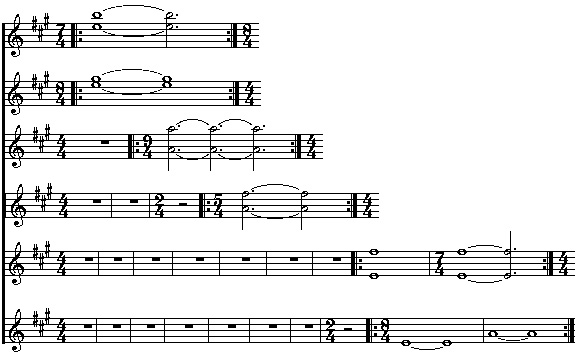
In An Angel Moves Too Fast to See Chatham solved the reading problem by dividing his 100 guitarists into an inner and outer circle, with the musically literate in the inner circle. In the fifth movement (he now calls the piece his First Symphony, though I think he avoided that at the time because Branca was for some reason being criticized for calling his pieces symphonies), he divided the orchestra into six rhythmic layers, each repeating a chord or phrase at diverse regular intervals (monomial or binomial periodicities). As you can see in the example below, one rung of guitarists played E and B every 7 beats; another E and G# every 8 beats; another an octave A every 9 beats; another, after a pause, A and F# every 5 beats, and then two more groups on longer patterns:
Angel1.jpg

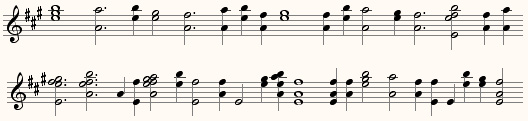
Put them all together, and the following process-generated melody is clearly audible:
Angel2.jpg

What you can’t get from the recording (excerpted here, and available on Table of the Elements) is the totally original correlation of space and pitch that resulted. (I just missed the Lille performance by hours, but heard the North American premiere in Montreal.) A hundred guitarists, each with an amplifier and enough room to swing around and look cool, take up a tremendous amount of space; and since each group was herded together, the E-B chord might come from the middle, while the A-F# came from 60 feet away on the left, and the G# an equal distance on the right. Note by note, the melody bounced over wide distances as though the audience members were ants sitting in the middle of an enormous keyboard. Listening was like watching an arrhythmic tennis game.

This is not new information, by the way; it’s all in my book American Music in the 20th Century. Now that Branca is gathering 100 guitarists to reprise his 13th Symphony in Los Angeles, it may be worth recirculating at the moment.

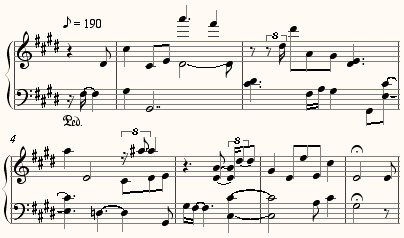
At about the same time I was experimenting with a similar process to generate textures in a considerably more modest setting. My Windows to Infinity for piano (1987) was a reflection on Nietzsche’s concept of the eternal recurrence. I had been amused to read philosopher Arthur Danto parse out the statistical likelihood of eternal recurrance in his book on Nietzsche, and in response wrote a piano piece stretching out to infinity, tracking a recurring combination of notes as it gathered coincidences through millions of repetitions. As you can see below, there’s a middle D# every 5 8th-notes, a middle C# every 7 8th-notes, a lower F# every 29 16th-notes, and so on up through four-digit primes. Every phrase comes back to the C#-D#-E-G# “theme” found in the 4th and 5th measures (a motif also used in my two-piano piece Long Night):
Windows.jpg

In theory, this nine-minute piece would eventually repeat itself if extended for thousands of years. No one’s ever played the piece but me, and as I’m not terribly satisfied with my one recording, I think I won’t post it here. I used a similar technique soon after in the first movement of Cyclic Aphorisms for violin and piano. I’m sure others have stumbled across this interference of pitch-periodicities concept, but I don’t know of any examples of such an atomistic totalist technique past 1989. It may be worth noting that Nancarrow used the interference of much longer, more complex periodicities in his Study No. 9, way back in the 1950s.

March 1, 2006 4:30 AM | | Comments (3)

Categories:

3 Comments

Good points. I should mention as one of Branca's 100 guitarists, that the 13 that will be played in LA this month (and was performed at Montclair State University last month) is a completely different piece from the 13 that was played at the WTC in 2001. Having played both versions (the earlier one at the 2004 sessions), I'd say that the earlier one was a great example of how to derive complex effects from players of varying abilities (nothing shorter than a quarter note, for example). The new version's rather more complex, with lots of syncopation, polyrhythms, dotted eighths, ties across the bar, etc. I like both, though they're very different. The Montclair show and sessions leading up to it were recorded, btw.

It cannot have escaped your notice that when complete, your series on neorhythmic/totalist/metametric composers will provide a superb survey course of postmodern music...complete with musical examples. If profs teaching modern music haven't already downloaded your series and stitched it together on CD-ROM for distribution to their students, they ought to. And doubtless will. (Welcome to the post-copyright era, where information wants to be free, and the darknet rulez.)

Now that's what I call subversion! Everyone else is typing away madly pounding out silent books, while you're grabbing the students directly by the throat with musical example. Gee. I wonder which approach will have more influence among the online millenial generation...?

Once again, Gann proves that he gets it, while the other new music weenies don't.

Apropos of nothing in particular, you just made Metafilter today.

http://www.metafilter.com/

(see metafilter item number 17 as of 12:15 pacific standard time)

That's the big time. Mefi, along with blgodex and boingboing, constitute the creme de la creme of the blogospheric folksonomy, with many millions of page views per day. Congrats!

Too bad there's not an illiteracy
solution for reviewers.

Leave a comment

Sites To See

Postclassic Radio! - Kyle Gann's internet radio station that accompanies the blog; see the playlist at kylegann.com

American Mavericks - the Minnesota Public radio program about American music (scripted by Kyle Gann with Tom Voegeli)

Kalvos & Damian's New Music Bazaar - a cornucopia of music, interviews, information by, with, and on hundreds of intriguing composers who are not the Usual Suspects

Iridian Radio - an intelligently mellow new-music station

New Music Box - the premiere site for keeping up with what American composers are doing and thinking

The Rest Is Noise - The fine blog of critic Alex Ross

William Duckworth's Cathedral - the first interactive web composition and home page of a great postminimalist composer

Mikel Rouse's Home Page - the greatest opera composer of my generation

Eve Beglarian's Home Page - great Downtown composer

Just Intonation Network - a meeting place for people interested in alternative tunings

Erling Wold's Web Site - a fine San Francisco composer of deceptively simple-seeming music, and a model web site

The Dane Rudhyar Archive - the complete site for the music, poetry, painting, and ideas of a greatly underrated composer who became America's greatest astrologer

Utopian Turtletop, John Shaw's thoughtful blog about new music and other issues

About this Entry

This page contains a single entry by PostClassic published on March 1, 2006 4:30 AM.

Time Ends in Santa Fe was the previous entry in this blog.

Thank Goodness for Insomnia is the next entry in this blog.

Find recent content on the main index or look in the archives to find all content.

AJ Ads

Introducing
AJ Arts Blog Ads

Now you can reach the most discerning arts blog readers on the internet. Target individual blogs or topics in the ArtsJournal ad network.

Advertise Here

AJ Blogs

AJBlogCentral | rss

culture
About Last Night
Terry Teachout on the arts in New York City
Artful Manager
Andrew Taylor on the business of arts & culture
blog riley
rock culture approximately
CultureGulf
Rebuilding Gulf Culture after Katrina
Dewey21C
Richard Kessler on arts education
diacritical
Douglas McLennan's blog
Flyover
Art from the American Outback
Life's a Pitch
For immediate release: the arts are marketable
Mind the Gap
No genre is the new genre
Rockwell Matters
John Rockwell on the arts
Straight Up |
Jan Herman - arts, media & culture with 'tude

dance
Foot in Mouth
Apollinaire Scherr talks about dance
Seeing Things
Tobi Tobias on dance et al...

jazz
Jazz Beyond Jazz
Howard Mandel's freelance Urban Improvisation
ListenGood
Focus on New Orleans. Jazz and Other Sounds
Rifftides
Doug Ramsey on Jazz and other matters...

media
Out There
Jeff Weinstein's Cultural Mixology
Serious Popcorn
Martha Bayles on Film...

classical music
The Future of Classical Music?
Greg Sandow performs a book-in-progress
On the Record
Exploring Orchestras w/ Henry Fogel
Overflow
Harvey Sachs on music, and various digressions
PostClassic
Kyle Gann on music after the fact
Sandow
Greg Sandow on the future of Classical Music
Slipped Disc
Norman Lebrecht on Shifting Sound Worlds

publishing
book/daddy
Jerome Weeks on Books
Quick Study
Scott McLemee on books, ideas & trash-culture ephemera

theatre
Drama Queen
Wendy Rosenfield: covering drama, onstage and off
lies like truth
Chloe Veltman on how culture will save the world
Stage Write
Elizabeth Zimmer on time-based art forms

visual
Aesthetic Grounds
Public Art, Public Space
Artopia
John Perreault's art diary
CultureGrrl
Lee Rosenbaum's Cultural Commentary
Modern Art Notes
Tyler Green's modern & contemporary art blog
Creative Commons License
This weblog is licensed under a Creative Commons License.